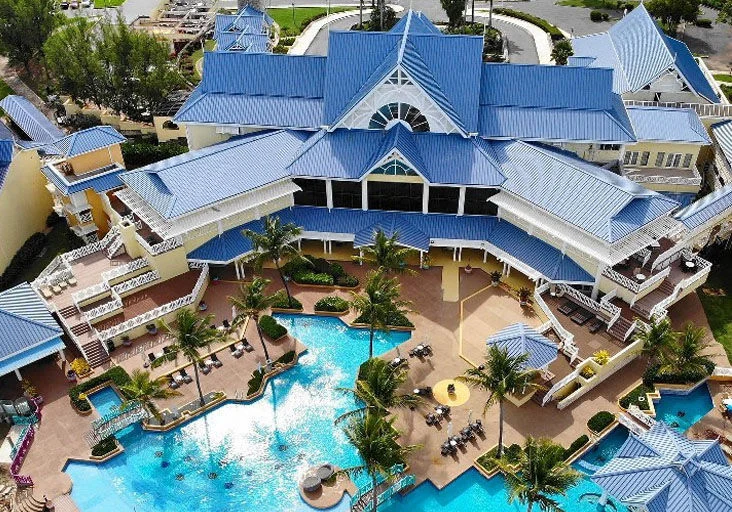
As the government of Trinidad and Tobago moves forward with plans to sell off two state-owned hospitality properties, newly obtained financial records reveal starkly divergent 10-year performance trajectories that have culminated in a combined $246.1 million in total cumulative losses. The data, obtained exclusively by the *Sunday Express*, shows the vast majority of losses stem from Tobago’s Magdalena Grand Beach and Golf Resort, which has failed to turn a profit in every year between 2016 and 2025, while Hilton Trinidad and Conference Centre in St Ann’s has posted profits in six of the 10 years surveyed, with its downturns concentrated almost entirely in the period following the COVID-19 pandemic.
Financial records compiled from audited annual statements and recent unaudited management accounts show Hilton Trinidad’s total net losses over the decade amount to just $8.5 million, compared to Magdalena’s staggering $237.6 million in cumulative after-tax net losses. Importantly, the $246.1 million cumulative loss figure only accounts for annual deficits, not offsetting profits earned by Hilton during its profitable years.
Unlike its struggling counterpart in Tobago, Hilton Trinidad has a proven track record of profitable operation. The hotel posted consistent gains from 2016 through 2019, before global travel shutdowns brought on by the COVID-19 pandemic upended the international tourism and hospitality sector. The property recorded a $2.5 million net loss in 2020, followed by a smaller $700,000 deficit in 2021, with losses peaking at $3.7 million in 2022, the largest annual shortfall recorded by the hotel over the 10-year period.
Hilton Trinidad rebounded to return to profitability in 2023 and maintained positive bottom lines in 2024, signaling a strong post-pandemic recovery, before slipping back into a $1.6 million net loss in 2025. While the financial breakdown does not disclose the exact total profit figures for Hilton’s six profitable years, it confirms that the hotel’s financial challenges were overwhelmingly tied to the global pandemic and its immediate aftermath, though the 2025 loss indicates ongoing industry headwinds. All of Hilton’s annual figures are sourced from fully audited annual financial statements.
Following months of uncertainty surrounding the property’s future, the Trinidad and Tobago government implemented a new ownership and management structure for Hilton Trinidad in September of this year. Under the new framework, state-owned enterprise Evolving TecKnologies and Enterprise Development Company Ltd (e TecK) purchased all outstanding issued shares of Hilton International Trinidad Ltd, which was subsequently renamed HotelTT Asset Management Company Ltd, now operating as a fully owned subsidiary of e TecK.
The agreement restructured the previous landlord-tenant arrangement into a formal hotel management contract, under which the Hilton brand will continue to handle daily operations while the state retains ownership of the hotel and all its underlying assets. The initial contract has a six-month term, with an option to extend for an additional six months. At the time of the restructuring, Minister of Land and Legal Affairs Saddam Hosein explained that the arrangement was designed to preserve the Hilton brand, maintain continuous operations, and protect employee jobs while the government evaluated long-term options for the property.
That long-term path was clarified last week, when Prime Minister Kamla Persad-Bissessar announced at the sod-turning ceremony for a new Marriott hotel development in Tobago’s Rocky Point that the government would soon issue requests for proposals to fully divest both state-owned hotel properties. The Prime Minister argued that the state has no place in operating commercial hotel businesses, and that private sector investment would deliver a more sustainable operational model for both properties.
The divestment announcement has reignited concerns among Hilton Trinidad workers represented by the Communication Workers’ Union (CWU). The union had previously raised alarms over job security, the future of hotel operations, uncertainty around planned capital renovations, and the status of previously allocated refurbishment funds, while calling for greater transparency around the property’s future. Those concerns had eased temporarily after the September management agreement guaranteed that employees would retain their roles with no immediate changes to salaries, benefits, reporting structures or working conditions.
For the Magdalena Grand Beach and Golf Resort, the financial outlook is far more troubled. The Tobago-based resort has recorded net losses in every single fiscal year from 2016 through 2025, accumulating the $237.6 million cumulative deficit with no profitable years to offset its operating and accounting costs.
Losses were particularly severe in the early years of the surveyed period: the resort posted a $34.2 million net loss in 2016, followed by a $35.8 million deficit in 2017, with annual depreciation charges topping $25 million in both years based on the property’s original asset valuation. The resort’s worst annual performance came in 2018, when losses surged to $81.9 million. Roughly half of that 2018 deficit stemmed from a $41.9 million impairment loss, an accounting adjustment that reflects a downward revaluation of the resort’s asset value and does not represent an equivalent outlay of cash during the fiscal year. Even with this accounting adjustment, the 2018 loss remains the largest annual deficit recorded by the resort over the decade, accounting for approximately 34.5% of its total cumulative losses.
Following the 2018 asset revaluation, annual depreciation charges were cut significantly, leading to a sharp drop in reported losses starting in 2019, when the resort recorded an $11.2 million deficit, a major improvement from the previous year. Losses fell further to $3.7 million in 2020 at the height of pandemic travel restrictions, but that downward trend did not hold. The resort posted a $21.5 million loss in 2021, followed by a reduced $9.3 million deficit in 2022. Financial conditions worsened again in 2023 with a $16 million net loss, before declining to $9.9 million in 2024 and rising once more to $14.1 million in 2025.
Figures for 2024 and 2025 are drawn from unaudited management accounts, as statutory annual audits for those years have not yet been completed, while all data from 2016 through 2023 comes from fully audited financial statements.
The financial records make clear that Magdalena’s ongoing financial struggles are not a product of the COVID-19 pandemic alone. The resort had already accumulated hundreds of millions in losses before the pandemic began, and has continued to post annual deficits even as global tourism activity rebounded in recent years. The published figures also include non-cash accounting charges such as depreciation and impairment, which must be separated from the resort’s actual cash operating performance when evaluating its ongoing viability.