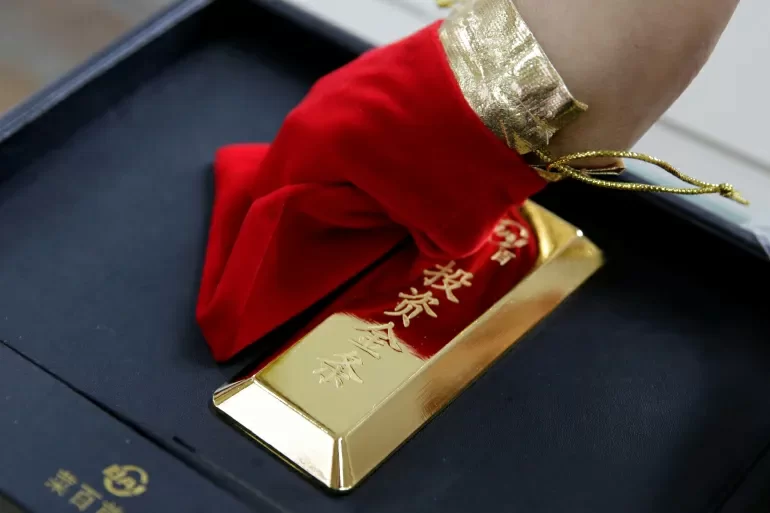
Against a backdrop of rising global geopolitical tensions and shifting financial risk landscapes, China has continued its consistent expansion of gold reserves, marking 23 consecutive months of net purchases as part of a broader strategy to reduce reliance on U.S. dollar-denominated assets and buffer against external economic and political shocks. In September 2026 alone, the People’s Bank of China (PBOC) added 23 tons of gold to its official holdings – the largest single-month purchase since October 2023, according to industry data.
Data from the World Gold Council (WGC), the leading global industry body for the gold sector, shows China’s total official gold reserves stood at approximately 2,410 tons by the end of September 2026. Gold now accounts for 8.5% of China’s total official foreign reserves, a marked increase from just 5.5% at the end of 2024, reflecting the steady pace of the central bank’s buying spree.
This consistent gold accumulation forms a core pillar of Beijing’s long-term plan to diversify its massive foreign reserve holdings. For decades, China has held a large share of its reserves in foreign currency-denominated assets, most notably U.S. Treasuries. While these government bonds generate steady interest income, they carry growing systemic risks amid escalating cross-border political and economic friction.
The 2022 freezing of roughly $300 billion in Russian central bank assets by Western countries following the invasion of Ukraine served as a critical wake-up call for many global central banks, including China’s. The event demonstrated that foreign-held reserve assets can become completely inaccessible in scenarios of heightened geopolitical confrontation. For China, which faces deepening strategic rivalry with the United States, this risk is particularly acute: in the event of a severe diplomatic or military standoff, China’s overseas-held assets could face similar capital controls or freezes.
Domestically held gold offers a unique hedge against this risk. Unlike foreign currency assets or sovereign debt, gold does not represent a claim on a foreign government, making it far less vulnerable to external sanctions or asset freezes. Analysts emphasize that the strategy is focused on long-term risk diversification and strengthening China’s overall financial resilience, not an immediate full departure from the U.S. dollar as a reserve currency.
The trend of growing Chinese demand for gold extends beyond the central bank to ordinary households and private investors, though their motivations differ significantly. While the PBOC aims to protect international reserve holdings, Chinese consumers are turning to gold to preserve the value of their personal savings amid ongoing domestic economic uncertainty.
China’s real estate sector has struggled for years with persistent headwinds, including excess inventory, high developer debt levels, and falling property prices, eliminating it as a reliable store of value for many households. Domestic equity markets have also failed to deliver the stability many savers seek, pushing more to turn to gold as a safe alternative. According to the China Gold Association, purchases of gold bars and coins by Chinese consumers jumped 28.4% year-over-year in the first half of 2026.
Gold investment vehicles have also seen surging demand. WGC data shows that holdings of Chinese exchange-traded gold funds rose by 11 tons in September 2026 to hit a new record high of 304 tons, with net inflows continuing into October. This broad-based demand does not extend to gold jewelry, however; soaring gold prices have made jewelry far less affordable for average consumers, keeping overall jewelry demand under persistent pressure.
Notably, China’s sustained gold buying has not insulated global gold prices from short-term volatility. The international benchmark gold price fell roughly 8.5% in September 2026, a drop the WGC attributes to a strengthening U.S. dollar and rising yields on U.S. Treasuries. When bond yields rise, interest-bearing assets become more attractive to investors than non-yielding gold, dragging down its spot price. Yet the price decline did not slow the PBOC’s buying, a clear signal that Beijing prioritizes long-term reserve composition over short-term price fluctuations. In total, the PBOC added 63 tons of gold in the third quarter of 2026, bringing total cumulative purchases for the first nine months of the year to 103 tons.
Despite this steady shift toward gold, the U.S. dollar retains its dominant position in the global financial system for the foreseeable future. It remains the primary currency for international trade, cross-border payments, and central bank reserves, and gold cannot fully replace the dollar: central banks require highly liquid assets to execute international payments and stabilize domestic financial markets, a role gold cannot fill.
That said, the gradual shift toward greater gold holdings could have meaningful long-term consequences. If China and other central banks continue to increase their gold allocations, they will naturally purchase fewer new U.S. Treasuries over time. The overall impact on U.S. government financing will depend on the pace and scale of this shift.
China is far from alone in this trend: central banks across the world, particularly in emerging market economies, are increasingly buying gold to diversify their reserve holdings. Poland has been one of the most active buyers in 2026, with the Polish central bank purchasing 31 tons of gold in the first quarter and an additional 8 tons in July, per WGC data. This global trend is rooted in widespread geopolitical uncertainty, growing concerns over sovereign debt sustainability, and a widespread desire to reduce dependence on Western-dominated financial systems.
Even after 23 months of consistent purchases, China’s total gold reserves still trail far behind those of the United States. U.S. official gold holdings stand at roughly 8,133 tons, more than triple China’s 2,410-ton reserve as of September 2026.