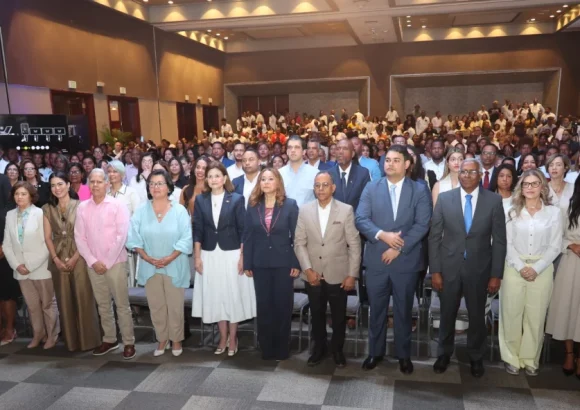
Against the backdrop of the International Day for the Eradication of Poverty, Dominican Republic’s leaders and development experts gathered this week for a national conference focused on progress made and remaining challenges in pulling families out of poverty. The event highlighted the Dominican tradition of community solidarity, encapsulated by a local saying that captures the spirit of sharing even when resources are scarce: one person will take the bread from their own mouth to give it to another.
Opening the conference, Vice President Raquel Peña leaned into this longstanding cultural value of solidarity, noting that even the most humble Dominican household always finds room to share a plate of food with someone in need. Beyond the spirit of shared responsibility that defines Dominican communities, the conference centered on a critical question: how far has the nation come in cutting poverty, and what work remains to lift the most vulnerable households into economic stability?
In her remarks, Peña emphasized that poverty should never be reduced to a set of cold statistics. “Poverty is not a cold figure: it has a human face, it has a name,” she said, a sentiment echoed by participating panelists who gathered to reflect on the ongoing challenges of inequality in the country.
Official data presented at the conference reveals remarkable progress in poverty reduction across the country. General monetary poverty, which spiked to 30.4% in 2020 amid the economic fallout of the COVID-19 pandemic, has plummeted to 17.3% as of 2025, down from 30.7% in 2021. Preliminary figures for 2026 indicate this downward trend is continuing: the poverty rate averaged 14.58% across the first half of the year, falling from 15.4% in the first quarter to 13.75% in the second.
Breaking down the numbers further, Peña noted that urban poverty has dropped from 25% in 2019 to 15% in the first half of 2026, while extreme poverty has fallen sharply from 8.7% in 2015 to just 2.2% this year. The country has also cut the prevalence of undernourishment to less than 2.5%, according to data cited from the United Nations Food and Agriculture Organization’s (FAO) Hunger Map. Current public spending on social protection now exceeds 8% of the nation’s gross domestic product (GDP).
Looking ahead, the Dominican Republic’s 2036 Goal Plan sets ambitious targets for tackling multidimensional poverty in rural areas: officials aim to reduce the rate to 15% by 2028, and to less than 10% by 2036. Multidimensional poverty measures a broader set of living condition indicators beyond just income, giving a more complete picture of household well-being.
Mayra Jiménez, general director of Supérate, the country’s leading social protection program, described the poverty reduction achieved to date as historic. She outlined the nation’s aspirational goal: for the Dominican Republic, despite its small size on the global stage, to become a model for successfully eradicating extreme poverty.
To sustain this progress and continue expanding opportunity for all Dominican families, conference participants identified three core priority areas. Rolando Guzmán, economist and director of local newspaper HOY, explained that sustained poverty reduction depends on strategic investments in education and job training, social protection policies that build individual capacity, and the creation of high-quality, decent jobs that generate sufficient income for working families.
Guzmán emphasized that education and training should extend far beyond formal academic instruction. Effective training programs must prioritize skills development that align directly with the current needs of private sector employers, creating a clearer pathway from education to sustainable employment.
On the topic of social protection, Guzmán noted that effective public policy goes beyond short-term assistance: it must also invest in building the capacity of low-income households to improve their own long-term livelihoods. The health of the labor market is also a critical factor, since access to stable, well-paying work directly determines a family’s ability to stay out of poverty once they have left it behind.
Mercedes Canaan, executive president of Banco ADOPEM, echoed these observations, stressing that it is just as important to strengthen the economic stability of people who have already escaped poverty, as this reduces their risk of falling back into hardship.
Beyond data points and policy discussions, the conference gave space to the human side of poverty reduction. Families who have benefited from the country’s social protection programs shared personal testimonies of their experiences and the transformative changes in their living conditions, putting a human face to the progress captured in the official statistics.