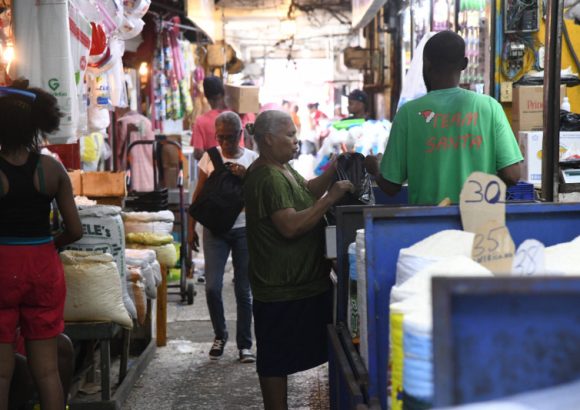
Across bustling public markets in Greater Santo Domingo, ordinary Dominican consumers and household managers are sounding the alarm over a crippling cost-of-living crisis driven by skyrocketing prices for basic food goods. For working families and low-income households that already stretch every peso to cover daily needs, the relentless inflation has turned routine grocery runs into a stressful balancing act that leaves many unable to cover basic needs.
Mercedes Upia, one of the local shoppers interviewed during a market visit, summed up the widespread frustration bluntly: even 1,000 Dominican pesos, a sum that once covered a full day of household essentials, now barely makes a dent in the shopping list. “Housewives cannot keep up with how prices are right now,” she explained, her tone carrying the shared anxiety of Dominican families across the country. She added that the pace of price growth has been “too much,” making it nearly impossible to cover every need her household has. Where 1,000 pesos once filled a supermarket cart with plenty of goods for the home, that same sum today buys next to nothing, and cannot even cover one full day of essentials.
The core pain point for consumers is a simple but devastating shift: the same fixed monthly budget that bought a full basket of groceries just months ago now purchases far fewer items. Miriam Peña, another local homemaker, detailed how even small, affordable staple purchases have shifted dramatically out of reach. She explained that just a few months back, 20 pesos bought enough vegetables to feed her household for two full days. Today, that same amount of produce costs 70 pesos – a 250% jump that has forced deep cuts to household spending. “It has affected me tremendously, because the entire basic food basket is more expensive,” Peña said. “When prices go up but your income stays the same, your shopping basket shrinks. You have no choice but to buy fewer goods just to get by.”
Máximo Amparo echoed these frustrations, noting that the price surge hits every shopping destination, from open-air neighborhood markets to large chain supermarkets. “Everything is too expensive, prices have gone up far too much,” he said. “Supermarkets are so expensive that people are already crying out over the burden.”
The crisis is even more acute for households that rely on government financial assistance to make ends meet. For these families, fixed aid payments have not kept pace with accelerating inflation, leaving support checks exhausted long before the end of the month. Leonidas Linares, a householder who relies on the government’s aid card, described the current situation as “very bad,” explaining that the funds loaded onto her assistance card run out almost immediately after she starts shopping. “Every time I use the card, I need more and more money just to cover basics, because the funds disappear in a flash,” she said. “Prices go up every single day.”
Beyond food costs, Linares added that rapid price hikes for prescription medications have put even more strain on her household budget. She noted that drug prices can change in as little as a week or two, often forcing her to abandon prescribed brand-name medications and switch to cheaper alternatives from different manufacturers to afford care. “When I go back to buy the same medicine after just 15 days, it already has a new higher price,” she explained. “Sometimes I have no choice but to switch medicines, find an equivalent option from a different lab that I can afford.”
As consumers scramble to adjust by cutting back on purchases, switching to cheaper goods, and stretching every peso as far as it can go, their collective testimony paints a clear picture: the income that once covered all of a household’s basic needs is now no longer enough to get by.