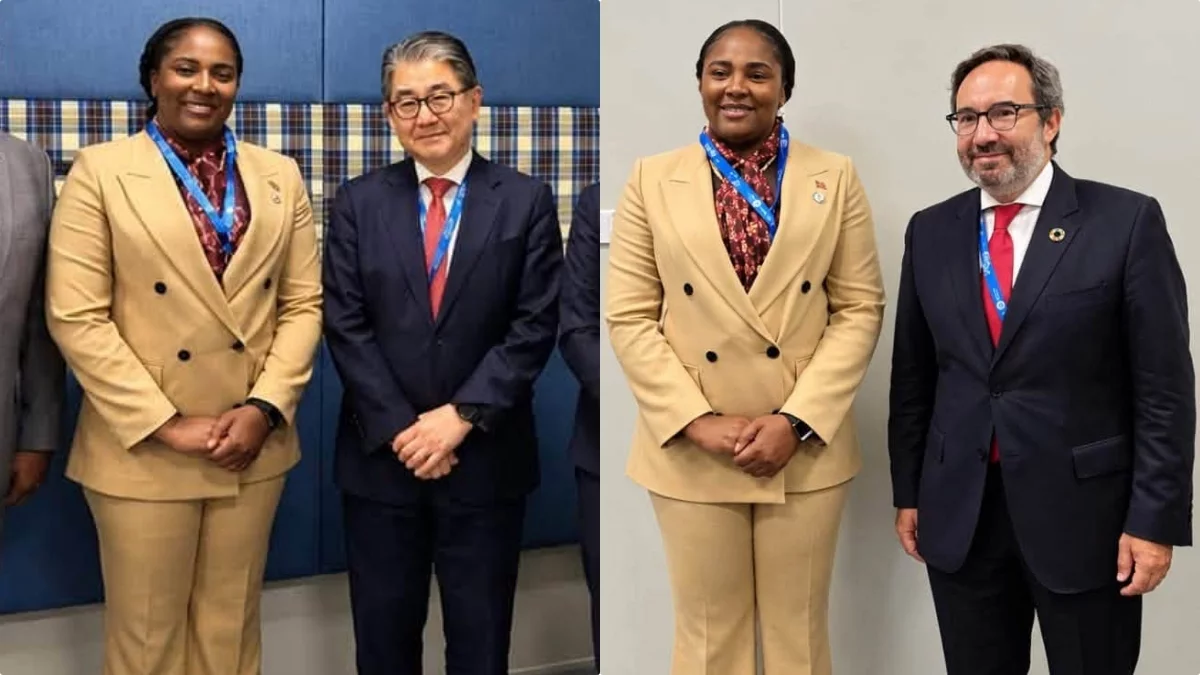
Amid the high-stake 2026 Annual Meetings of the International Monetary Fund and the World Bank Group held in Bangkok, Thailand, Haiti’s top planning official has advanced targeted new development cooperation partnerships with two leading global development institutions, outlining actionable priorities to address the Caribbean nation’s pressing social and economic challenges.
On Thursday, October 15, 2026, Sandra Paulemon, Haiti’s Minister of Planning and External Cooperation, held separate bilateral working meetings with Hara Shohei, Vice President of the Japan International Cooperation Agency (JICA), and Jorge Moreira da Silva, Executive Director of the United Nations Office for Project Services (UNOPS), to map out new areas of collaborative action.
In her discussion with JICA’s Hara, Paulemon opened by recognizing Japan’s decades-long commitment to supporting progress in Haiti, then put forward a bold new phase of bilateral cooperation centered on two core goals: generating urgently needed employment and lifting up Haiti’s most vulnerable communities. At the heart of her proposal is a large-scale labor-intensive public works initiative, designed to deliver both infrastructure improvements and direct economic benefits to marginalized groups. The proposed program spans a wide range of high-impact projects: rehabilitating rural access roads, clearing and maintaining critical drainage and irrigation canals, protecting vital watersheds, implementing landscape reforestation and erosion control projects, completing minor rehabilitation work on community-facing facilities including schools and health centers, and upgrading sanitation services in neighborhoods hosting displaced populations and their local host communities. Crucially, the plan explicitly prioritizes inclusion, ensuring women, unemployed young people, and low-income vulnerable households capture the full economic benefits of generated work opportunities.
To turn this vision into actionable projects, Paulemon laid out three clear requests for JICA: evaluating potential avenues for financial investment, mobilizing specialized technical assistance to guide project identification, design, and on-the-ground supervision, and exploring alternative Japanese cooperation frameworks alongside potential co-financing arrangements with other multilateral development partners. Beyond the proposed public works program, the two sides also discussed expanding cooperation to other priority areas including strengthening Haitian government institutional capacity, expanding access to basic public services, advancing sustainable agricultural development, and improving national disaster risk management systems.
Responding to the proposal, Hara Shohei reaffirmed JICA’s ongoing commitment to partnering with Haiti on its development journey. He noted that Paulemon’s presentation gave JICA leadership greater clarity on Haiti’s current on-the-ground challenges and opened up promising new pathways for collaboration. Moving forward, the two sides have scheduled follow-up technical working sessions to refine proposals and formalize the scope of JICA’s potential support.
In her subsequent meeting with UNOPS Executive Director Jorge Moreira da Silva, Paulemon focused on unlocking new cooperation to address a persistent gap in Haiti’s development progress: turning pledged financial commitments into tangible, completed projects that deliver real benefits to communities. She emphasized that while the Haitian government has made significant progress in mobilizing international funding for development, the country still faces critical unmet demand for social infrastructure, essential public services, and accessible economic opportunity.
Against that backdrop, Paulemon proposed a pilot collaboration aligned with Haiti’s 2026–2030 National Program for Stabilization and Economic, Social, and Territorial Recovery (PNSREST), under which UNOPS would provide technical and operational support for one to two initial high-priority projects. The two priority areas identified are the rehabilitation of social and community infrastructure—including schools, health centers, and clean water supply systems in low-income disadvantaged areas—and labor-intensive community public works that simultaneously upgrade local infrastructure and generate rapid employment and income growth for vulnerable populations.
Paulemon noted that UNOPS brings unique value to these efforts beyond its well-regarded operational expertise. The organization’s neutral, credible international standing can help mobilize additional funding from global partners and increase confidence among donors that pledged resources will be delivered effectively. She added that the proposed cooperation would not be limited to direct project execution by UNOPS; the partnership could also accelerate and de-risk the delivery of projects funded by other international partners, strengthening alignment between the Haitian government, multilateral development banks, and bilateral donors by presenting clear, credible operational roadmaps for implementation.
For his part, Jorge Moreira da Silva reaffirmed UNOPS’s full readiness to support Haiti’s long-term sustainable development goals. He outlined that the organization stands ready to contribute across multiple priority areas, from building climate-resilient infrastructure and expanding access to essential services to strengthening local workforce skills and institutional capacity, and creating new economic opportunity for Haitian communities.
The diplomatic meetings mark a key step forward for Haiti as it seeks to expand international partnerships to advance its national stabilization and recovery agenda, with tangible follow-up steps already scheduled to turn discussions into on-the-ground action.