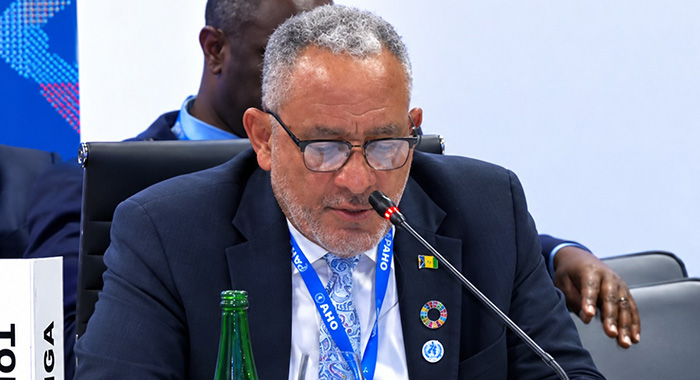
Against a backdrop of growing international scrutiny of Caribbean citizenship-by-investment (CBI) schemes, Prime Minister Godwin Friday has reaffirmed St. Vincent and the Grenadines’ commitment to launching a revised, highly regulated CBI programme, with a targeted launch in the first quarter of 2027. The announcement came during an on-the-record interview with St. Kitts and Nevis-based journalist Andre Huie, held on the sidelines of the International Monetary Fund-World Bank Annual Meetings in Bangkok, Thailand.
Friday acknowledged that CBI programmes face widespread global headwinds, particularly after the European Union issued a mandate in June 2024 demanding that five existing Caribbean CBI-hosting nations — Antigua and Barbuda, Dominica, Grenada, St. Kitts and Nevis, and St. Lucia — phase out their programmes by 2028 or face the loss of visa-free access to the Schengen Area. In response to this demand, Caribbean CBI leaders crafted a coordinated joint response in July, opting for sustained diplomatic dialogue over immediate compliance and planning a high-level delegation visit to Brussels to meet with senior European Commission, European Council, and European External Action Service officials, as well as representatives from individual EU member states.
Despite this external pressure, Friday stressed that CBI programmes remain a viable economic development tool for small island nations, pointing to growing global uptake of similar schemes: Argentina recently launched its own CBI initiative, and multiple European countries already operate active programmes. The Prime Minister, whose New Democratic Party (NDP) made introducing a CBI programme a core campaign pledge ahead of its November general election victory, noted that both the economic opportunities of CBI and international concerns about the scheme — including risks of money laundering, illicit financial flows, and security gaps — are equally valid.
To address these widespread concerns while unlocking economic benefits for St. Vincent and the Grenadines, Friday confirmed the new programme will depart significantly from older CBI models. Key reforms include strengthened cross-border due diligence screening for all applicants, centralized national oversight coordinated by a dedicated government unit, and aligned regional governance through the Organisation of Eastern Caribbean States (OECS). The Eastern Caribbean Central Bank will also play a formal role in ongoing monitoring and regulatory compliance, embedding robust financial safeguards into the programme’s structure from its launch.
A third-party consultancy is currently finalizing the programme’s design, integrating adjustments to resolve concerns raised by the EU and other objecting nations. Friday added that peer OECS member states with existing CBI programmes are already implementing similar regulatory overhauls to address international scrutiny, signaling a region-wide shift toward more rigorous governance of these schemes. The Prime Minister expressed confidence that through targeted reforms, sustained diplomatic engagement, and shared goodwill between Caribbean nations and the EU, a mutually acceptable resolution can be reached that allows CBI programmes to operate responsibly while delivering broad economic benefits to small island developing states.