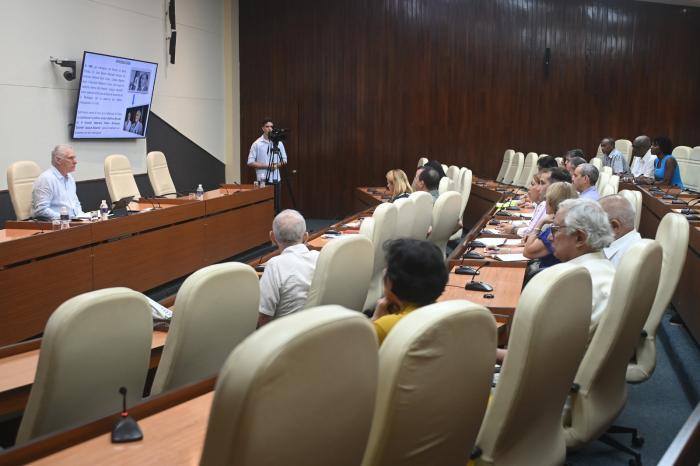
In an October 2026 meeting with leading health experts and scientists, Cuban President Miguel Díaz-Canel Bermúdez has reaffirmed the Cuban government’s longstanding political commitment to prioritizing chronic kidney disease (CKD) care and advancing the nation’s nephrology sector — a specialty first championed by former Commander-in-Chief Fidel Castro Ruz.
The gathering, which also included Deputy Prime Minister Eduardo Martínez Díaz and Public Health Minister José Angel Portal Miranda, centered on the impactful work of Cuba’s Institute of Nephrology (INEF), a pioneering research and clinical center that will mark its 60th anniversary on December 1. Founded at Havana’s Joaquín Albarrán Hospital under the leadership of Drs. Abelardo Buch López, Charles Magrans Buch, and Reinaldo Mañalich Comas, INEF has grown from a small specialized unit to the national alma mater of Cuban nephrology, anchored in a decades-long tradition of scientific advancement and a culture of homegrown innovation.
Cuba currently mirrors global CKD trends: data presented at the meeting shows one in 10 Cubans live with the disease, aligning with global estimates that 850 million people worldwide are affected. Despite severe economic and energy challenges stemming from the long-running U.S. blockade that have created widespread fuel shortages, Díaz-Canel highlighted that Cuba’s national public health system has prioritized CKD care by allocating electric vehicles specifically to transport patients to hemodialysis appointments, ensuring uninterrupted access to life-sustaining treatment.
Today, INEF anchors a national network of 450 polyclinics and medical offices staffed by 348 practicing nephrologists, 246 resident physicians, more than 1,600 nurses, and over 600 medical technicians. Across the country, 3,856 CKD patients receive ongoing care: 2,876 undergo regular hemodialysis (22 of whom are pediatric patients), and 900 are living kidney transplant recipients. Over its 60-year history, INEF’s kidney transplantation program alone has benefited more than 6,000 Cubans.
Beyond clinical care, the institute maintains 36 active research projects, leads the nationwide Dialysis Project, and hosts 10 doctoral and master’s degree programs alongside ongoing professional education initiatives. Dr. Yamilé García Villar, INEF’s Director General, explained that the advanced-stage Dialysis Project aims to develop domestic manufacturing capacity for dialysis reuse machines, hemodialysis units, and dialyzers — a development that would cut substantial costs from public health budgets, which currently dedicate a disproportionate share of funding to treat a relatively small patient population. INEF also collaborates with BioCubaFarma, Cuba’s state biopharmaceutical holding, on multiple clinical trials, including the evaluation of a candidate vaccine for patients with chronic kidney failure, one of dozens of Cuban scientific advances in nephrology over the past five years.
Leading national and international nephrology researchers used the meeting to outline the ongoing challenges Cuba faces in addressing CKD. Dr. Raúl Herrera Valdés, a preeminent authority in the field, noted that while an estimated 700,000 Cubans likely live with CKD, only 25,000 are formally registered in the national health system for the condition. CKD is a progressive, lifelong, often fatal condition that causes enormous social, economic, and human harm, and it frequently goes undiagnosed until patients develop life-threatening complications such as cardiovascular disease. To address this gap, INEF is working to shift the national CKD paradigm toward early risk identification and prevention, a shift that experts say will save lives and reduce long-term care costs. Dr. Herrera also emphasized that one in four people with high blood pressure will eventually develop CKD, underscoring the urgent need for early screening.
Dr. Jorge Pérez-Oliva Díaz, president of the Cuban Society of Nephrology, highlighted the critical role that Cuba’s domestic biopharmaceutical sector has played in expanding CKD care. He noted that without BioCubaFarma, scaling up hemodialysis and peritoneal dialysis access across the country would not have been possible. He also credited the Center for Genetic Engineering and Biotechnology (CIGB) for its recombinant hepatitis B vaccine, which reduces CKD risk by preventing viral infection that can damage kidneys, and the Center of Molecular Immunology (CIM) for producing recombinant human erythropoietin, a key drug for CKD patients. Dr. Guillermo Guerra, head of the National Nephrology Group, closed the discussion by stressing the need for continued work to strengthen the clinical, epidemiological, and social infrastructure for CKD prevention and treatment, for the long-term benefit of the Cuban people.
As the institute prepares to mark six decades of advancing kidney care in Cuba, the meeting served to reaffirm that CKD care and nephrology innovation will remain a top priority for the Cuban government and public health system, even amid ongoing external challenges.