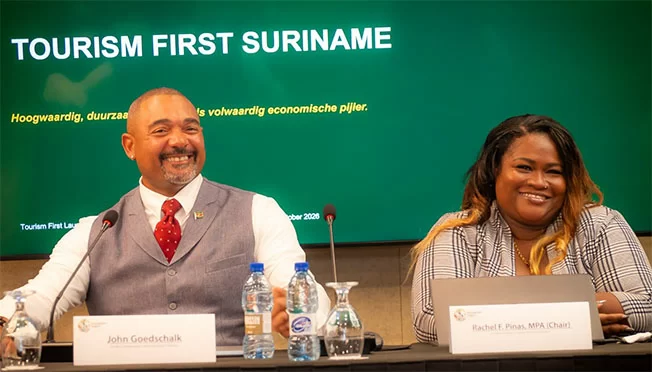
Facing an economic outlook heavily tied to mining and upcoming oil and gas production, the South American nation of Suriname has launched an ambitious new development strategy aimed at accelerating the growth of its tourism sector to build a more balanced, resilient national economy. Unveiled during a press conference this Monday by John Goedschalk of the national Project Preparation Unit (PPU) and Rachel Pinas, chair of the program’s steering committee, the *Tourism First* initiative seeks to lay the foundational groundwork for large-scale investment in sustainable tourism, though key details including funding structures, regulatory reforms and implementation agreements remain to be finalized. Currently, no dedicated funding scheme is available for local tourism entrepreneurs to access through the program.
The core mission of Tourism First is to align the efforts of government agencies, private sector stakeholders, financial institutions and local communities to position tourism as a fully-fledged, independent pillar of Suriname’s economy. Program backers emphasize that the country’s vast, untapped natural wealth and unique cultural heritage hold enormous untapped economic potential, and that this value can be unlocked without damaging Suriname’s old-growth forests, unique biodiversity, or local living environments. Goedschalk noted that the initiative directly follows the policy priority set by Suriname President Jennifer Simons, who has publicly stated that tourism development must be a top national focus. He added that the country can begin growing tourism revenue immediately, even before large-scale offshore oil production fully ramps up.
As a preparatory initiative, Tourism First is first focused on improving Suriname’s overall investment climate to attract larger tourism and conservation-focused projects. Key early priorities include updating outdated laws and regulations, streamlining burdensome permit approval procedures, upgrading critical infrastructure, and improving coordination across disjointed government agencies. Program organizers stress that attracting capital alone is not enough; investors need clear, consistent regulatory frameworks and well-functioning responsible institutions to feel confident committing to long-term projects.
Additional priorities set out in the program’s framework include improving national and international air and overland connectivity, expanding industry-specific vocational training for local workers, boosting international marketing of Suriname as a travel destination, and expanding access to affordable credit for small and medium-sized local tourism businesses. Unlike mass-market low-value tourism strategies, Tourism First targets high-quality, sustainable tourism, where success is measured not just by total visitor numbers, but by the quality of visitor experiences and the net economic benefit retained within Suriname.
Despite its focus on enabling large-scale investment, *Tourism First* has not yet finalized its own core funding arrangements. According to background information shared at the press conference, potential funding sources and eligibility terms are still under assessment, with no final funding amounts, formal commitments or support schemes publicly announced to date. At this stage, local entrepreneurs cannot yet submit applications for credit or other financial support through the program. Officials confirmed that eligibility criteria, selection processes and application procedures will only be published once concrete funding agreements are put in place.
Organizers also noted that agreements on regulatory amendments, nature conservation protections and implementation workflows are still in preparation, and that this week’s program launch does not mean these supporting measures have been formally adopted.
Plans are also underway to restructure Suriname’s national tourism governance: the term of the previous board of the national tourism authority has expired, and a new governing board is currently being assembled. The current steering committee is currently tasked with reviewing and aligning policy documents, and once the new board takes office, the tourism authority will be integrated into the development process and given a leading role in implementing national tourism policy.
A central equity principle of the program is that economic benefits from tourism development should not accrue exclusively to large external investors. Local Surinamese entrepreneurs, workers and domestic suppliers are guaranteed opportunities to participate, including transportation providers, tour guides, small-scale farmers, hospitality operators, artisans, and cultural activity organizers. In the country’s inland regions, indigenous and tribal communities will be actively included in tourism project development, with explicit commitments to respect their territorial rights, traditional knowledge, cultural practices, and living environments. Concrete agreements on community participation, institutional responsibilities, and benefit-sharing are still being negotiated directly with affected communities.
Nature conservation is embedded as a non-negotiable core component of the initiative. Program backers argue that Suriname can carve out a unique competitive advantage in the global sustainable tourism market through its combination of vast intact rainforests, exceptional biodiversity, and rich cultural heritage. However, the formal frameworks for protecting these natural assets, including monitoring and enforcement rules, have yet to be finalized.
Over the coming months, the program will move into a broad stakeholder consultation phase. Starting October 15, targeted discussions with all affected parties will be held across the country, followed by multi-sector roundtable meetings in November that will include representatives from government ministries and district-level authorities. Under the current timeline, the first consultation phase is scheduled to conclude by mid-December, after which proposals will be translated into concrete agreements, assigned responsibilities, and actionable implementation measures.
Ultimately, the core goal of Tourism First is to prevent Suriname from remaining over-reliant on the volatile oil and gas sector for its long-term economic growth. Whether the initiative will successfully deliver new private investment, job creation, and broad-based income growth for Surinamese communities will depend on the timely finalization of funding, coordinated decision-making across government, and consistent execution of the promised policy reforms.