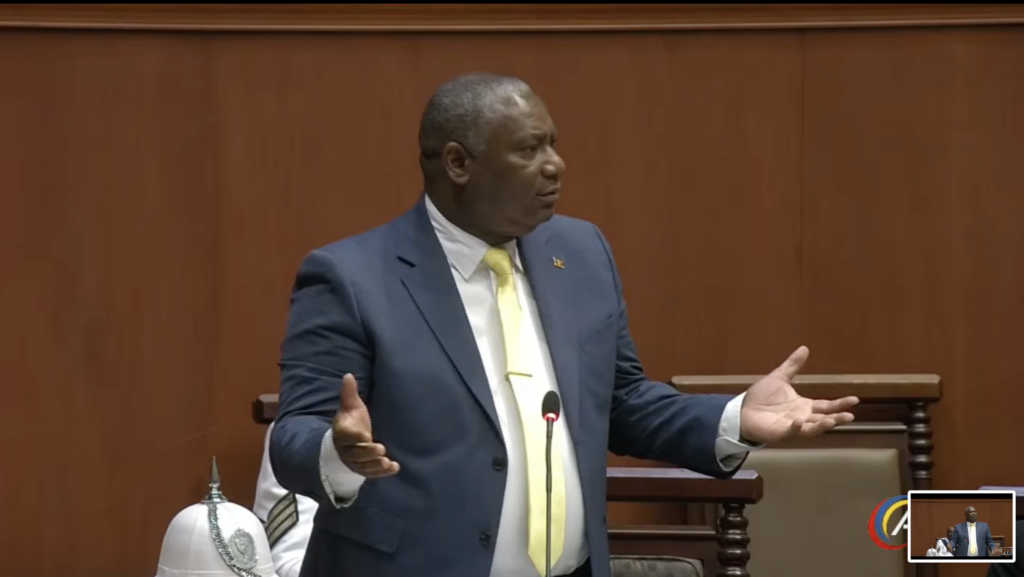
As Antigua and Barbuda’s Senate deliberates on landmark legislation to strengthen penalties for illegal firearm offenses, a senior opposition lawmaker has launched a scathing critique of the government’s controversial decision to name popular Jamaican dancehall performer Masicka as a national cultural ambassador.
Opposition Senator Chester Hughes told the chamber the timing and nature of the appointment sends a deeply contradictory message to the public, particularly young people, at a moment when the nation is grappling with rising gun violence and working to address its root causes. Hughes noted the government brought the artist in to address youth audiences just on the eve of a recent general election, despite what he describes as graphic, violence-glorifying content in many of Masicka’s most popular tracks. Even after the election, he emphasized, Masicka retains his official ambassador title for the twin-island nation.
Hughes made the remarks during floor debate on the 2026 Firearms Amendment Bill, the government’s flagship legislation aimed at cracking down on gun-related crime. He argued that the appointment lays bare a troubling disconnect between the government’s rhetorical commitment to reducing violence and the public figures and messages it chooses to endorse as representative of the nation. To illustrate his point, Hughes recalled that a shooting incident was reported in the Michael’s Mount neighborhood on the exact same night Masicka was scheduled to perform at a local venue. He was careful to clarify that he is not drawing a direct causal link between the artist or his performance and the gun violence incident, but instead used the coincidence to underscore his broader argument that the government must exercise far greater caution when choosing which voices and messages to elevate.
The senator also revealed that members of Antigua and Barbuda’s own local musical community had raised formal objections to Masicka’s appointment ahead of its announcement, but the government dismissed their concerns out of hand. “The problem in our society is we are not prepared to listen to the other view,” Hughes told the chamber.
Beyond the controversy over the cultural ambassador appointment, Hughes used the debate to raise fundamental objections to the government’s approach to tackling gun crime overall. He argued that the Firearms Amendment Bill, which centers on harsher prison sentences for firearm offenses, was brought to the Senate without the inclusive public consultation needed to address the underlying drivers of violent crime. “If we were serious, this bill coming to this House would have had a lot more conversations,” he said.
Hughes also challenged the government’s narrow focus on increasing criminal penalties, arguing that families affected by gun violence are far more focused on having law enforcement solve existing crimes and hold offenders accountable than they are on longer sentences for future offenses. “What about solving those crimes to bring closure for these families?” he asked.
He further questioned the government’s failure to outline clear plans to provide local police with the resources, personnel, and infrastructure needed to meet expanded expectations for crime investigation, proactive patrols, and 24-hour police station operations. Noting that police officers are people with their own family obligations and limits, Hughes asked whether the force actually has enough personnel to carry out all the duties the government is mandating. “Police must patrol. Police must this, police must do that. What police? Are they human? Do they have family too?” he said.
In closing, Hughes laid out his own vision for a comprehensive national response to gun violence, arguing that meaningful progress requires combining targeted adjustments to sentencing law with broad public consultation, sustained resourcing for effective community policing, and tangible investment in solving open cases to deliver justice to affected families.