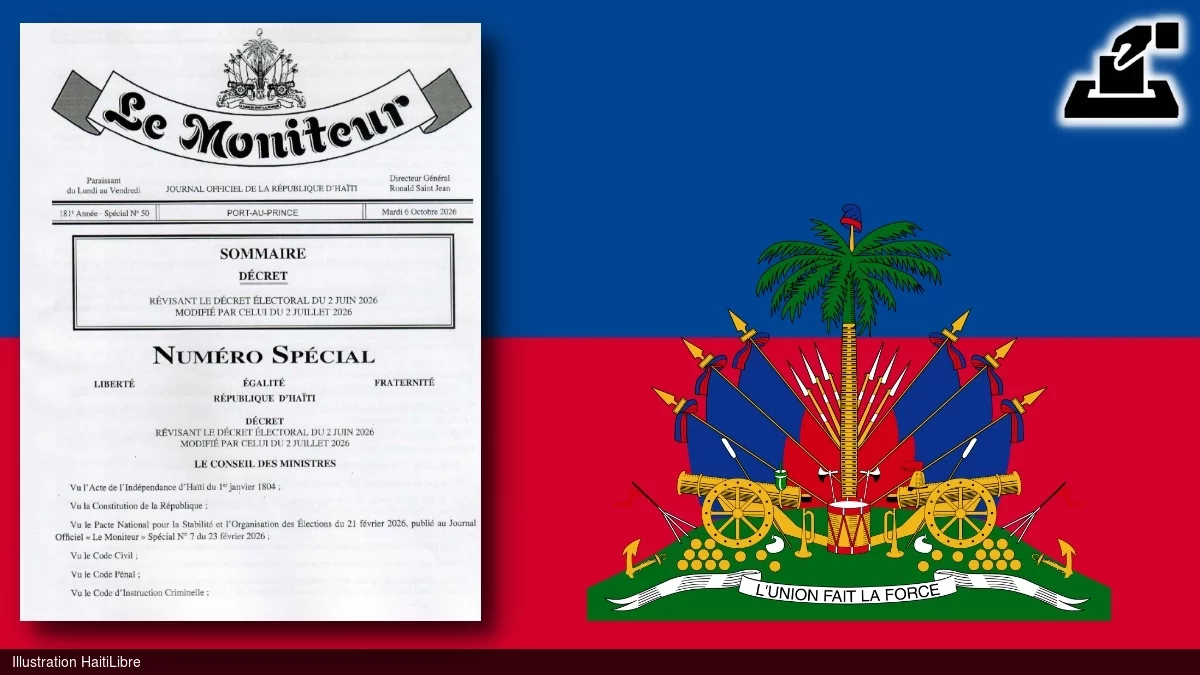
On October 6, 2026, Haiti’s Prime Minister’s Office released a third round of revisions to the country’s electoral decree, updating versions previously amended in June and July of the same year. The most consequential changes involve the elimination of several key administrative, financial, and legal candidate vetting safeguards that were designed to filter out ineligible hopefuls.
Two full paragraphs from Article 153 of the original decree have been struck entirely. Paragraph 20 previously required candidates to submit a certificate from the Bank of the Republic of Haiti (BRH) confirming they had no history of bounced check bans, insolvency, or bankruptcy. It also formally barred individuals sanctioned by the UN Security Council, the U.S. Treasury’s Office of Foreign Assets Control (OFAC), or other foreign governments from running for office. Paragraph 21, meanwhile, mandated certificates from Haiti’s National Old-Age Insurance Office (ONA) and Industrial Development Fund (FDI) proving candidates held no outstanding public debts. With these provisions removed, eligibility requirements for financial standing and international compliance have been sharply loosened, allowing political actors facing international sanctions or holding unresolved debts to state institutions to register for office without barrier. International bodies including the United Nations and independent political analysts have issued warnings that the changes weaken Haiti’s protections against the infiltration of illicit criminal capital and sanctioned figures into electoral politics at a time when guardrails against corruption are desperately needed.
Additional adjustments to candidate requirements have been made across multiple articles of the decree. In remaining paragraphs of Article 153, the mandatory negative police record certificate has been replaced with a requirement to submit a personal asset declaration, and a formal mental health certificate has been simplified to a standard general medical certificate. A notarized affidavit of eligibility remains required. Provisions outlining the core duties of the Provisional Electoral Council (CEP)’s steering committee, previously laid out in Article 14 (Paragraph 8, point 3) and Article 22.2, have been repealed and will instead be addressed in the CEP’s internal regulations. The 2% representation quota for persons with disabilities within the national Electoral Office has also been eliminated.
The revised decree also adjusts electoral timelines, institutional roles, and candidacy challenge procedures. The CEP’s official reporting deadline has been extended from 15 days to 30 days, and responsibility for validating the membership of political parties claiming 30,000 registered members has been transferred from the Ministry of Justice directly to the CEP. New rules allow any registered voter to challenge a candidate’s eligibility regardless of whether the candidate is running in the voter’s district of residence. For incumbent mayors seeking re-election, the mandatory resignation deadline has been relaxed: mayors now only need to step down within seven days of the publication of the decree, provided their candidacy is officially validated.
To expand candidate accessibility, the government has cut registration fees for most office types, framing the change as a move to boost electoral inclusivity. The 2,000,000 HTG fee for presidential candidates remains unchanged, but Senate candidate fees have been halved from 800,000 HTG to 400,000 HTG. Chamber of Deputies fees have dropped from 300,000 HTG to 100,000 HTG, municipal council candidate slate fees have been cut in half from 100,000 HTG to 50,000 HTG, and CASEC candidate slate fees have been reduced from 25,000 HTG to 15,000 HTG for most slates, with a further reduction to 5,000 HTG for a subset of candidates.
The cumulative effect of these revisions has made the original electoral timeline unworkable, leading to a national postponement of key deadlines. Candidate registration has been pushed back to October 31, 2026. The general elections and constitutional referendum previously scheduled for December 13, 2026, remain unconfirmed as of press time, with a new full schedule yet to be published.
While Article 76, the provision outlining candidate tax status requirements, was not eliminated in the October 2026 revision, it has been reframed to align with the broader relaxation of eligibility checks. The article still formally requires candidates to be in good standing with Haiti’s General Tax Authority (DGI), but the elimination of the Article 153 financial requirements has drastically narrowed the scope of overall financial vetting. Previously, the Article 76 tax clearance certificate worked in tandem with the BRH, ONA, and FDI debt certificates to fully vet a candidate’s financial standing. Today, a candidate can receive a valid DGI tax clearance proving they are current on their declared taxes while still holding outstanding unpaid debts to state-owned banks or public development funds, as those requirements are no longer enforced.
The only remaining targeted financial screening applies to former public officials: former ministers, general directors, and public fund managers are still required to obtain a formal discharge ruling from the Superior Court of Auditors and Administrative Disputes (CSC/CA) in addition to their general tax clearance. Article 76 remains the last major financial safeguard in the revised electoral decree, requiring all candidates to be up to date on declared tax obligations. However, its ability to block insolvent candidates or those with illicit funding from appearing on the ballot is severely diminished, as it only checks compliance with declared tax obligations and does not include verification of personal credit history or bankruptcy records.