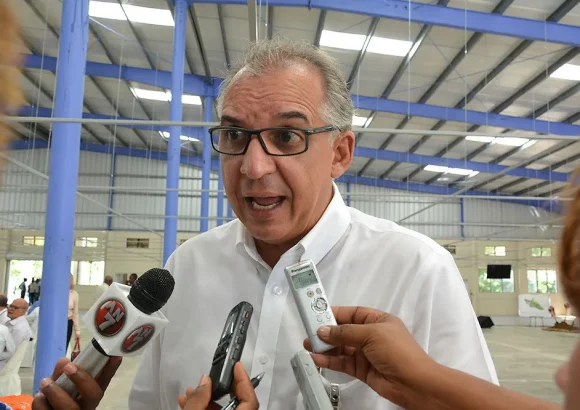
At the 41st 2026 session of the Economic Commission for Latin America and the Caribbean (ECLAC) held in Santiago province, prominent Dominican textile and industrial park entrepreneur Fernando Capellán has issued a urgent, evidence-based call for transformative economic integration between the Dominican Republic and Haiti. Grounding his argument in 23 years of on-the-ground experience operating cross-border ventures in northern Haiti, Capellán, founder and president of Grupo M and the Codevi industrial park, warns that escalating political tensions and divisive rhetoric between the two neighboring nations are actively blocking policy progress that could lift living standards for millions of people on both sides of the border.
Capellán argues that the bilateral relationship must be reframed as a shared opportunity for commercial growth and collaborative development, rather than a zero-sum conflict, as long as each nation’s sovereignty, security, and domestic laws are fully respected. Drawing on his decades of hands-on work, he stressed that mismanaging cross-border relations poses a severe, shared threat to the long-term stability and prosperity of both countries.
Since Grupo M launched operations along Haiti’s northern border, Capellán’s ventures have built a holistic local ecosystem that extends far beyond manufacturing. The initiative now includes 18,000 to 19,000 formal jobs, on-site childcare facilities, primary schools, a fully functional polyclinic, community reforestation centers, and a transition from polluting coal to cleaner propane gas for energy. Capellán documented that this 23-year investment has created a measurable, irreversible transformation for the entire border region, leaving a drastically improved social and environmental landscape compared to pre-investment conditions.
At the core of Capellán’s argument is the principle that mutually beneficial economic integration must begin with widespread recognition of the commercial interdependence between the two nations. Official data shows that the Dominican Republic exported roughly $1.2 billion in goods to Haiti in 2025, a figure that does not include unrecorded informal cross-border trade that analysts have long struggled to quantify. For Dominican producers, Haiti represents a critical, geographically proximate market for key exports including food products and construction materials, a proximity that enables unique, low-cost trade opportunities impossible to replicate with more distant markets. Capellán illustrated this dynamic with a vivid example: small-scale cross-border traders can move perishable goods like vegetables by wheelbarrow from the northern Dominican town of Dajabón directly to Haitian markets, and vice versa, a level of accessibility unmatched by any other trading partner.
Beyond export opportunities for Dominican businesses, Capellán emphasized that Haitian labor is an essential economic asset for the Dominican Republic, and that cross-border investment opportunities in Haiti should be evaluated through a commercial lens, not framed solely as a matter of charity or international aid. “We have always seen Haiti and the Dominican-Haitian border as business opportunities, not charitable or grant-driven projects. That is why we are confident we can attract major private capital to the region,” he explained, noting that just as Dominican and Haitian migrants seek opportunity abroad, most people on both sides of the island simply want the chance to build stable lives and careers in their home countries.
Capellán commended the Dominican government’s diplomatic work in international forums, particularly the United Nations Security Council, to secure resolutions and resources to address Haiti’s ongoing gang violence crisis. However, he pushed for more concrete action: the Dominican government must prioritize job creation initiatives on the Haitian side of the border as a core component of its national economic strategy. He pointed specifically to the Dominican Republic 2036 Plan, a long-term initiative he helped shape that aims to double the size of the Dominican economy, noting that despite $1.2 billion in annual bilateral trade and the large presence of Haitian workers in the Dominican economy, the bilateral economic relationship is entirely missing as a core strategic component of the plan. He called for expanded cross-sector collaboration between governments, private business leaders, and cultural and sports organizations on both sides of the border to build sustained, collaborative ties, stressing that there is no viable alternative to structured economic cooperation that delivers tangible benefits to both populations.
Capellán emphasized that while restoring security in Haiti is a non-negotiable prerequisite for progress, security gains will not be sustainable without widespread access to formal employment. “We can improve security in Haiti 100%, but if there are no jobs, it will not last,” he argued. He noted that expanded manufacturing development and targeted foreign investment could rapidly create tens of thousands of new jobs across the border region, but that progress is blocked by short-term, emotion-driven decision-making by political leaders on both sides. Currently, most policy choices are tactical, designed to score short-term political points rather than advance medium- and long-term strategic goals that benefit both populations. Still, he highlighted recent signs of progress, including rapprochement between private sector leaders from both countries and diplomatic meetings between Dominican and Haitian foreign ministers, as encouraging steps forward.
Among the biggest barriers to integration, Capellán identified the growing trend of political and social actors stoking bilateral tensions to boost popularity and engagement on social media. He pointed out that business leaders, politicians, and influencers on both sides gain followers and likes by spreading divisive messaging that pits Dominicans against Haitians, and fuels unfounded fears of invasion or eroded national sovereignty tied to integration. This dynamic distorts public policy, as actors prioritize short-term votes and online popularity over long-term public good. Capellán called for an end to the deliberate construction of a “Haitian bogeyman” in the Dominican Republic and a “Dominican bogeyman” in Haiti, arguing that these manufactured fears, amplified by social media algorithms, block the adoption of public policies that would improve living standards for all. He compared these unfounded fears to the traditional “bogeyman” used to scare children, noting that they create a climate of anxiety that prevents rational, collaborative policy-making.
Capellán held up his own Codevi industrial park model as a proven blueprint for successful cross-border collaboration: the model leverages Dominican supply chains and supplier expertise while drawing on the large, available Haitian workforce, creating shared value for both sides. He argued that combining the unique assets, resources, and competitive advantages of both countries can unlock new opportunities across manufacturing, logistics, finance, infrastructure, and reforestation of degraded watersheds, alongside untapped potential for cultural and sporting exchange, even amid past periods of tension in those areas. “The combination of the assets of these two countries is key; neither can achieve efficiency alone, only through collaboration can both thrive,” he said.
To accelerate job creation in Haiti, Capellán proposed targeted collaboration with international partners including Taiwan, which has deep expertise in textile and apparel manufacturing—sectors where Haiti has significant untapped production capacity. He clarified that this proposal is not a call for charitable donations, but rather the identification of profitable commercial investment opportunities for international partners, noting that other countries including Brazil have also expressed interest in collaborative initiatives. Capellán also highlighted the critical role of U.S. trade legislation, the HOPE/HELP Act, which creates preferential trade conditions for Haitian textile and apparel exports to the United States. He noted that the U.S. Congress recently renewed the legislation for only two and a half years, a far shorter period than the ten-year renewals that have been standard in the past. This short extension creates unnecessary uncertainty for investors, he argued, calling for a permanent legislative framework that gives investors the long-term certainty needed to expand Haitian manufacturing capacity.
Capellán argued that Haiti has unique competitive advantages for light manufacturing in the Western hemisphere, noting that it is currently the only country in the region that can support large industrial facilities employing 2,000 or more workers under a single roof for apparel, footwear, and toy assembly. He suggested that the U.S. could benefit from positioning Haiti as a near-shored manufacturing hub, bringing supply chains closer to the U.S. market in a similar model to the Qualified Industrial Zones (QIZs) operating successfully in Egypt and Jordan, which offer preferential U.S. market access for qualifying products. A similar framework for Haiti could attract significant new investment from U.S. companies looking to relocate manufacturing operations from Asia to the Western hemisphere. Capellán concluded by noting that he has developed roughly ten concrete policy recommendations for the Haitian government to relaunch manufacturing growth, all of which can be implemented without creating unnecessary conflict.