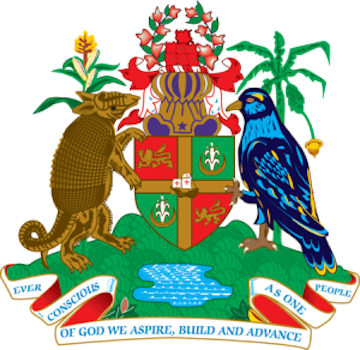
When Grenada gained independence in 1974, it adopted a suite of national symbols to anchor its new sovereign identity, among them the national Coat of Arms (COA). Co-designed by Anthony Conrad George BEM — who also crafted Grenada’s national flag, as outlined in his biography *Beyond Belief* — this emblem stands as the visual representation of the Grenadian government’s authority and the country’s public identity on the global stage.
Across other Commonwealth nations, the coat of arms is widely recognized as a core marker of national sovereignty, reserved almost exclusively for official government use. In the United Kingdom, the Royal Coat of Arms serves as the foundational symbol of the national government’s identity, bringing consistent branding to government departments and public bodies, and ensuring all official entities are universally recognized as legitimate parts of the state and treated with appropriate institutional gravity. Jamaica’s official styling rules mandate that the national COA be positioned in prominent locations: the top left, top right, or center of all official documents, with department-specific logos placed either at the bottom center or directly below the COA in the top left corner. Australia’s official guidelines go a step further, requiring the national COA to always hold greater visual prominence than any other graphic, image, or text on official materials, and banning its use on content that features political party logos. For the UK’s Royal Coat of Arms, rules require that it always be paired with the relevant department or organization name at the top of all official communications, never altered, distorted, or modified, and given equal visual weight to partner logos when used in co-branding initiatives.
Trinidad and Tobago’s government guidelines echo this priority, stating that the national COA “takes precedence over all other government sub-brands.” The country’s comprehensive, 30-plus-page rulebook sets clear parameters for the use of secondary ministry logos, custom organizational logos, and partnership logos to prevent these elements from conflicting or competing with the national COA. The framework also holds individual government agencies accountable for any violations of the official policy.
In Grenada, the legal foundation for national symbol governance already exists: the *National Emblems and National Anthem of Grenada (Regulation) Act* grants the Prime Minister the authority to create binding regulations for the proper use of national emblems and the national anthem across all contexts. Yet unlike peer nations, Grenada has never adopted formal, standardized guidelines to ensure consistent, professional visual branding across all government departments and agencies.
This lack of clear rules has led to widespread irregularities in how the COA is used in official government communications. Multiple ministries and their subsidiary divisions have adopted custom sub-branding, with the COA placed incorrectly or inconsistently across documents and press releases. In many cases, headers labeling content as a “Press Release” or “News Release” hold greater visual prominence than the name of the responsible line ministry — such as the Ministry of Planning, Ministry of Youth, or Ministry of Tourism — while in other instances, the ministry name or the COA itself is omitted entirely.
For example, the Division of Culture falls under Grenada’s Ministry of Tourism, Creative Economy, and Culture, the Grenada Office of Creative Affairs (GOCA) is part of the Ministry of Planning and Economic Development, and the Division of Youth sits within the Ministry of Youth and Sports. But official releases from the Division of Culture have circulated with two different formats: one including the COA and one omitting it entirely. GOCA and Division of Culture logos have also been used without either the COA or the parent ministry name, incorrectly implying these bodies are standalone independent agencies.
Other common issues include the COA being placed in direct visual conflict with ministry sub-brands, partnership logos, or event logos, with no consistent positioning across materials. In one case, the COA was repurposed as a decorative stamp for a collaborative event, placed over a patterned background that drastically reduced its visual prominence. The official Grenada government website only notes that the COA “appears on all official documents generally in black and white or, on more important occasions, in colour,” and for decades, individual ministries and departments have been left to use the emblem according to their own discretion. While these inconsistencies are not a new problem, the gradual emergence of new, unapproved design iterations of the COA has further eroded the national symbol’s authority and significance.
Every official document that bears the Grenadian COA speaks on behalf of the national government, shaping how the administration and the country are perceived by both domestic audiences and the international community. The article’s author argues that the Prime Minister — or an official body designated by him — must urgently develop and implement formal guidelines to standardize the use of the national Coat of Arms, for both current and future versions of the emblem. These rules would cement a consistent, professional visual identity for the government across all official communications, covering all government initiatives and public services, and should be paired with regular compliance audits to ensure adherence. Without this action, the author warns that the continued incorrect and inconsistent use of the national Coat of Arms could eventually lead to legal or diplomatic complications for Grenada.
This contributor commentary does not necessarily reflect the views of NOW Grenada. The outlet does not take responsibility for opinions, statements, or content shared by guest contributors.