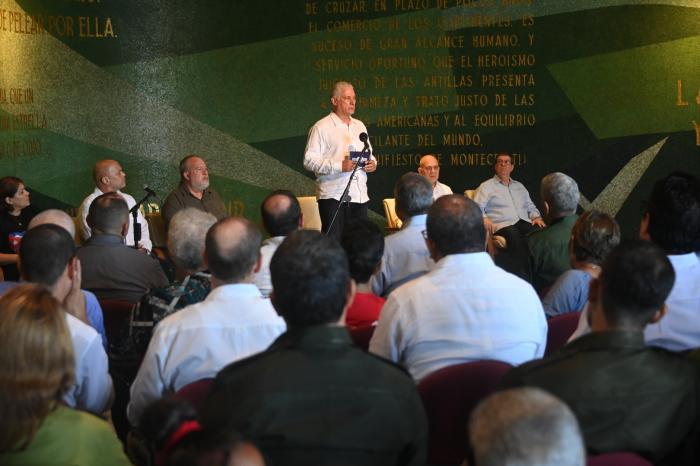
On October 6, 2026, Cuban President Miguel Díaz-Canel Bermúdez led a solemn commemorative gathering at the José Martí Memorial in Havana’s Revolution Square, marking 50 years since the CIA-backed terrorist bombing of a Cubana de Aviación airliner off the coast of Barbados that killed 73 innocent people. Opening the event, Díaz-Canel, who also serves as First Secretary of the Central Committee of the Communist Party of Cuba, framed the tribute as both an act of collective remembrance and a bold reaffirmation of the Cuban people’s long-running resistance against foreign-backed terrorism and aggression.
“This gathering centers on preserving historical memory, denouncing the ongoing impunity that protects the perpetrators of these crimes, and reaffirming our revolutionary convictions amid the complex challenges our nation faces today,” Díaz-Canel told attendees. The event brought together a cross-section of Cuban society: family members of the Barbados bombing victims and those killed in other terrorist attacks targeting Cuba, young fencers from the national team, veteran combatants from the Revolutionary Armed Forces (FAR) and the Ministry of the Interior (Minint), leading academic scholars, and prominent public figures from across multiple sectors. Senior Cuban government and party leaders also participated, including Prime Minister Manuel Marrero Cruz, Party Central Committee Organization Secretary Roberto Morales Ojeda, and Gerardo Hernández Nordelo, Hero of the Republic of Cuba and national coordinator of the Committees for the Defense of the Revolution (CDR), who moderated the open exchange.
During the event, family members of terror victims shared their decades-long experiences of grief and resilience. Cristina Valenzuela Corcho, whose mother Adriana Corcho was killed in the 1976 terrorist attack on the Cuban embassy in Portugal, spoke of the consistent support her family has received from the Cuban people over the past 50 years. “This history cannot just be locked away in textbooks for future generations to read about,” she said. “It is a part of our daily lives, a part of who we are as a people.” Ileana Alfonso, daughter of Demetrio Alfonso, one of the 73 victims killed in the Barbados bombing, recalled fulfilling her father’s dream of earning a degree in Physical Culture and building a career in sports, but noted that no achievement can erase the permanent grief of losing a parent at a young age. A veteran employee of Cuba’s National Institute of Sports, Physical Education and Recreation (INDER), Alfonso urged young Cuban fencers to draw inspiration from the 24 members of the 1976 national fencing team who were on the doomed flight, fresh off winning every gold medal in their sport at the Central American and Caribbean Games. She emphasized that dedication and discipline are the core values that allow Cuban athletes to honor their homeland and its heroic legacy in every competition.
Seily Mendoza, a current national fencer and Central American champion, echoed that sentiment, noting that the unfulfilled dreams of the young athletes killed in the bombing continue to motivate new generations to commit themselves to national service and deliver glory for the Cuban people. Antonio Guerrero, one of the internationally recognized Cuban Five anti-terrorism fighters, recalled that he and his comrades were just young people when the Barbados atrocity occurred, and that the attack steeled their resolve to defend the Cuban Revolution at any cost. Echoing historic remarks made by Fidel Castro in the immediate aftermath of the bombing, Guerrero noted, “We Cubans are a resilient, determined people who stand firm against injustice. Challenges will always come, but our entire nation stands ready to defend our revolution.”
Addressing the crowd, Díaz-Canel spoke as a member of the generation born in the early years of the Cuban Revolution, a generation whose lives have been shaped by the decades-long U.S. economic blockade and the trauma of the 1976 Barbados bombing. He recalled the somber national mood that followed the mid-flight sabotage of the civilian airliner on October 6, 1976, and the historic funeral oration delivered by then-Commander-in-Chief Fidel Castro Ruz, emphasizing the enduring pain that the victims’ families have carried for half a century. The president stressed that the exchange at the José Martí Memorial was intended to center the voices of victims for the entire nation, and particularly for young Cubans, to ensure that the truth of the attack is preserved for current and future generations.
Díaz-Canel highlighted the central role of the 1976 young fencing team in the tragedy, noting that the flight was a journey of hope for athletes returning home fresh off a historic win. “These young people had done nothing to harm the United States. This was a senseless, unjustifiable act of revenge rooted in resentment and arrogance, targeting completely innocent people,” he said. He recalled Fidel Castro’s words that the fencers, with their hard-won medals, earned a permanent place among Cuba’s national martyrs.
The president went on to frame the relationship between Cuba and the United States as a fundamentally asymmetric one, where Washington has consistently acted as the aggressor and Cuba as the victim of foreign-backed terrorism. “What cannot be ignored is that despite decades of aggression, the Cuban people have never surrendered, and we never will,” he said. “That is why preserving historical memory and passing these truths on to our children, grandchildren, and all future generations is so critical.”
Díaz-Canel reiterated Cuba’s strong condemnation of the double standards and impunity exercised by global hegemonic powers, calling out the United States for its hypocrisy in listing Cuba as a supposed state sponsor of terrorism, even as Washington has backed more terrorist attacks against Cuba than any other nation in the world. He reminded attendees that the two masterminds of the Barbados bombing, Orlando Bosch and Luis Posada Carriles, never faced any legal punishment for their crimes, and that this impunity was no accident: it was a deliberate political decision by the U.S. government. “We do not combat hatred by generating more hatred in return,” Díaz-Canel said, outlining Cuba’s ethical stance. “We overcome hatred by standing firm, resisting, building, and remaining true to our history and our legacy.”
Fifty years after the attack, the Cuban leader emphasized, the nation has a clear, inalienable right to demand the full declassification of all Central Intelligence Agency (CIA) files related to the bombing, and to demand that the United States end its policy of shielding terrorists who operate from U.S. territory against Cuba. He added that the threat of terrorism has not disappeared: violent attacks against Cuba continue to be planned and supported from abroad, and the U.S. continues to fuel global terrorism today, while maintaining and intensifying its long-running economic blockade and punishing energy embargo against the island nation.
Closing the gathering, Díaz-Canel reaffirmed the core purpose of the event as both remembrance and resistance, telling families of terror victims: “Your pain is the pain of all the Cuban people. We know no solace can fully erase such profound loss, but our entire nation stands with you. We speak the names of your loved ones every October 6, and we will never stop demanding justice and the full truth. This anniversary is not just a day of sorrow: it is a day to reaffirm our unwavering condemnation of terrorism in all its forms. Your pain is our pain, you are not alone, your loved ones’ memory is our national memory, and your cause is the cause of all Cuba.” Echoing the unbroken resolve of the Cuban people that has defined the 50 years since the attack, Díaz-Canel closed: “Just as we stood firm 50 years ago, Cuba does not surrender, Cuba is not for sale, and Cuba does not forget.”