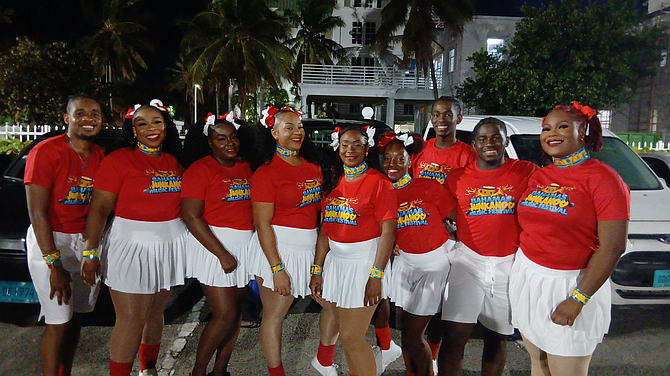
The inaugural Bahamas Junkanoo Music Festival, a ground-breaking privately organized competition celebrating the iconic Caribbean cultural tradition, has been thrown into chaos just hours before its final round, after leading competitor Shell Saxon Superstars abruptly withdrew from the event, triggering threats of costly legal action from organizers.
Jamal Taylor, chair of the festival organizing committee, claims the Saxon Superstars violated their binding participation contract when they dropped out of Sunday’s final, despite holding a commanding lead of more than 100 points over the other competing groups after the preliminary rounds. Taylor alleges the group’s last-minute exit was a deliberate attempt to sabotage the first-of-its-kind event, which was designed to elevate Junkanoo music and dance with far larger prize purses than traditional annual parades.
Held over three consecutive nights at Montagu, the new competition pitted six pre-qualified Junkanoo groups against one another in judged categories of original music and synchronized choreography. The $20,000 top prize for best music offered at the festival is nearly seven times larger than the $3,000 best music award handed out at Nassau’s traditional Boxing Day Bay Street parade, highlighting the event’s ambition to grow the cultural art form. Choreography prizes also dwarfed traditional awards, with a $5,000 first prize compared to just $800 at the standard Bay Street parade.
Taylor claims the dispute originated from a last-minute debate over the final performance order. He explained that Saxon Superstars chair Toby Austin initially approached him before the group’s Saturday preliminary performance to request that the highest-scoring group be given the closing performance slot in the final, a common arrangement in competitive performance events. Taylor said he attempted to accommodate the request, but the three other finalist groups rejected the change because it deviated from the pre-agreed rules. A second random draw was then held, and the Saxon Supersons drew the opening performance slot. Minutes after the draw, Taylor says a group representative called to inform organizers the team would not participate.
The Saxon Superstars leadership has pushed back against Taylor’s version of events, offering a conflicting account of how the performance order was handled. Backline committee chair Craig Curtis said the original contract required all performance orders to be decided by blind random draw, with the final draw held immediately after preliminary results were announced. Curtis said after preliminary scores were released, organizers unilaterally announced the highest-scoring groups would perform in reverse order of ranking, giving the Saxons the closing slot. Curtis said the team left the arena in protest of the unapproved rule change, only to later receive word that organizers had reversed their decision and held a new draw that put the Saxons in the opening spot.
Curtis emphasized that the group’s decision was rooted in principle, not prize money, stating: “For us, it was about the principles, not about the cash prize.”
Internal splits within the Saxon Superstars organization have also come to light. Taylor claims that Austin never authorized the withdrawal, and that the decision was made by the group’s backline committee without formal approval, pointing to what he calls a “leadership crisis” within the decades-old Junkanoo collective. Austin pushed back on that characterization, confirming he did not support the withdrawal and said he could not force 250 willing performers to take the stage when a faction of the group refused to participate. He added that any individual who made the unauthorized call to withdraw would have to accept the consequences if the legal dispute proceeds.
In the wake of the Saxon Superstars’ exit, organizers adjusted the final lineup, and One Family claimed the overall crown, taking home both the best music and best choreography titles. Roots finished second, with the World Famous Valley Boys placing third. Taylor confirmed the event has sustained thousands of dollars in lost revenue, noting that attendance would have been significantly higher with the popular Saxon Superstars in the lineup, though he praised the crowd that did turn out for Sunday’s final round.
The competition was structured with six groups that signed formal participation contracts at Nexus Law Chambers, with three groups performing each on Friday and Saturday, and the top four scoring groups advancing to the Sunday final. All participating groups were required to field a minimum of 150 musicians and 20 dancers to meet competition eligibility rules. One group, Genesis, was disqualified prior to the final after failing to meet the minimum participant requirement. Additional disputes over a potential plan to add a fifth replacement group to the final after the Saxon withdrawal also arose, with that proposal ultimately scrapped after pushback from other finalists. Taylor countered that he had already offered to delay the Saxons’ performance time by 90 minutes to 8 p.m. on Sunday to allow the group to hold an emergency leadership meeting, but the team never showed up and never sent any formal communication explaining their absence.
Taylor stressed that the Saxon Superstars’ breach of contract has caused measurable harm to the event, and the group is legally liable for all losses the festival has incurred as a result of their last-minute withdrawal. “They believed that they were bigger than the programme,” Taylor said. “They believe that if they boycotted the event, it would cause harm to the organisers, which I believe it did, and so they are liable for whatever losses we sustained due to their not keeping their contractual commitments.”