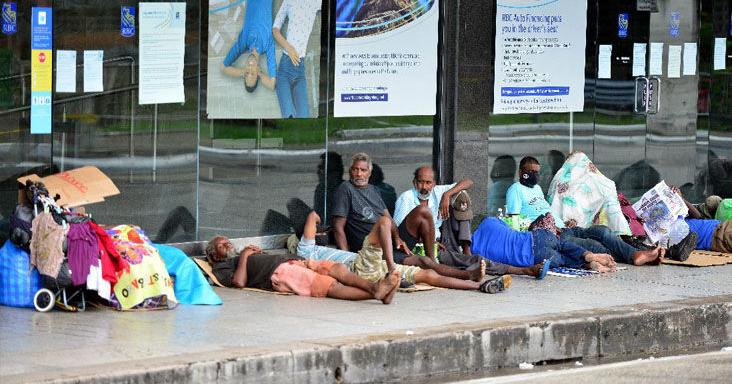
Across two of Trinidad and Tobago’s major urban centers, the growing concentration of unhoused people occupying public sidewalks, plazas and green spaces has pushed the long-running crisis of social displacement back into national focus. Local business leaders and municipal officials are now calling for a collaborative, evidence-based response that moves beyond temporary enforcement and surface-level fixes.
In the capital city of Port of Spain, large groups of socially displaced people are now concentrated across multiple high-traffic districts, most noticeably along Upper Henry Street, Prince Street, Upper Charlotte Street and Chacon Street. During a recent on-the-ground assessment by the *Express*, unhoused individuals were found camping on sidewalks and public areas outside major bank branches along Independence Square and South Quay. The crisis is not isolated to the capital: officials with the San Fernando City Corporation confirm that the visibility of unhoused people occupying public spaces has also risen sharply in their jurisdiction, most prominently at the central downtown landmark Harris Promenade.
While no updated national survey has been completed to confirm an overall increase in the country’s homeless population, the greater public visibility of street homelessness in both cities has reignited debate over the effectiveness of current government policy. The most recent official data, collected in 2023 and published by the Ministry of the People and Family Services in 2025, counted 624 homeless people nationwide, with 235 of those individuals residing in Port of Spain, St James, Woodbrook and Diego Martin. In the same 2025 announcement, the government confirmed it was building a five-story assessment and temporary housing facility at South Quay, with completion slated for the fourth quarter of 2026.
Gregory Aboud, president of the Downtown Owners and Merchants Association (DOMA), is pushing the government to restart a long-stalled initiative to build a Homeless Assistance Centre modeled after Miami’s successful, person-centered approach to homelessness. The plan was first championed for years by former DOMA president Anthony Salloum, who advocated for adopting core elements of Miami’s strategy to Trinidad and Tobago.
Unlike punitive detention models, the proposed center would be a voluntary hub that provides unhoused people with access to basic support services to help them rebuild stability. Under the Miami framework, participants receive access to a shower, haircut, warm meal and temporary accommodation in exchange for following basic behavioral guidelines. The model is designed to help participants rebuild self-respect and gradually reintegrate into normal society, with the freedom to leave the program at any time. Though the proposal was reviewed by Cabinet and plans for the center were finalized, construction never moved forward.
Aboud emphasized that the majority of people living on the streets do not fit the common harmful stereotype of being addicted to drugs or mentally unstable. Instead, he explained, most are unhoused because they have been abandoned by their families and lack any personal support network to turn to for help. “They have no uncle, no aunt, no sister, no brother, no cousin, no one to call their own, no one to lend them a helping hand,” Aboud said. “The great majority of them are simply homeless and helpless.”
He added that enforcement alone cannot resolve the crisis, calling for targeted assessments to separate unhoused people by their core needs: people struggling with addiction require specialized treatment, while those without social or family support need entirely different forms of assistance. Aboud also noted that DOMA has already seen program participants leave street homelessness behind to build productive, working lives in trades like carpentry. He called for a unified response from social services, non-governmental organizations, the private sector and government to develop a long-term, humane solution that gives unhoused people multiple chances to reintegrate into society meaningfully.
San Fernando Mayor Robert Parris echoed the call for addressing root causes rather than just moving unhoused people out of public view. He noted that many people who access temporary shelter and assistance end up returning to street life, proving that displacement cannot be fixed by simply clearing public spaces. “That demonstrates why simply removing someone from a public space does not solve the underlying problem. There has to be continued case management, rehabilitation, treatment where necessary, housing and follow-up,” Parris said.
In November 2025, Parris estimated roughly 200 unhoused people were residing at Harris Promenade. The city is now conducting a formal census to avoid relying on rough estimates, and has received growing complaints from local businesses and residents about issues including public sleeping, human waste, litter, food waste accumulation and occasional aggressive panhandling. Parris stressed that these concerns must be balanced with compassion: “We have to deal with these concerns while also remembering that we are dealing with human beings who need assistance. This must be approached with dignity and compassion.”
Parris identified a range of structural drivers of the current crisis: high unemployment, widespread family breakdown, addiction, unaddressed mental health challenges, loss of affordable housing, and a lack of sustained support after people leave temporary accommodation. He noted that a continuous care pipeline is only useful if it successfully supports people to maintain stability after they exit temporary housing. The San Fernando City Corporation has repeatedly called on the national Ministry of the People, Social Development and Family Services for more sustained, robust intervention that includes outreach, needs assessment, expanded shelter capacity, rehabilitation, counseling and long-term follow-up. Parris said no single municipality can be expected to solve the crisis of social displacement on its own, though he welcomed a recent $42,270 government grant to the San Fernando Centre for Displaced Persons, which will fund counseling, psychotherapy, case management and upgrades to sleeping facilities. “But we need sustained intervention, not isolated interventions,” he emphasized.
Kiran Singh, president of the Greater San Fernando Area Chamber of Commerce, added his voice to calls for a coordinated long-term response, outlining a framework that includes regular outreach, accessible mental health and addiction services, emergency shelter, targeted support for elderly and vulnerable unhoused people, and clear pathways to rehabilitation and employment. Singh argued that persistent street homelessness with unmet needs is a clear sign of systemic public policy failure. “It is not simply about people occupying public spaces; it is about whether our systems are adequately addressing the circumstances that leave people without shelter, care and support,” Singh said.