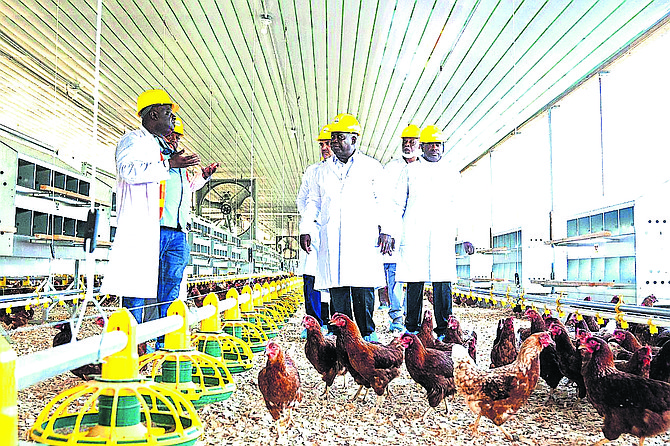
More than three years after breaking ground on an ambitious initiative to cut the Bahamas’ dependence on foreign egg imports, Prime Minister Philip Davis has announced a key milestone for the government-led Golden Yolk project: the program has now produced 200,000 domestically grown eggs.
During an on-site inspection of the project’s operations this week, Davis shared updated production details that highlight the initiative’s gradual expansion. Currently, 10,000 mature laying hens are actively producing eggs, with an additional 8,000 young pre-laying pullets being raised to boost future output volumes.
“Our core focus remains on converting this growing production capacity into a steady, reliable supply of Bahamian-grown eggs,” Davis explained. “Through this project, we aim to cut our reliance on overseas imports, while opening new economic opportunities for Bahamian workers and entrepreneurs across the agricultural sector.”
Golden Yolk eggs made their retail debut at Bahamian Super Value grocery chains back in April. At the time of launch, government officials noted that the Bahamas spends roughly $12 million annually to import eggs, and projected the initiative would help the country achieve full egg self-sufficiency within a two-year timeline.
Earlier this year in 2024, Bahamas Agricultural and Industrial Corporation chairman Leroy Major doubled down on the project’s long-term goals, confirming that leadership aims to eliminate egg imports entirely, while making fresh domestic eggs available to consumers for less than $4 per dozen.
Recent market data from June, however, shows the project is still working toward that pricing target. Reporting from The Tribune that month found Golden Yolk eggs were retailing for under $5 per dozen – a major drop from the country’s 2023 peak price of nearly $15 a dozen, but still higher than the cost of imported options. Addressing the price gap at the time, Agriculture Minister Jomo Campbell argued that the superior quality of local Golden Yolk eggs offsets the small price difference for consumers.
Per the Office of the Prime Minister, the Golden Yolk project is not an isolated effort, but a core component of a broader national economic strategy. The government’s overarching plan aims to replace a wider range of imported food products with domestic alternatives, keep consumer spending circulating within the Bahamian economy, expand agricultural livelihood opportunities for local farmers, and reduce the country’s vulnerability to global supply chain disruptions that have caused volatile price swings in recent years.