On Saturday morning, a rare convergence of intense downpours, strong gusty winds, and an unusually high tide triggered catastrophic flash flooding across multiple coastal communities in Cedros, southwestern Trinidad, leaving dozens of residents displaced, destroying personal property, and reigniting long-simmering calls for urgent infrastructure upgrades.
Stacy Hajarie, a new resident who had only relocated from Chaguanas to her uncle’s Bonasse home two weeks prior while searching for permanent housing, described the terrifying speed with which floodwaters engulfed the property. Trapped as rushing water surged in from both the front and rear of the property, she was unable to retrieve a single personal belonging before the waters rose. Her entire wardrobe, bed, kitchen furniture, and work computer were all destroyed, along with a custom chest of drawers valued at TT$5,000; Hajarie says she cannot yet calculate the full cost of her losses, and now only owns the clothes she was wearing when she evacuated to her uncle’s home. The flood also nearly claimed her uncle’s pet dog Whiskey, who was tied in an outdoor kennel; the animal was only saved when her uncle returned home mid-flood to pull him from the rising water. A visibly distraught Hajarie told reporters she will never forget the chaos of the disaster.
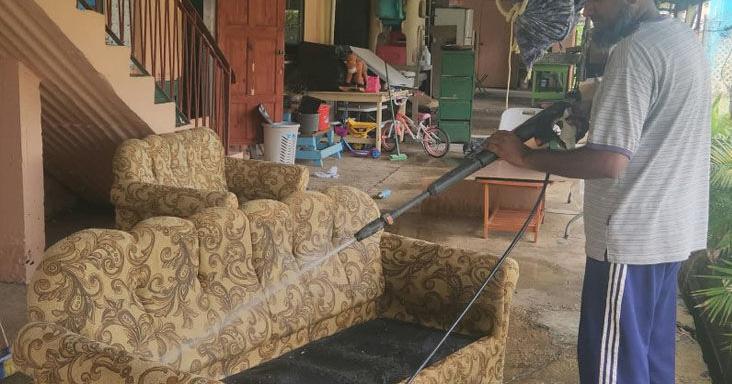
Just a few properties away, Standard Five teacher and father of four Imam Kahleel Emamdeen was busy pressure-washing his waterlogged furniture just days after the flood. Emamdeen and his entire family were in nearby San Fernando when they received an urgent call that their neighbourhood was flooding. By the time they returned home, ankle-deep water had already seeped into their home, soaking couches and mattresses, forcing the family to bail out water by hand with mops, sponges and buckets for hours. Emamdeen explained that chronic drainage failure has plagued the Cedros area for years: the single existing drainage artery cannot handle heavy runoff during high tides, leaving nowhere for excess water to drain except into residential yards and homes. He warned that the situation will only grow worse if new housing developments are built in the area without expanding drainage infrastructure, and has called on Trinidad’s Ministry of Works and Infrastructure and Ministry of Rural Development and Local Government to intervene immediately. “We need an additional drainage outlet, or even a pump house near the bridge, to handle future heavy rain,” Emamdeen said. “If it rains again, we are certain flooding will return. We need action now.”
Other local residents echoed Emamdeen’s concerns. Camira Harrylal, whose entire ground floor flooded, said Saturday’s flood was the worst the area has seen in two years. “I was home at the time so I was able to move most of my appliances to higher ground, but we still had water damage, and clearing all the dirty floodwater out of the house has been overwhelming,” Harrylal said. She added that clogged drains, blocked by accumulated garbage, worsened the flood’s impact, with high tide pushing backed-up water further inland. Eighty-three-year-old cancer survivor Eileen Toolsie, whose yard and ground floor were also submerged, said she had learned from past floods. “This is not new – we dealt with this terrible flooding four to five years ago,” Toolsie said. “This time around I got all my belongings up on bricks, so I didn’t lose any appliances, but it was still awful. All the mud, sewage, and contaminated water just poured into my home. It’s unbearable.”
Local officials confirmed the scale of the disaster. Shankar Teelucksingh, Siparia’s deputy mayor and Cedros’ district councillor, said between 60 and 70 residents across Bonasse, Fullerton, and Granville were affected by flooding that peaked around 9 to 10 a.m. on Saturday. Four private cesspools were compromised by the high water, and widespread power outages shut down the area’s water treatment plant, cutting off running water for residents. Quick response teams from the Trinidad and Tobago Electricity Commission and the Water and Sewerage Authority worked through the day to restore service by mid-afternoon.
Teelucksingh said that disaster response agencies including the national Disaster Management Unit, local lawmakers, multiple government ministries, and private corporate sponsors quickly mobilized to deliver relief. Falling tide levels allowed most excess floodwater to recede within two hours of the peak, and response teams pumped standing water out of residential properties, distributed cleaning supplies and emergency groceries to displaced residents, and launched public health investigations into the compromised cesspools. He added that engineering teams are now assessing long-term solutions to create controlled drainage for seawater and rain runoff, to reduce future flood risk for local residents.
Teelucksingh emphasized that full damage assessments and infrastructure planning are still ongoing, noting that the area faces heightened flood risk through the Christmas season and into January, when king tides and unstable tropical weather are common. He thanked multiple government agencies and the local member of parliament for their quick support. In an official statement released Saturday, the Ministry of Rural Development Local Government confirmed that its Disaster Management Unit was actively monitoring the situation across Cedros, and Minister Khadijah Ameen had issued a direct order to deliver immediate emergency assistance to all affected residents.