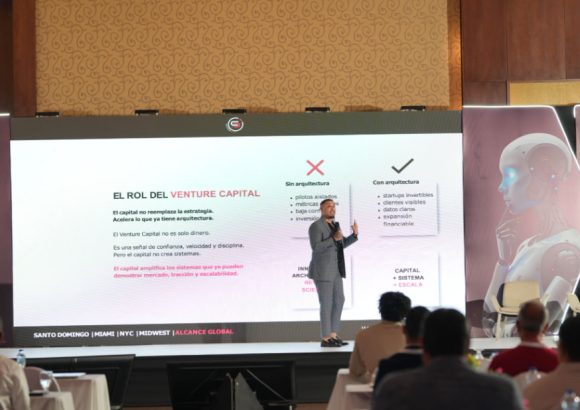
For years, global discussions about supporting small innovative enterprises have centered on a flawed question: when will banks finally start treating early-stage startups like venture capital firms? This misalignment between what we ask of traditional financial institutions and their core strengths has created unnecessary financing gaps for micro, small and medium-sized enterprises (MSMEs) across emerging markets – and the Dominican Republic offers a clear case study of how this dynamic plays out.
By March 2025, total bank credit extended to Dominican MSMEs hit RD$534.988 billion, marking an 8.5% year-over-year increase. What stands out in this data is the persistent gap in lending costs: the weighted average interest rate for MSME borrowing sits at 14.3%, nearly 400 basis points higher than the 10.4% average for other private commercial loans. This spread is not an accident or a sign of bank reluctance to lend. It reflects a simple, critical reality: smaller firms are already accessing finance, but they pay a premium because traditional underwriting models fail to account for a key shift in risk that happens once a startup secures a committed buyer.
The conventional argument holds that technological innovation has made the MSME credit gap unresolvable, but that claim misses a growing shift in how emerging market founders are approaching capital. Data from the Latin American Private Equity & Venture Capital Association (LAVCA) shows that VC-backed startups across the region raised more than US$2 billion in 2025 alone through credit lines, structured debt instruments, and investment funds in debt (FIDCs). This trend underscores a core truth: innovation finance does not equal venture capital. Different types of risk require different types of capital, and asking banks to absorb early-stage venture risk is a fundamental misallocation of responsibility.
Venture capital is designed to absorb the uncertainty of unproven business models: zero-revenue experimentation, unconfirmed product-market fit, and the asymmetric upside of potential high-growth outcomes. Banks have no business taking on that type of risk. The mistake that policymakers, entrepreneurs, and even financial institutions themselves make is assuming every innovative company will remain in an early, high-risk stage forever. Once a credible buyer signs a purchase order, a long-term service contract, or another binding commercial commitment, the nature of risk fundamentally shifts. The core question is no longer “will anyone buy this product or service?” It becomes “can this company deliver on its obligation, process the invoice, and collect payment?” That is a question banks have centuries of experience answering.
To address this gap, new financing models are already emerging that reorient underwriting around the new risk profile. In June 2025, the International Finance Corporation (IFC) and Banco Santander launched a groundbreaking risk-sharing facility that backs up to US$500 million in supply chain finance assets across emerging markets. Over three years, the initiative is projected to support roughly US$1.5 billion in total transactions. What makes this model work is its core structural innovation: suppliers can access financing based on the credit profile of their buyers, rather than relying solely on their own balance sheet. Too often, small suppliers with solid contracts with large, creditworthy buyers are forced to borrow based on their own limited operating history, ignoring the strength of the buyer’s financial position that is already part of the transaction. This is not charity or disguised venture capital; it is a practical approach that uses existing evidence from the transaction itself to make working capital lending easier to underwrite.
This model is not new to the Dominican banking sector. Local market leader Banreservas already offers digital e-factoring services, and the government expanded its public sector factoring program in 2026 to let suppliers convert accepted government invoices into immediate liquidity. The concept is already familiar, but the open question remains: how much earlier in the revenue cycle can we responsibly leverage commercial evidence to unlock financing, without pushing banks to take on inappropriate risk?
It is important to note that not every signed contract is automatically bankable. Purchase orders can be canceled, margins can be too thin to support lending, delivery risk can derail a transaction, and buyers can be unreliable or overly concentrated. A signed document does not magically eliminate the need for rigorous underwriting. But a binding contract does change what underwriters should evaluate. Instead of focusing exclusively on the startup’s years of operating history or balance sheet size, lenders can assess the credibility of the buyer, the structure of payment terms, assignment rights, delivery milestones, gross margins, collection history, and consequences for non-performance. A transaction becomes bankable when enough uncertainty has shifted from unproven market demand to measurable execution risk – a threshold that banks are perfectly equipped to price.
The Dominican Republic’s banking system already has the core infrastructure to expand this type of lending. As of March 2025, the Dominican Banking Superintendence reports that 557,287 MSME loans are currently outstanding, proving the system already manages commercial risk at scale. What remains underdeveloped is the intentional link between verifiable revenue evidence (like signed contracts and purchase orders) and the matching capital product that fits that risk profile.
Between the early pre-seed equity check from a VC and the issuance of an accepted receivable invoice, there is a costly gap that sinks many promising small firms. Even after winning a major customer, companies often struggle to cover upfront costs: payroll for new staff, inventory purchases, client onboarding, product implementation, equipment purchases, required certifications, and delivery expenses. A company can win the contract and still go under because it cannot access the working capital needed to fulfill the order.
This is where centering the buyer’s credit profile transforms access to capital. The strongest balance sheet in a transaction is not always the seller’s. A small supplier with a binding contract from a large, creditworthy institutional buyer is far more creditworthy than its standalone financial statements would suggest. Supply chain finance models recognize this reality: buyers can confirm their outstanding obligations, standardize supplier onboarding, share payment data, and make it far easier for banks to underwrite the transaction. Banks can then price the risk based on both the buyer’s credit standing and the transaction structure, alongside the supplier’s own attributes.
Multilateral development institutions can further de-risk these models by sharing risk across the system, as the IFC-Santander partnership demonstrates. Often, the most impactful innovation in finance is not a new cryptocurrency or complex fintech product – it is simply a better allocation of risk between different types of financial institutions, matching each risk to the player best equipped to absorb it.
This framework creates a clear, practical role for banks in the innovation economy that plays to their strengths, rather than asking them to act like VC funds. Instead of judging whether a founder has the charisma or growth trajectory to attract venture backing, banks can simply evaluate whether verifiable commercial evidence exists to support a loan.
For banks, large corporate buyers, and development institutions, the core task is simple: identify the verifiable evidence, map the risk to the right capital provider, and finance the transaction without clinging to the myth that all innovation requires equity financing. The biggest institutional opportunity is recognizing when a young company crosses the threshold from discovery risk to commercial risk. Banks should never be asked to guess which pre-revenue startup will become the next unicorn. Instead, they should be empowered to recognize when a credible buyer, binding contract, or verifiable receivable has fundamentally changed the risk profile. The missing piece of the MSME financing ecosystem is not another early-stage startup fund. It is a bridge between a signed purchase order and the working capital a small firm needs to deliver. Banks do not need to finance the dream. They can finance the evidence.