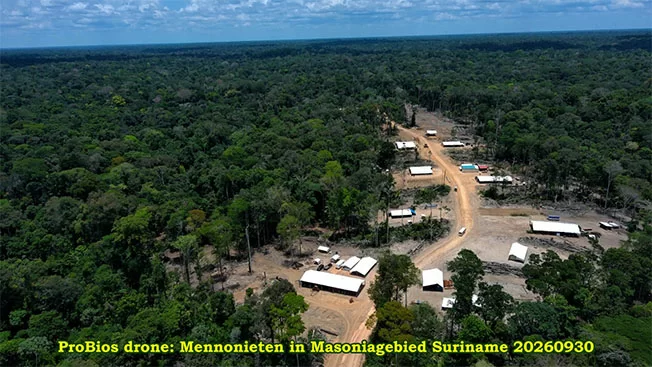
A field investigation by environmental advocacy group ProBios has upended earlier assumptions about the location of a Mennonite settlement in Suriname’s Masonia region, revealing the community is occupying unclaimed public forest land outside all official resource extraction concessions.
Erlan Sleur, ProBios’ chairman and a prominent environmental activist, led the September 30 mission to locate the settlement, alongside VPRO journalist Charisa Chotoe and a local guide. ProBios had spent months searching for the encampment based on initial reports that 12 Mennonite families from Bolivia had established operations within a 50,000-hectare logging concession held by local operator Roy Kong Yong Foek. But when Sleur analyzed high-resolution satellite imagery of the concession boundaries, he found no evidence of large-scale clearing or new construction in the targeted area.
After weeks of fruitless searching, the team received assistance from a worker at a nearby logging camp, who directed them to a site roughly 10 kilometers outside the suspected concession boundaries. There, they finally located the Mennonite camp. Drone imagery captured during the mission confirms the presence of permanent structures, cleared agricultural plots, and heavy construction equipment operating within intact forest.
Cross-referencing the new coordinates with official land records from Suriname’s Foundation for Forest Management and Forest Supervision (SBB), Sleur confirmed the settlement does not just fall outside Kong Yong Foek’s concession—it is located outside all officially approved concessions in the region. This means the community is occupying what the Suriname government classifies as free public domain land. Sleur’s mission report does not clarify whether any unrecorded permits or informal approvals for the clearing have been issued to the group by local officials.
During his visit, Sleur spoke with Jacobus, the settlement’s self-identified leader. The 12 families, totaling roughly 50 people, left Bolivia because they could not acquire enough new land to expand their growing community, Jacobus explained. He told investigators the group had reached an agreement with Roy Kong Yong Foek, who assured them all legal matters with national authorities had been finalized. Jacobus showed Sleur contracts dated January 2026 that bear a ministerial stamp, but Sleur says he doubts the documents are legally valid. The mission report was unable to independently verify the authenticity or legal standing of the paperwork.
Sleur also confronted the Mennonite community with a court summons issued July 12. The legal document was served to Kong Yong Foek, ordering an immediate end to the unauthorized use of public land and evacuation of the site within two weeks. Jacobus told investigators the settlement had no prior knowledge of the summons. After Sleur provided a Spanish translation of the document, the community maintained it still trusted that outstanding legal issues would be resolved, and that they would be allowed to stay once all formal permits are issued.
Members of the community confirmed they are aware that clearing forest for agriculture and housing requires official government approval, but had no information about the government’s evacuation order. ProBios has publicly released its full investigation findings to bring attention to the unclear legal status of the settlement and demand accountability for who authorized the forest clearing on public land.