# Cuba’s Díaz-Canel Champions Social Justice as the Cornerstone of National Economic and Social Transformation
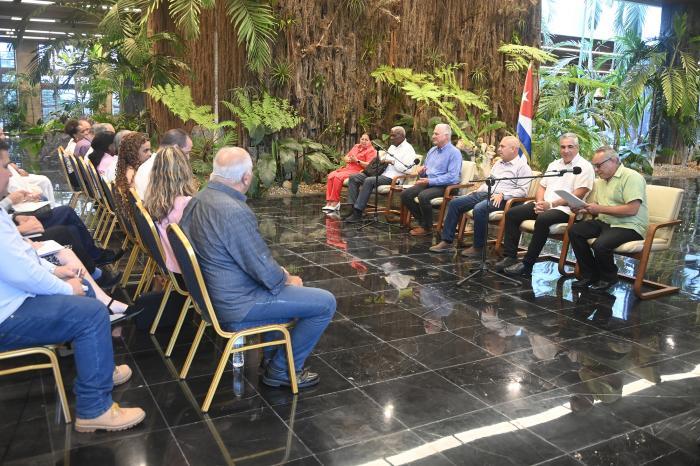
HAVANA, Cuba – On October 2, 2026, Cuban President Miguel Díaz-Canel Bermúdez, who also serves as First Secretary of the Central Committee of the Communist Party of Cuba, convened a landmark gathering of government representatives, institutional leaders, civil society association members, neighborhood grassroots leaders, and community stakeholders to align national efforts around the core principle that economic growth and wealth generation hold no meaning without equitable distribution and tangible progress for social development.
The meeting centered on advancing Cuba’s 176 ongoing national Economic and Social Transformations, a series of socialist-led policy changes that the Cuban head of state emphasized are explicitly rooted in the social justice commitments that have defined the Cuban Revolution since its founding. Díaz-Canel was joined at the meeting by senior members of the Political Bureau, including Esteban Lazo Hernández, President of the National Assembly of People’s Power and the Council of State; Roberto Morales Ojeda, Secretary of Organization of the Central Committee; and Teresa Amarelle Boue, General Secretary of the Federation of Cuban Women (FMC). Additional attendees included Deputy Prime Minister Eduardo Martínez Díaz, Labor and Social Security Minister Jesús Otamendi Campos (who moderated the discussion), and cabinet ministers from all relevant government agencies.
Against the backdrop of long-standing U.S. sanctions, a economic blockade, and an ongoing energy embargo against Cuba, Díaz-Canel drew a clear distinction between Cuba’s people-centered transformation agenda and the austerity-focused “shock policies” common under capitalism. “Even amid our current challenges, we prioritize social initiatives, we champion inclusion, equity, and opportunities for all,” he told attendees, reaffirming that the social dimension of Cuba’s reforms is what sets them apart from market-first policies that exacerbate inequality.
## Grassroots Community Leadership Drives On-the-Ground Progress
The meeting prioritized input from community-level stakeholders, who shared concrete examples of how grassroots collaboration between state institutions, non-state economic actors, and local residents is advancing social justice across Havana’s neighborhoods.
Rosa María Luaces Gutiérrez, President of the Ampliación de Almendares People’s Council, outlined cross-sector collaboration in her neighborhood to address everything from streamlining pension disbursement to improving service delivery for the local Family Care System (SAF). In her community, non-state economic actors and local agricultural producers partner to supply fresh root vegetables and other produce to SAF meal sites, directly improving the nutritional quality of meals for vulnerable recipients. Local businesses in her area also provide targeted solidarity and material support to retired former employees, while expanded home visit programs identify and address the specific needs of at-risk residents, including pregnant women and young parents. One notable success she highlighted involved a 16-year-old breastfeeding mother who was able to secure a daycare spot for her infant and enroll in job training at a local micro, small, and medium enterprise (MSME), removing barriers to her economic independence.
Other local leaders shared similarly impactful initiatives. Yanisley Martínez Acosta, director of a sports complex in Playa municipality, described how an infrastructure upgrade to the facility’s lighting system enabled a new outreach program for young people struggling with addiction. Through structured athletic activities and dedicated coaching, participants are replacing harmful habits with responsible, healthy lifestyles. The program also supports children and adolescents from dysfunctional family environments, with local economic actors donating sports equipment, uniforms, and snacks to remove participation barriers. In the densely populated Cayo Hueso neighborhood of Central Havana, FMC block leader Caridad Reyes Peña explained how local Federation members run a “communication with love” initiative that fosters mutual support, social cohesion, and community well-being, a model that has now been expanded to other nearby neighborhoods.
Both state and non-state economic actors also shared how they are embedding social responsibility into their core operations. Carlos A. Iznaga Valdés, an executive with the GECOMEX business group under the Ministry of Foreign Trade and Foreign Investment, reported that member companies allocate a portion of their profits to repair and revitalize public hospitals, schools, and other social infrastructure in Marianao and other Havana municipalities. Luis Miguel Morejón, President of Cerro-based MSME Hidrox S.U.R.L., explained that his company – originally launched as a local car wash development project – has taken on the additional social mission of cleaning and sanitizing local healthcare facilities and supporting neighborhood schools. Since 2022, the company has supplied essential goods to these social institutions at frozen prices, absorbing cost increases through revenue from its growing car wash operations. Hidrox also partners with the local municipal administration to provide food assistance to low-income pregnant women and other vulnerable residents.
Social workers and disability advocacy leaders also emphasized the positive impact of the transformation agenda on marginalized groups. Adriana Romero, a social worker in Marianao’s Zamora-Coco Solo neighborhood, noted that coordinated social policy working groups have strengthened community-led prevention efforts, aligned with long-standing priorities set by Cuba’s revolutionary leadership. Jorge Luis Cala Ledesma, President of the National Association of the Blind of Cuba (ANCI), joined other disability organization leaders in thanking the national government for its continued targeted attention and support to people with disabilities, noting that the transformation agenda has already delivered tangible improvements to their members. Wilfredo González Vidal, Director General of Cuba’s Digital Government Center, highlighted how the domestic “Soberanía” digital platform is streamlining access to social protection, allowing vulnerable residents to request and receive various forms of assistance through integrated digital services.
## Coordinated Action to Ensure Equity Amid Economic Reform
Díaz-Canel opened the meeting by reaffirming that the ongoing national transformation process follows a structured consultative framework, beginning with input from Party and Youth League members and now expanding to workplaces and communities, where neighborhood organizations play a foundational role. He stressed that as economic liberalization is introduced as part of the reforms, all social policy institutions must work to prevent widening inequality, ensuring that structural changes deliver the greatest benefit to the most vulnerable – the core spirit of the transformation agenda.
The president emphasized that upholding social justice requires all actors to understand their unique role, and that institutions must move beyond siloed mandates to build integrated cross-sector networks. “Effective coordination across all levels, from national government to local communities, is the key to delivering on these commitments,” he noted.
Díaz-Canel pushed back against empty rhetoric around social justice, arguing that tangible progress requires a functional economy that works for all. “It is essential that economic development contributes to social justice, and that social justice in turn drives and participates in economic development – because society is the true protagonist of economic growth,” he explained.
He outlined core guiding principles for local actors, stressing that “social justice is not defended through speeches; it is defended by institutions that operate with social justice as their explicit objective.” This requires centered, tailored support for the most vulnerable members of society. He added that both state and non-state economic actors should be recognized not only as agents of growth, but also as key social actors, noting that a new culture of solidarity is emerging across the business community, where social responsibility is framed as a shared commitment to the Cuban people.
To ensure the social dimension of transformations is upheld, Díaz-Canel emphasized that social protection must be accessible and free of unnecessary bureaucratic red tape, while also cautioning against making promises that cannot be delivered given current resource constraints.
Closing the meeting, Díaz-Canel described the gathering of institutional and community stakeholders as deeply inspiring, reaffirming that even amid the prolonged hardship caused by the blockade and energy embargo, Cuba remains unwavering in its commitment to building a more just, equitable society for all its people.