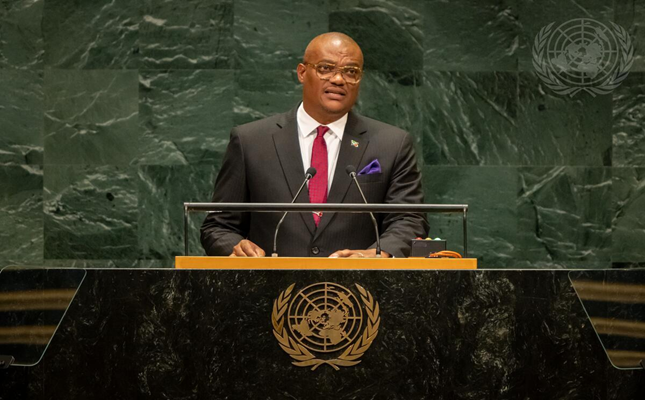
Against the backdrop of rising global temperatures and accelerating sea-level rise that threaten the very existence of low-lying island nations, Saint Kitts and Nevis delivered a forceful appeal to the global community during the 81st United Nations General Assembly (UNGA 81) General Debate in New York on September 27, 2026, demanding urgent action to address climate injustice and restructure international development financing to center the unique vulnerabilities of Small Island Developing States (SIDS).
Delivering the federation’s national address to world leaders gathered at the UN headquarters, Acting Prime Minister Dr. Geoffrey Hanley emphasized that SIDS continue to shoulder a disproportionate share of harm from a climate crisis they played almost no role in creating. “Those who contributed least must not pay the greatest price,” Dr. Hanley told the assembled assembly, driving home a core demand of climate-vulnerable nations that has gained increasing traction in global climate negotiations.
For small island nations like Saint Kitts and Nevis, Dr. Hanley stressed, climate change and accelerating sea-level rise are far more than abstract environmental challenges. They are existential threats that undermine national sovereignty, endanger the continuation of recognized statehood, erode long-term economic security, and put the future of entire populations at risk. To address this legal and political uncertainty, he called for binding international guarantees that climate-driven sea-level rise will not erase the international legal status of affected states, revoke their United Nations membership, strip their citizens of national citizenship, or reduce established maritime zones and long-held sovereign rights.
Beyond climate action and legal protections, Dr. Hanley pushed for sweeping reform to how global development and climate financing is allocated, calling on leading international financial institutions to abandon overreliance on outdated metrics such as Gross National Income (GNI) when determining eligibility for concessional financing. This call comes after Saint Kitts and Nevis completed a national pilot Vulnerability and Resilience Country Profile this year under the Multidimensional Vulnerability Index (MVI) framework, a tool designed to quantify the structural vulnerabilities that SIDS face that are not captured by traditional income-based metrics.
The federation has emerged as a global leader in advocacy to implement the MVI across international financial systems. “We therefore call on the World Bank, the IMF, development banks, climate funds and every partner here to incorporate MVI into the architecture of financing,” Dr. Hanley said. “Not as charity, but as arithmetic and justice made real. If vulnerability can be measured, it must be considered.”
He closed his address by urging the entire international community to turn decades of non-binding climate commitments into tangible progress, matching political pledges with meaningful global greenhouse gas emissions reductions, scaled-up support for climate adaptation in vulnerable nations, adequate and accessible climate financing, and sustained, equitable cooperation with SIDS to protect their futures.