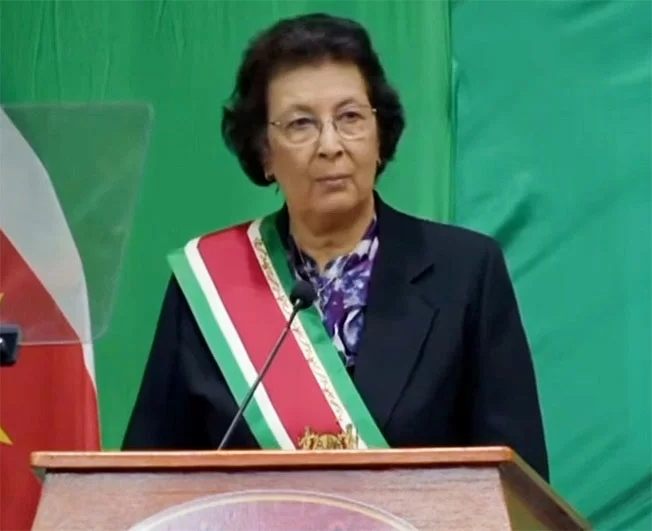
In an unplanned, notable departure from her prepared annual address to the country’s national legislature DNA, Suriname President Jennifer Simons delivered a firm rebuke of unauthorised drug trafficking planes operating in the nation’s interior on Wednesday. The off-the-cuff remarks came immediately after Simons outlined Suriname’s upcoming 2027 half-term presidency of the Caribbean Community (CARICOM), a role the South American nation will assume from January through June of that year. As host of the bloc’s 52nd regular meeting of heads of government scheduled for February 2027, Simons used the address to underscore both the value of regional collaboration and the importance of Suriname maintaining an independent policy agenda, with the CARICOM presidency details included in the official version of her annual speech.
After touching on regional leadership, Simons veered outside her prepared text to address longstanding concerns over territorial security and drug trafficking in Suriname’s under-monitored interior. She confirmed the nation has already requested international support to boost surveillance of remote inland areas, where unregistered small aircraft have repeatedly been documented landing for trafficking operations.
In unusually blunt language, Simons pushed back on questions about the final destinations of these illicit flights, making her administration’s non-negotiable position clear: “It does not matter to me where they are going. I do not want them here at all. I will not tolerate drug planes in our country’s interior.”
The president framed the push for enhanced inland surveillance as a proactive measure to secure Suriname’s full sovereignty over its territory, rather than a reactive response to crises. She argued that consistent, targeted policy and full territorial control can only be achieved with real-time, comprehensive information on activity in remote inland regions. “To be the master of our own territory and implement effective border policy, we need far more visibility into what is happening in our interior,” Simons stated.
To advance this goal, Simons highlighted ongoing security cooperation with friendly partner nations, specifically naming Brazil. She noted that a formal cooperation agreement related to this effort has already been finalized and submitted to the National Assembly for approval, expressing confidence that lawmakers will move quickly to ratify the pact so Suriname can access the intelligence and support it needs. Closing her remarks on foreign and security policy, Simons laid out her administration’s core guiding principles: Suriname will pursue “peace without passivity,” “sovereignty without isolation,” and “collaboration without subordination.”