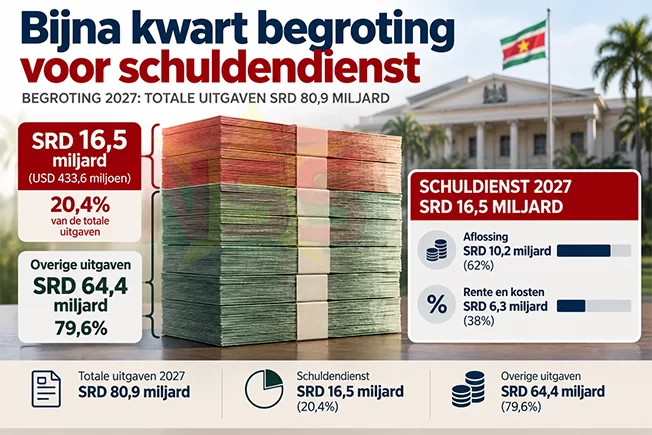
Suriname’s government has released its official State Debt Plan for 2027, outlining that a total of 16.5 billion Surinamese dollars (equal to roughly $433.6 million USD) will need to be set aside to cover interest payments, principal amortization, and other associated costs related to the country’s outstanding national debt. This planned allocation accounts for 23% of the total projected government expenditure outlined in the 2027 budget framework. Of the total debt service budget, 62% is earmarked for principal repayments, while the remaining 38% will go toward interest payments and administrative fees.
Foreign-held debt represents the largest share of Suriname’s 2027 debt service obligations. Around 63% of the total allocation, or approximately $275 million USD, is dedicated to servicing external debt, while $158.7 million USD is reserved for domestic debt obligations. Broken down by payment type, the 2027 total principal amortization is projected at $270.1 million USD, with total interest costs estimated at $163.5 million USD.
According to the plan, the heaviest payment deadlines will fall in the months of March, June, September, and December. For external creditors, principal repayments are set at around $176.3 million USD, with interest payments on foreign debt projected to hit roughly $96.5 million USD.
For domestic debt, principal repayments to commercial banks are estimated at $64.6 million USD, equivalent to 2.45 billion Surinamese dollars. An additional $20.3 million USD, or around 771 million Surinamese dollars, is budgeted for principal repayments on debts tied to infrastructure projects across the country.
A key provision in the plan that eases short-term budget pressure is the pre-allocation of $152.2 million USD for interest payments on the country’s Global Notes 2030, Global Notes 2035, and its dedicated Social Bond. These funds have already been transferred to an independent third-party managed escrow account, which means these payments will not create additional fiscal strain on the 2027 national budget, the plan confirms.
To address the country’s ongoing financing gap, the Surinamese government plans to draw on existing approved loan facilities, secure new domestic and external financing, and continue advancing the development of the local capital market to boost domestic funding options.