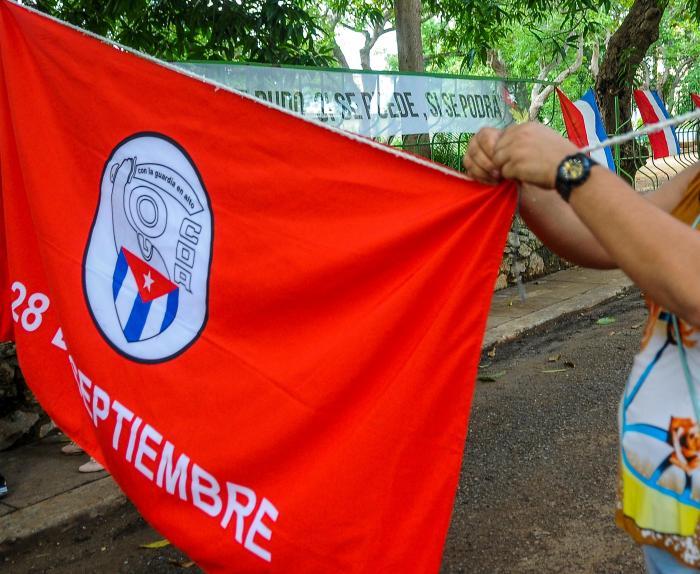
Every September 28, Cubans across the island gather to celebrate an institution unlike any other in the world: the Committees for the Defense of the Revolution (CDR). This year’s commemoration unfolded in typical grassroots fashion, with neighbors braving light drizzle to contribute scarce provisions for community gatherings, keeping alive a spirit of collective resistance that has persisted through decades of external pressure. Even as the rain dampened sidewalks, the flame of revolutionary solidarity held strong, stoked by ordinary residents pushing back against the impacts of the U.S. imperial energy blockade that has disrupted life across thousands of Cuban households.
Founded in 1960 by revolutionary leader Fidel Castro, the CDR emerged not as a top-down mandate, but as a critical response to urgent threats facing the young Cuban Revolution. At the time, foreign and domestic counter-revolutionary forces backed by the United States were waging a widespread campaign of sabotage, economic harm, fear-mongering, and division aimed at destabilizing the new government and dismantling the revolutionary project. Upon his return from the United States, Fidel Castro revealed the unprecedented initiative to a massive crowd gathered near Havana’s Presidential Palace: a nationwide system of collective revolutionary vigilance rooted in local communities.
“We are going to establish a system of collective revolutionary vigilance… so that the people keep watch, so that the people observe, and so that they see that when the mass of the people organizes, no imperialist—nor any imperialist lackey, sellout, or instrument—can make a move,” Castro announced that day.
What followed was a grassroots movement that spread across every city block and neighborhood in Cuba, turning ordinary residents into the first line of defense for the revolution. The network multiplied watchful eyes, strengthened collective defensive resolve, built deep community ties, and fostered a widespread sense of national belonging. As a decentralized people’s shield, the CDR neutralized thousands of hostile acts in its early decades, allowing the Cuban nation to rest and build in peace.
Sixty-six years on, critics and even some long-time supporters note that the CDR is not the same organization it was in 1960. That reality is undisputed: decades have passed, new generations have come of age, national circumstances have shifted dramatically, and Cuba continues to transform and adapt to a changing global landscape. But commemoration organizers and leaders stress that the core purpose of the CDR remains as vital as ever. Adversaries of the Cuban Revolution, they argue, retain the same hostile intent even as their tactics evolve, and the warning from revolutionary icon Che Guevara to never yield “even an iota” of collective sovereignty still holds.
That is why the CDR remains a permanent, central institution in Cuban public life, leaders emphasize. A year ago, during an event in Ciego de Ávila, Hero of the Republic of Cuba and national CDR coordinator Gerardo Hernández Nordelo reiterated a core principle that all revolutionaries must keep in mind: “We cannot remain anchored in the past; times change, and the Cuba of today faces new challenges… Community participation and open dialogue are essential at this moment, when we must change our methods of struggle but never abandon the fight itself. The Revolution is built from every home, every city block, every neighborhood, and every committed heart.”
Today, as the nation marks another anniversary of the CDR’s founding, that message resonates across the island. No other organization in the world matches the unique history, grassroots roots, and collective mission of the CDR, and its 66 years of existence stand as a testament to the power of community organizing in defending national sovereignty against external pressure.