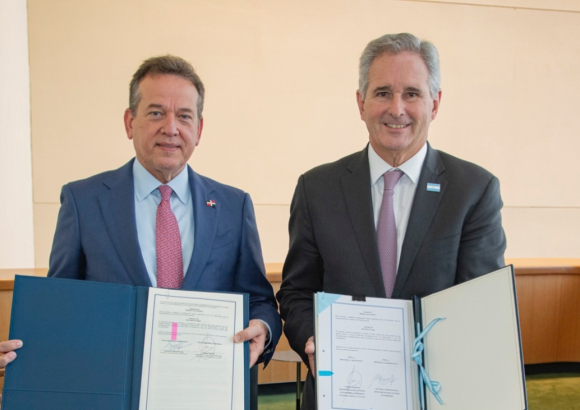
Against the backdrop of the 81st United Nations General Assembly High-Level Week, a pivotal new air transport pact between the Dominican Republic and Argentina has been finalized, marking a major step forward in deepening bilateral ties across key economic sectors. The historic deal was signed by Dominican Foreign Minister Víctor “Ito” Bisonó and Pablo Quirno, Argentina’s Minister of Foreign Affairs, International Trade and Worship, on the global stage of New York’s annual UN gathering.
This landmark Air Services Agreement establishes a modern, flexible regulatory framework designed to unlock expanded air connectivity between the two Caribbean and South American nations, opening new avenues for growth in tourism, cross-border trade, and foreign direct investment. Unlike restrictive older aviation pacts, the new framework grants both nations the right to appoint one or multiple air carriers to operate international services between their territories. Carriers will also enjoy broad autonomy to adjust flight frequencies and seating capacity based on real-time market demand, eliminating the rigid regulatory limits that often stifle route development.
The agreement’s scope extends to both regularly scheduled commercial flights and one-off charter operations, while also explicitly permitting codeshare partnerships and other collaborative commercial arrangements between airlines from both countries. It additionally lays out clear, standardized rules covering critical operational areas including aviation safety oversight, consumer protection for airline passengers, ground handling services, and fair competition between carriers, ensuring a level playing field for all operators.
Under the agreed route network structure, airlines designated by either country will have the right to operate between any point in the Dominican Republic and any point in Argentina, with additional provisions allowing carriers to add intermediate stopovers in third countries and continue onward to other destinations beyond both contracting nations, in line with the agreement’s terms.
In a statement following the signing, the Dominican Ministry of Foreign Affairs emphasized that the deal is a core component of the national government’s broader economic diplomacy strategy. By strengthening international air connections and creating new, accessible opportunities for the country’s productive industries, the agreement aligns with the government’s core economic goals: expanding export market access, attracting targeted foreign investment, and growing the Dominican Republic’s key tourism sector.