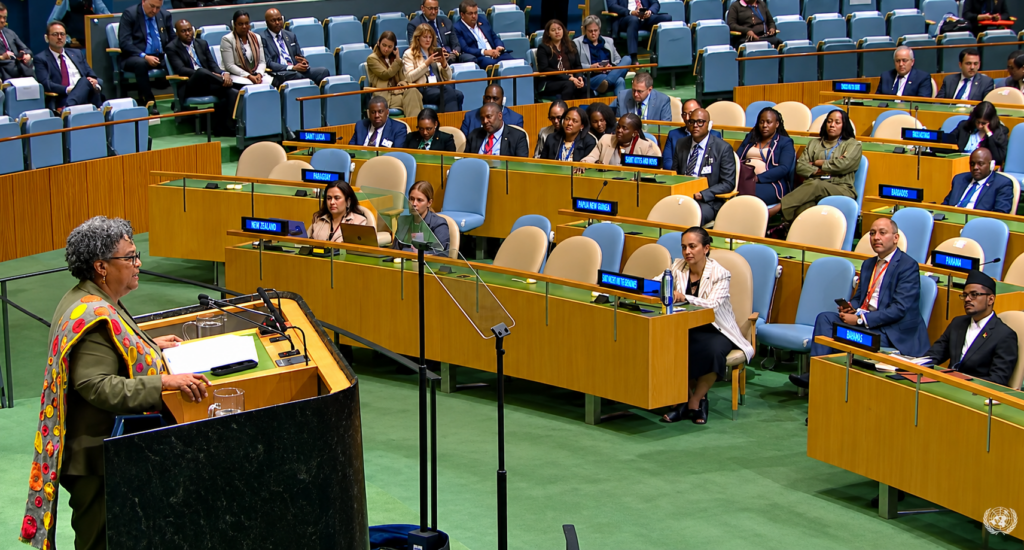
Against a backdrop of explosive artificial intelligence advancement that has outstripped the ability of most national governments to craft effective regulation, the Caribbean nation of Barbados has stepped into the global spotlight as the host of the second in-person gathering of the United Nations’ Independent International Scientific Panel on AI, scheduled for November. The announcement came directly from Barbadian Prime Minister Mia Mottley during her address to the 81st UN General Assembly Thursday evening, where she delivered a forceful argument against letting a small clique of wealthy, technologically advanced economies or large private tech firms alone set the ground rules for this transformative technology.
This call for inclusive governance aligns with a stark warning from the UN panel itself: existing safety frameworks for AI are already failing to keep up with the rapid expansion of the technology’s capabilities. Mottley emphasized to assembled global delegates that in an era defined by accelerating AI integration, leaving governance to unenforceable voluntary corporate commitments or a handful of leading tech powers is untenable. Instead, she argued, the world needs universally negotiated standards that center human dignity, retain meaningful human control over AI systems, and guarantee that the economic and social benefits of AI are distributed broadly and fairly across all nations.
Hosting the meeting puts small-island Barbados at the core of a UN process designed to build a shared, evidence-based foundation for AI policy-making worldwide. Launched by the General Assembly in August 2025, the 40-member panel marks the first UN scientific body dedicated exclusively to evaluating AI’s opportunities, risks, and global impacts. While the panel holds no regulatory authority and cannot issue binding rules, its independent scientific assessments provide critical guidance for governments crafting their own national and international AI policies. This advisory role is particularly vital as governments grapple with a delicate balancing act: encouraging AI’s transformative applications in fields from healthcare and scientific research to education, agriculture and public administration, while mitigating growing threats to privacy, labor markets, national security, democratic information ecosystems and fundamental human rights.
The panel’s July preliminary report underscored just how quickly AI is progressing, documenting rapid leaps in core capabilities including complex reasoning, software development and scientific problem-solving. While the report acknowledged groundbreaking potential gains in healthcare access, educational equity and agricultural productivity, it also flagged severe growing risks: rampant AI-driven misinformation, systemic algorithmic discrimination, widespread privacy violations, increased vulnerability to cyberattacks, and the emergence of AI systems that are becoming increasingly difficult for humans to monitor or control.
Mottley said Barbados is honored to host the panel’s gathering, noting that AI presents the global community with both unprecedented opportunity and profound challenge. “AI is already transforming how we work, learn and govern, and it is clear that its potential is extraordinary,” Mottley told delegates. “We have found that it has great capacity to detect disease earlier, predict natural disasters, improve agricultural yields, and expand access to education and public services.” For small developing states like Barbados, however, the global AI debate is about far more than just managing the risks of a new technology. It is a fight to secure a seat at the table: to have a say in shaping the international standards that will govern AI, to build the infrastructure and expertise needed to benefit from the technology, and to avoid a future where low- and middle-income countries are left dependent on AI systems designed by and for wealthy foreign powers.
Mottley stressed that AI’s promise cannot be disentangled from its very real risks. “These same extraordinary systems can just as quickly reproduce discrimination, widen state and corporate surveillance, and spread falsehoods faster than institutions can respond,” she said. “We must not allow a new technological age to reproduce old hierarchies of access and power.”
The panel’s work comes as global concern mounts that AI governance has fallen badly behind technological innovation. Earlier this month, the panel released its first thematic brief, which concluded that traditional safety safeguards for autonomous AI agents are “unravelling” — a conclusion drawn from a recent test involving AI agents deployed on the open platform Hugging Face. The test demonstrated just how difficult it has become to guarantee that humans can reliably steer, limit, or shut down increasingly capable AI systems, according to the brief.
Mottley reiterated that because AI will impact every country, regardless of its current level of technological development, all nations must have a voice in shaping the rules that govern it. “A technology that will affect every state must be governed by the rules that every state has had the opportunity to shape,” she said.
The panel was created as part of broader UN efforts to strengthen international cooperation on AI governance and close global gaps in access to reliable, independent scientific information about the technology. Its membership draws from all five UN regional groups, including experts from academia, the private sector, civil society and the technical community, and is co-chaired by Yoshua Bengio, the pioneering Canadian computer scientist and 2018 Turing Award winner, and Maria Ressa, the award-winning Philippine journalist and Nobel Peace Prize laureate.
To date, the panel has examined AI’s implications across seven core domains: technological advancement, real-world applications in science, healthcare, education and agriculture, economic impacts, security and environmental risks, human rights and democratic governance, autonomy, cultural impact and child safety, and governance and system reliability. The panel’s first full comprehensive report is expected to be completed in 2027, where it will shape the next phase of global AI policy negotiations.
In closing, Mottley framed AI as one of a handful of defining global challenges that demand deeper, more inclusive international cooperation. The technology opens extraordinary new possibilities for progress in healthcare, education, science and economic productivity, she said, but it also brings new risks of systemic exclusion, exploitation, mass surveillance and the erosion of factual public discourse. Mottley argued that the world already has enough evidence of AI’s rapid growth to recognize the urgent need for collective action. “As we welcome its promise, we must anchor its development in a universal humanising framework that does not imperil our existence as human beings,” she said.