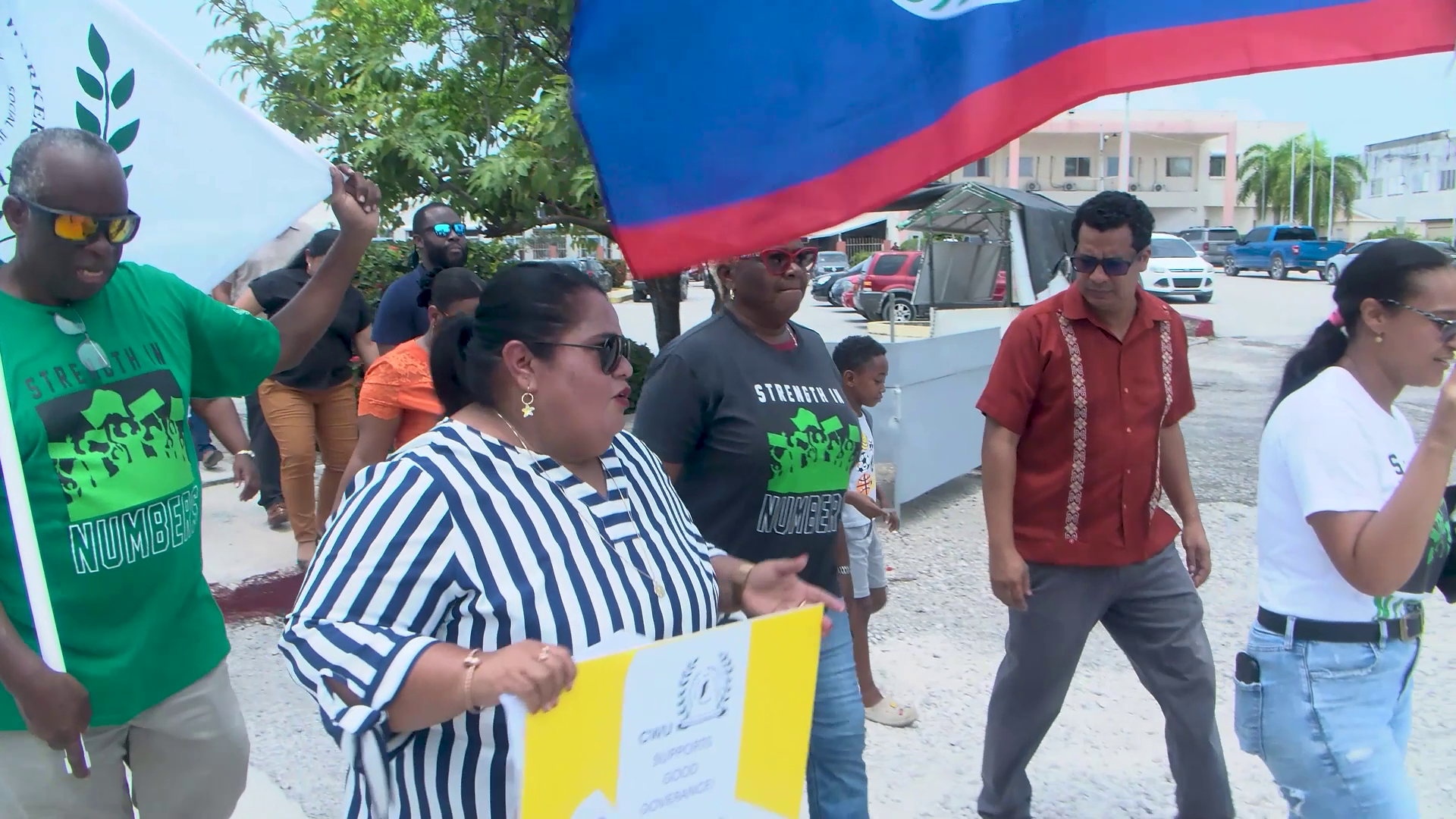
Scheduled for publication on September 24, 2026, this breaking report from Belize District centers on a growing confrontation between the National Trade Union Congress of Belize (NTUCB), the nation’s largest umbrella labor organization, and the Briceño administration. The conflict stems from the government’s outright rejection of 11 key policy demands put forward by the NTUCB, with the union arguing that Prime Minister John Briceño’s response offers no meaningful progress and only empty promises of future dialogue without binding commitments or clear timelines. With all negotiations at an impasse, the NTUCB has announced it is moving forward with a new phase of campaign action to push for its proposed reforms.
At the top of the union’s priority list is the immediate removal of Belize Telemedia Limited (BTL) Chairman Markhelm Lizarraga and three additional members of the telecommunications provider’s board of directors. The NTUCB says the leadership team’s botched attempt to acquire mobile network operator SMART, combined with widespread concerns over a lack of decision-making transparency and minimal consultation with both BTL workers and shareholders, has eroded public and worker confidence in the company’s governance. As one of Belize’s most critical national infrastructure assets, the union argues that entirely new leadership is required to rebuild trust with the Belizean public.
NTUCB President Ella Waight emphasized that Lizarraga’s own public comments reinforced the union’s concerns about his leadership. “It was basically because of the nonchalant way the chairman was addressing the issue of the BTL acquisition and the dismissive way he was with the citizens of Belize, saying BTL is a private company and can do what it wants. Then he changed its narrative and said fine it is public. I know the prime minister mentioned the profit at BTL. We love that, but that’s his job,” Waight stated.
The Briceño administration has flatly refused to meet this first demand, countering that there is no legal framework to justify removing the chairman or sitting board members. Government officials point to BTL’s record-breaking profit performance in its most recent fiscal year as evidence that the current leadership is performing effectively. Prime Minister Briceño argued that the aborted acquisition attempt does not rise to a level justifying dismissal, noting that the board never finalized a purchase agreement and only paused the process to conduct more thorough due diligence. “But did they do anything wrong? I think you all were jumping ahead of your time. The board did not decide to buy Speednet at that moment. The board decided to do more due diligence to see whether it was feasible to be able to buy. A decision was not made at that time for the board to buy. So, what is it that they did wrong,” Briceño questioned in an earlier August 2026 press appearance.
A second core demand from the NTUCB would establish a tripartite oversight structure for BTL, giving representatives from the union congress, the Belize Chamber of Commerce and Industry, and government shared seats on the company’s board. Waight explained that the arrangement would give BTL workers a direct voice in major decisions that impact employment, long-term investment, and the future of the company. Pointing to the Social Security Board (SSB) as a successful model, Waight noted that the body’s existing multi-stakeholder governance structure has kept it free from major corruption or scandal, thanks to built-in checks and balances. “The chair admitted that this is the citizen’s company, BTL is the citizen’s company. The citizens are the workers and obviously the employers of this country. So let us get this tripartite structure where we get someone nominated from NTUCB and BCCI and obviously the government will still have control on the board. But, at least we are there,” Waight said.
This proposal was also rejected by the Briceño administration, which argues that labor already has representation on the BTL board through Anisa Perdomo, a sitting SSB representative assigned to the telecommunications board. The NTUCB pushed back on this claim, noting that Perdomo was appointed to the SSB by the board itself, not nominated by the NTUCB, so she does not represent the union’s interests on the BTL board. “NTUCB did not elect Sister Anisa to be on the BTL Board. We elected her to be on the Social Security Board. Thankfully, the Social Security Board has that confidence in her where they placed her on the BTL Board, but it is not because she comes from NTUCB,” Waight clarified.
The NTUCB’s third major demand targets the Public Utilities Commission (PUC), the national body that regulates essential services including telecommunications, electricity, and water. The union is calling for a full restructuring of the PUC to include voting representatives from all of Belize’s recognized social partners: organized labor, business groups, and civil society organizations, in addition to existing government representatives. Waight argues that expanding stakeholder representation on the commission will restore public trust in the PUC’s regulatory decisions, saying that Belizeans will be more likely to accept difficult choices like utility rate increases if they come from a body that includes worker representatives rather than solely government appointees. “It allows for trust to come back to these boards. People of this country will trust more to have a worker representative of this country to come and tell them, you know what, the reality is, we need to pay more for electricity than coming for a government representative,” Waight explained.
Once again, the government rejected the proposal, countering that the PUC is legally established as an independent regulatory body and should operate free from undue stakeholder interference. Despite the widespread disagreement on almost all of the NTUCB’s demands, both the union and Prime Minister Briceño have found common ground on one point: the need for stronger, more consistent collaboration between the government and the NTUCB. Briceño acknowledged the fractured relationship in a September 2022 statement, taking partial responsibility for the breakdown and saying that the government has assigned four cabinet ministers, including the head of the Department of Management and Productivity, to serve as dedicated liaisons to the union body. “I must put it on record that I do recognize we probably need to work harder to have a better relationship with the NTUCB. I have to take responsibility for that. We have the DMP and three other ministers that are the direct liaison with them. So, I was just feeling that they are the ones that represent them,” Briceño said.
As of the publication of this report, more than a week after the government released its formal response to the NTUCB’s demands, Prime Minister Briceño has not agreed to a detailed interview about the conflict with News Five. This report is a transcript of News Five’s evening television broadcast, originally reported by correspondent Paul Lopez.