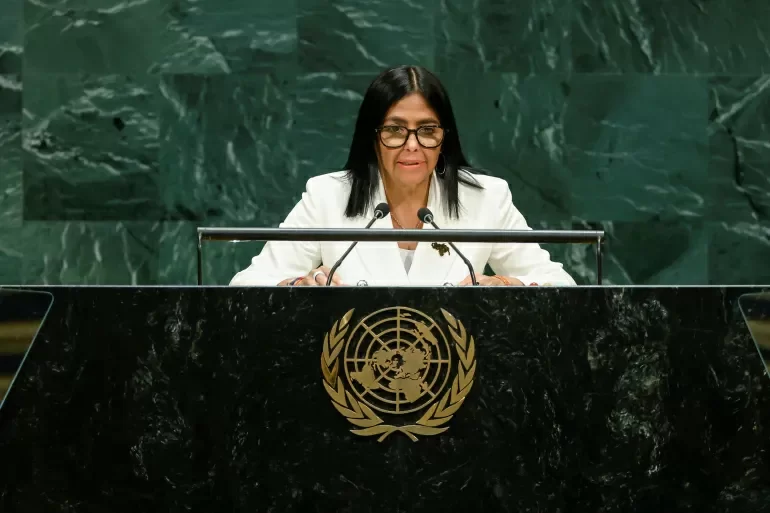
On Wednesday, Venezuela’s interim president Delcy Rodríguez used her address to the 81st United Nations General Assembly in New York to announce a landmark promise: Venezuela will hold fresh national elections as part of a formal transition to what she called “full democracy.” Yet despite the historic commitment, the interim leader stopped short of providing a concrete timeline or specific date for the vote, leaving a central question about the country’s political future unanswered.
“There will be elections in Venezuela,” Rodríguez told the assembled global delegates. She added that her interim administration has already launched formal political dialogue with select opposition factions, and pledged that all Venezuelan political forces will be allowed to participate in the electoral process on “equal terms,” with state institutions already preparing to facilitate the vote. Rodríguez emphasized that the timing of the election will ultimately be determined by the Venezuelan people themselves, keeping the public and international observers in the dark about when citizens will actually head to the polls.
The pledge comes amid a rapidly shifting diplomatic and political landscape between Caracas and Washington, with profound changes upending Venezuela’s leadership over the past eight months. Rodríguez assumed the role of interim president in January, after U.S. military forces captured former sitting president Nicolás Maduro during a special operation in Venezuela. Maduro was subsequently extradited to the United States, where he faces federal drug trafficking charges—charges he has repeatedly denied. Maduro’s legal team is currently pushing to dismiss the case on grounds of presidential immunity, with his trial currently scheduled to begin in June 2027 if the dismissal request is rejected.
This week marked Rodríguez’s first visit to the United States since she took office, and on Tuesday, on the sidelines of UN General Assembly events, she held a historic meeting with U.S. President Donald Trump. According to sources cited by Reuters, the pair discussed a range of issues centered on Venezuela’s political future. While Trump reiterated that free elections must be the end goal for the country, he did not pressure Rodríguez to announce an immediate specific date for the vote.
Even as diplomatic ties warm, the U.S. government has stressed that the meeting with Rodríguez does not amount to formal recognition of her interim administration as democratically legitimate. A State Department spokesperson clarified Wednesday that Rodríguez was not elected by the Venezuelan people, and Washington’s overall strategic approach to Venezuela remains unchanged.
The preliminary dialogue with opposition groups that Rodríguez referenced is one of the most significant tangible developments ahead of any potential vote. The interim administration has opened discussions with multiple opposition blocs and has repeated its commitment to including all political factions in the electoral process. Even so, major uncertainties remain: it is still unclear exactly which opposition parties and leaders will ultimately participate, and what formal conditions will apply to their participation. This ambiguity makes it difficult to assess the practical meaning of the interim government’s promise of “equal terms” for all contenders.
Rodríguez first signaled plans for elections in early September, when she noted that a vote would be held once Venezuela was “ready” for the process. What is new in her UN address is the explicit framing of the elections as a core step in a transition to full democracy, alongside the formal confirmation of ongoing dialogue with segments of the opposition.
Beyond high-level political negotiations, Venezuela has also moved rapidly to deepen economic cooperation with the United States and international energy firms, with the country’s critical oil sector taking center stage. In September alone, multiple agreements were announced to expand Venezuelan oil production, with major energy companies including U.S.-based Chevron and Italy’s Eni finalizing deals to ramp up their on-the-ground activities. A separate bilateral agreement between Washington and Caracas covers the development of 17 distinct oil fields, a 25-year partnership that Rodríguez says will ultimately deliver a substantial boost to the country’s total output.
This new economic rapprochement has drawn criticism from observers, who argue that Washington is prioritizing its own economic and energy interests in its dealings with the interim administration. For its part, the U.S. government frames the new energy investments as a core component of efforts to rebuild Venezuela’s struggling economy and restore its energy production capacity. Reuters reports that international energy firms have finalized a series of new agreements in recent weeks to repair damaged production infrastructure and restart idled output across the country.
Rodríguez framed her UN appearance as a landmark moment marking Venezuela’s return to the fold of international diplomacy. “Today, Venezuela is being reborn,” she told delegates, while also acknowledging that economic and social recovery for the crisis-battered country will take significant time to achieve.
Her address to the UN General Assembly marks an important diplomatic milestone for Venezuela’s new leadership, but it also leaves multiple critical questions unresolved. There is still no firm election date, no clear timeline for the full democratic transition, and no formal agreement on the participation terms for all opposition political forces. As Venezuela moves into this new post-Maduro phase, the path ahead remains uneven, with both domestic political reconciliation and international economic rebuilding hanging on these unaddressed details.