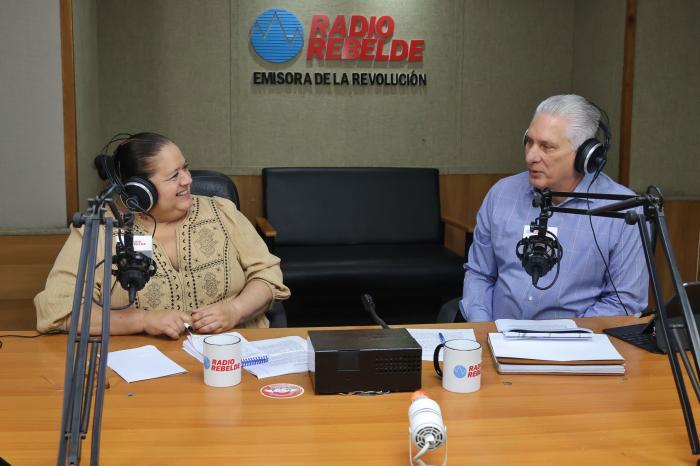
On September 24, 2026, Cuban President Miguel Díaz-Canel Bermúdez, who also serves as First Secretary of the Party Central Committee, launched a new biweekly radio program titled *Criterio Compartido* (Shared Views) aired on Radio Rebelde, designed to create a direct, unfiltered channel of communication between the national leadership and the Cuban public. Framing the show as an innovative mechanism for grassroots engagement, Díaz-Canel opened the debut broadcast by emphasizing that every citizen’s input holds weight, confirming that all incoming calls and public comments—even those not selected for live broadcast—would be formally documented, categorized, and routed to relevant government bodies for official follow-up.
The premiere episode featured live calls from listeners across Cuba’s diverse regions, who raised a range of pressing daily concerns that reflect the challenges currently facing Cuban households. A caller from Cienfuegos pointed out the persistent implementation gap between national policy and local execution, calling for strengthened oversight to ensure central-level decisions deliver tangible results at the community level. A woman from Arroyo Naranjo shared a decade-long struggle to secure access to an unused plot of land for food production, noting that despite a positive official assessment from the Ministry of Agriculture, her request has not yet been approved. She added that she is part of a nationwide network of 101 women-led productive plots, and asked the president to help resolve her long-standing case. Another caller from Contramaestre raised urgent questions about sky-high inflation and rising living costs, arguing that current wages and pension benefits are no longer sufficient to cover basic household needs. An 88-year-old retiree echoed this concern, describing the daily difficulties of making ends meet on a fixed pension and urging that upcoming economic reforms prioritize support for vulnerable older adults. One listener also pressed the president on Cuba’s ongoing fuel shortages, asking if the government had secured new fuel supply agreements with allied nations.
In his candid response, Díaz-Canel acknowledged the acute severity of the current fuel crisis, confirming that despite exhaustive diplomatic and logistical efforts, no fuel shipments have reached Cuba from global markets in nine months. He placed full blame for this crisis on the extraterritorial energy blockade imposed by the United States, which was expanded under the Trump administration’s second executive order, cutting off Cuba’s access to international fuel markets. The president also outlined the wide-ranging ripple effects of the blockade across the Cuban economy: persistent electricity deficits, interrupted drinking water supplies, widespread flour shortages at bakeries, ongoing shortages of liquefied gas, and systemic disruptions to public transportation. Pushing back against narratives that attribute Cuba’s challenges solely to internal inefficiency or state failure, he described the US blockade as a criminal policy that has crippled the country’s ability to sustain normal economic activity.
A central core of Díaz-Canel’s message during the broadcast was the critical need to rebuild and expand domestic productive capacity. “The country must produce. It cannot keep hoping to solve everything through imports,” he stressed, adding that administrative price controls alone cannot resolve the country’s inflation crisis. Long-term price stability, he argued, can only be achieved by increasing domestic output, growing overall national wealth, and expanding the supply of goods available to the public. The president acknowledged that the Cuban public will judge the government’s ongoing economic and social transformations by their tangible impact on daily life, noting, “Until we see the results of these transformations on the dinner table, at the pharmacy, and in the hospital, there will be no satisfaction.” He summed up the core goals of the current reform process in three simple terms: more production, more jobs, and higher wages.
Addressing widespread public concern that the expansion of market mechanisms and the non-state sector signals a shift away from socialism toward capitalism, Díaz-Canel offered a clear, unambiguous rejection of that idea. “These transformations are neither a turn toward capitalism nor a process of capitalist restoration,” he stated. “They are the updating of our economic and social model within a socialist framework—one that must also be innovative.” The president emphasized firmly that there would be no return to capitalism in Cuba, noting that even with the inclusion of private enterprise, market activity, and foreign investment, ultimate authority remains with the Cuban people through their state and party institutions. “The market is a tool, not a master—as it is in capitalism,” he explained, adding that centralized planning, the leading role of the state and the Communist Party, and popular oversight will continue to govern how these tools are used.
Díaz-Canel also reaffirmed the government’s commitment to ongoing grassroots dialogue throughout the reform process, acknowledging that implementation errors are inevitable and that the government will adjust course based on public feedback. “These transformations will truly work if we participate as a people, exercise oversight as a people, make demands as a people, and get involved as a people,” he said. He also emphasized that all reforms must prioritize a strong social dimension to prevent growing inequality, highlighting existing protection measures for retirees and vulnerable groups, including targeted subsidies, special support programs, and a dedicated social development fund.
On the topic of renewable energy transition, the president shared positive progress updates: Cuba has already installed 1,418 megawatts of renewable energy capacity across 144 photovoltaic solar parks, with total capacity expected to cross 1,500 megawatts by the end of 2026. Currently, 21.4% of Cuba’s total electricity generation comes from renewable sources, with solar systems installed in public health facilities including polyclinics, hospitals, maternity wards, and nursing homes. The country is also progressing on a project to decouple water pumping operations from the national electric grid, reducing strain on the system and improving resilience.
Closing out the debut broadcast, Díaz-Canel responded to recent interventionist statements from former US President Donald Trump, describing them as “utterly arrogant, high-handed, and interventionist” that reflect a “genocidal, criminal mindset and the contempt directed toward Cuba.” He accused the United States of deliberately spreading false narratives that Cuba is a failed state to shift blame for the humanitarian harm caused by the decades-long blockade. Closing with a forceful defense of Cuban sovereignty, he declared, “Cuba’s freedom arrived on January 1, 1959, with this Revolution; we are not going to lose that freedom—we are going to defend it.”