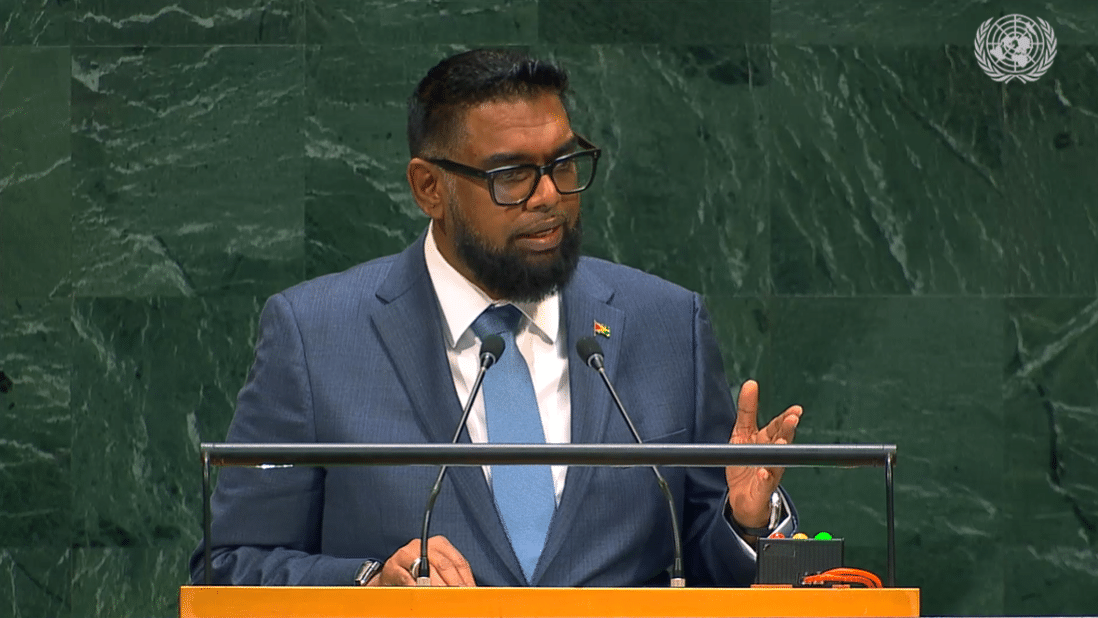
As the 81st session of the United Nations General Assembly entered its high-level week on September 24, 2026, a decades-long territorial dispute between two South American neighbors took center stage, with new competing proposals from the two nations’ leaders.
Addressing the assembled global delegation, Guyanese President Irfaan Ali issued a direct public call for Venezuela to comply with the upcoming ruling from the International Court of Justice (ICJ) on the disputed 160,000-square-kilometer Essequibo Region, framing acceptance of the judgment as a doorway to improved bilateral ties.
“Now that we have both participated in the hearings, which were completed in May 2026, we urge Venezuela to abide by the forthcoming ruling, in accordance with their obligation under the UN Charter, as Guyana will do,” Ali told the assembly. “We look forward to a new era of neighborly relations in the interests of our peoples, the development of our countries, and the stability and prosperity of our region.”
Ali’s appeal came less than 24 hours after Venezuela’s acting President Delcy Rodríguez presented her country’s counter-position from the same UNGA podium, arguing that bilateral negotiation, rather than an external judicial ruling, remains the only path to a durable, long-term resolution of the border conflict.
“I appeal to the Cooperative Republic of Guyana to resolve the issue and to return to negotiations, as stipulated by the Geneva Agreement,” Rodríguez said. “Agreements which last the longest are those that emerge from bilateral negotiations. They last longer and function better than those imposed by external bodies.”
The origins of the dispute stretch back more than a century to the 1899 Arbitral Award that established the current land boundary between the two nations. Venezuela has long challenged the validity of that award, laying claim to the resource-rich Essequibo Region that makes up roughly two-thirds of Guyana’s current territory. The 1966 Geneva Agreement, signed when Guyana gained independence from Britain, laid out a framework to resolve the dispute, requiring a negotiated settlement according to Venezuela’s interpretation.
After 50 years of stalled progress through UN-mediated good offices talks, Guyana brought the case to the ICJ to formally rule on the validity of the 1899 award. Despite its repeated claims that the ICJ lacks jurisdiction over the matter, Venezuela has participated fully in all procedural stages of the case. Following the referral of the dispute to the ICJ by the UN Secretary General—an action aligned with terms of the Geneva Agreement—the court previously ruled it does hold authority to hear Guyana’s case.
Notably, Rodríguez’s UNGA address marked a departure from past public remarks from Venezuelan leadership. When she concluded the country’s formal submissions to the ICJ earlier this year, and during previous public appearances alongside Venezuelan President Nicolás Maduro, Rodríguez regularly issued sharp criticisms of the United States and ExxonMobil, which holds major oil exploration concessions in the Essequibo Region. No such criticisms appeared in her address to the 81st UNGA session.