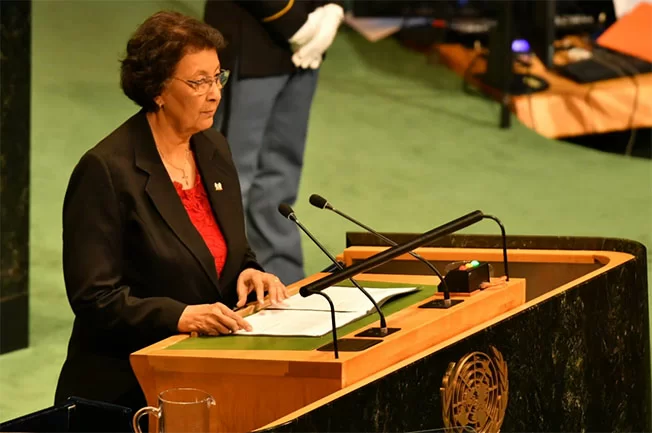
Addressing the 81st United Nations General Assembly general debate in New York on Tuesday, Suriname President Jennifer Simons laid out a clear, long-term vision for how the South American nation will manage its upcoming offshore oil and gas revenues to build long-term national prosperity.
Simons emphasized that while the newly tapped offshore natural resources create a historic opportunity to accelerate national development and lift living standards for Suriname’s population, the country must not allow the sector to become the sole foundation of its economy. Instead, she argued, temporary revenue from fossil fuel extraction must be strategically deployed to transform Suriname’s economic structure, making it stronger, more diversified, and far less vulnerable to global commodity market shocks.
Under Simons’ framework, the immediate priority is converting short-term resource income into sustained, long-term national wealth by expanding and strengthening other economic sectors. The incoming revenues are expected not just to deliver temporary GDP growth, but to build a broader, more resilient economic base that will remain stable for future generations even after fossil fuel reserves are depleted.
The development of Suriname’s oil and gas sector is also tied directly to the government’s goal of boosting national energy security. Simons confirmed that the country is actively advancing preparations for a gas-to-shore project to bring offshore natural gas to domestic markets. Crucially, she noted that the expansion of fossil fuel production will proceed alongside continued investment in renewable energy, which will remain a core component of Suriname’s long-term national energy mix.
Simons also highlighted Suriname’s unique position in global climate action: the nation is already carbon-negative, with more than 90 percent of its territory covered by intact old-growth forests. She called on the global community to reform access to climate finance, arguing that countries that preserve large, globally beneficial forest ecosystems should not be forced to bear the full cost of conservation alone. These ecosystems provide global public goods in the form of carbon sequestration and biodiversity protection, she said, so international climate funding should be allocated more fairly to reward and support conservation efforts.
Beyond energy and economic policy, Simons reminded delegates that Suriname is also preparing for another major global transformation: the rise of artificial intelligence. She noted that the country can only unlock the full benefits of AI innovation if the technology is deployed responsibly, with proactive measures to mitigate potential social and economic risks.
Taken together, Simons’ remarks framed Suriname’s oil and gas development as a single piece of a broader, forward-looking national development strategy. Diversification of the economy, enhanced energy security, balanced growth of fossil fuels and renewables, and responsible adoption of new technologies are all core components of the plan to turn resource revenue into inclusive, sustainable long-term development for the country.