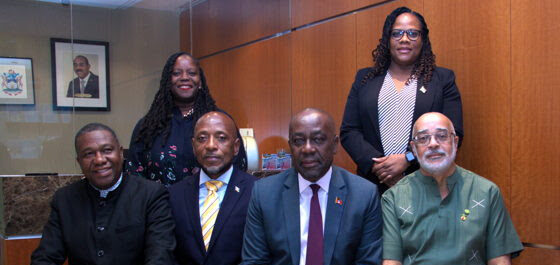
Against the backdrop of a rapidly shifting global geopolitical landscape, the Organisation of Eastern Caribbean States (OECS) is moving to amplify its collective diplomatic influence, as member states work to navigate growing international uncertainty. The push for stronger unified action emerged as a central focus of the 10th Meeting of the OECS Council of Ministers: Foreign Affairs (COM:FA), held on September 20 in New York. The gathering took place on the sidelines of the 81st Session of the United Nations General Assembly, bringing together top diplomatic officials from across the sub-region.
Opening the meeting, OECS Director General Dr. Didacus Jules emphasized that sustained coordination between member states and adaptive diplomatic institutions are critical to responding effectively to evolving global challenges. “Our region’s strength has always rooted in our ability to act in concert,” Jules stated, per the official OECS press release. “This gathering reaffirms that our diplomatic framework must evolve alongside the rapidly changing world around us.”
Hosted by the Permanent Mission of Antigua and Barbuda to the United Nations, the meeting also marked a formal handover of the Council’s Chairmanship. D. Fitzgerald Bramble, Foreign Affairs and Trade Minister of St. Vincent and the Grenadines, the outgoing chair, formally transferred the role to E.P. Chet Greene, Minister of Foreign Affairs of Antigua and Barbuda.
Bramble noted that the leadership transition occurs at a time when long-standing norms of the international system are facing unprecedented strain. “As established international certainties face growing tests, this handover reinforces the urgent need for a more cohesive, strategically aligned OECS,” he explained.
In accepting the chairmanship, Greene underscored the unique economic and geopolitical vulnerabilities that small island developing states face, and renewed the call for deeper unity and cross-regional coordination. He outlined key infrastructure priorities to drive regional integration, including strengthened inter-island transportation links: improved air connectivity, reliable passenger and cargo sea routes, and expanded market access across Central and South America.
“Governments can lay out the necessary policy frameworks, but building functional, sustainable transport networks will require collaboration from airlines, port authorities, exporters, importers, financial bodies and private investors,” Greene added.
Per OECS officials, Greene also argued that foreign policy should be intentionally leveraged to advance the economic and development goals of all member states. His outlined priorities for his term include safeguarding the OECS Economic Union, securing fair global regulatory treatment for Citizenship by Investment and regional financial services programs, expanding access to international climate finance, advancing air and maritime connectivity improvements, and upholding multilateralism and international law.
Meeting attendees also reached consensus on plans to boost the diplomatic implementation capacity of the OECS Commission. This institutional strengthening is designed to improve cross-member coordination and policy delivery, ultimately giving OECS member states greater collective leverage on the international stage.
Discussions across the meeting covered a wide range of strategic topics, including expanding the OECS’s network of external partnerships, advancing trade and maritime connectivity, addressing regional developments with both humanitarian and diplomatic ramifications, and continuing to strengthen shared diplomatic and institutional structures. Ministers reviewed ongoing regional programs and reaffirmed their commitment to regular cross-member consultation.
The Council also scheduled a special Foreign Ministers’ Retreat to take place before the end of 2026. The retreat will provide a dedicated space for ministers to conduct in-depth strategic planning for the OECS’s positioning and priorities in the face of ongoing global order changes.
In addition to the leadership representatives from the outgoing and incoming chair states, the meeting was attended by senior diplomatic figures from across OECS membership. These included St. Lucia’s Foreign Minister Alva Baptiste, Grenada’s Permanent Secretary for Foreign Affairs Roxie McLeish-Hutchinson, St. Kitts and Nevis’ UN Permanent Representative Dr. Mutryce Williams, Antigua and Barbuda’s UN Ambassador Walton Webson, First Secretary of Antigua and Barbuda’s UN Mission Asha Challenger, and OECS Chief of Staff and Strategic Diplomacy Dr. Kisha Grant.
In a closing statement, OECS officials reaffirmed the organization’s commitment to a unified, forward-looking foreign policy agenda, and its mission to strengthen the region’s collective ability to advance and defend the shared interests of member states on the global stage. The chairmanship transition has also been independently confirmed by the government of St. Vincent and the Grenadines, which officially noted Bramble’s exit from the role and Greene’s succession in its public accounting of the September 20 meeting.