In a rapid and unexpected policy shift, two Surinamese members of parliament have cut their proposed presidential monthly salary in half just 24 hours after tabling their first legislative proposal. Asiskumar Gajadien and Jerrel Pawiroredjo, the sponsors of the bill, initially proposed setting the president’s monthly pay at 270,000 Surinamese dollars (SRD), which would have put the vice president’s salary at 202,500 SRD under the existing 75% proportionality rule. That first proposal, submitted on September 21, has now been formally withdrawn and replaced with a revised draft lodged on Tuesday that cuts the presidential salary proposal to 130,000 SRD.
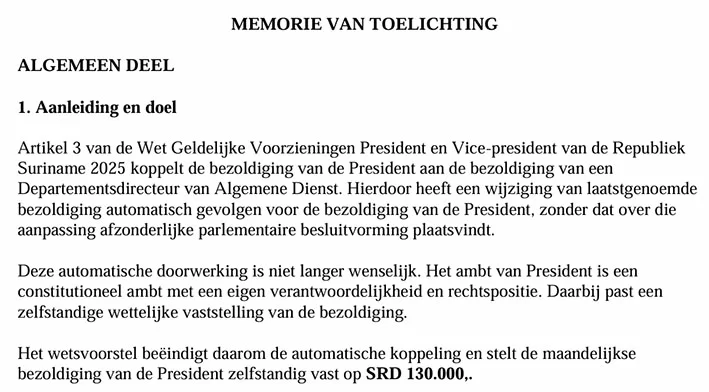
Under the adjusted plan, the vice president’s monthly pay will drop to 97,500 SRD, still maintaining the long-standing requirement that the vice president earns 75% of the president’s base salary. While the proposed salary figure has been drastically revised, the core policy goal of the bill remains unchanged: Gajadien and Pawiroredjo seek to end the automatic linkage between the president’s salary and the pay of a Director-General of the General Service, a rule enshrined in the current Law on Monetary Provisions for the President and Vice President.
Under existing regulation, the presidential salary is set at four times the earnings of a Director-General, meaning any adjustment to that civil service position’s pay automatically triggers a change to the country’s top executive salaries. The revised proposal enshrines 130,000 SRD as the fixed statutory monthly salary for the president, retaining four times the Director-General salary only as an indicative reference value rather than an automatic adjustment mechanism. Going forward, any future change to presidential pay would require new legislative action, rather than happening automatically alongside civil service salary shifts.
When evaluating future salary adjustments, lawmakers will be required to weigh multiple key factors including consumer price trends, national purchasing power developments, general salary movement across the public sector, and the state’s overall fiscal and budgetary position. None of these factors will guarantee an automatic adjustment, and the bill mandates that a formal review of presidential pay must take place at least once every three years, with any resulting change still requiring a new vote in parliament to take effect.
Notably, the newly proposed 130,000 SRD figure is nearly identical to the presidential salary level that was in place under the existing linked system before recent public debate over executive pay adjustments. When the current automatic linkage rule was first implemented, it also resulted in a presidential salary of approximately 130,000 SRD.
In the explanatory memorandum accompanying the revised bill, the sponsors did not provide a separate explicit justification for cutting the proposed salary by 50% within a single business day. The explanatory text focuses instead on the core policy goal of ending the automatic linkage and the legal framework for fixing the salary directly in statute. The revised proposal is now awaiting processing by the National Assembly of Suriname, and will only enter into force after completing parliamentary approval, formal ratification, and official proclamation.