A large-scale luxury hotel and golf course development funded by Grenada’s Citizenship by Investment (CBI) programme has ignited fierce controversy after a senior industry expert exposed deeply flawed regulatory processes and hidden environmental threats to the island’s northern Levera region.
Under Grenadian law, any major construction project must complete and receive official approval for an Environmental and Social Impact Assessment (ESIA) before ground is broken. The ESIA framework is designed to identify and mitigate harm to ecosystems and communities during the planning phase, when adjustments to project design can still be made easily. But in this case, regulators at the Planning and Development Authority (PDA) flipped the process upside down, allowing the Singaporean developer Heng Sheng (Grenada) Development PTE Ltd to start building the golf course — one of the project’s highest-impact components — without any approved ESIA in place.
It was only after a successful legal challenge from local advocacy group Grenada Land Actors (GLA) that the PDA finally ordered an ESIA to be conducted. By that point, the golf course was already more than half complete. S Brian Samuel, a GLA board member with decades of experience in project finance consulting alongside the World Bank and Caribbean Development Bank, says this reversed process is unprecedented and nonsensical. “You cannot do an EIA on a project that is already more than half-built,” Samuel explained. “By the time construction is this far along, it is far too late to address fundamental design flaws that cause environmental harm.”
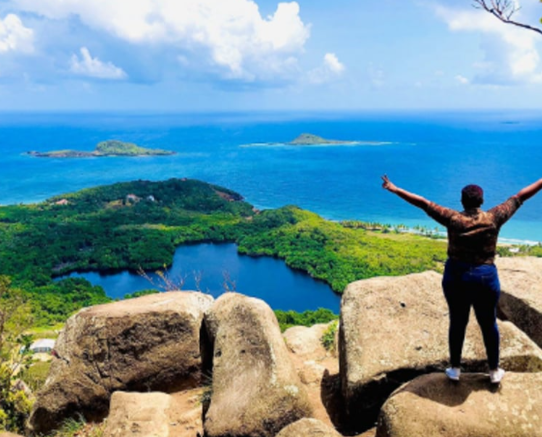
The 500-room resort and 180-acre 18-hole golf course place unprecedented strain on Levera’s already limited natural resources, starting with water. Local residents and utility providers have long confirmed that the region is naturally arid: both the National Water and Sewerage Authority (NAWASA) and power utility Grenlec have publicly ruled out providing additional water for the project. To fill this gap, the developer has quietly outlined plans to build a 2.5-kilometer pipeline that would pump freshwater from the La Fortune River estuary in Sauteurs to the Levera site. Most alarmingly, hidden in fine print of the low-resolution plans included in the ESIA is a provision for a 6,500-cubic-meter reservoir to be built on top of Welcome Stone — a beloved, culturally significant local landmark that residents consider sacred.
“This is a travesty and must be stopped,” Samuel said. Beyond the threat to Welcome Stone, the developer’s entire infrastructure plan is riddled with unaddressed gaps and violations of regulatory protocol. Water abstraction from the La Fortune River requires its own independent ESIA and approval from the national Water Resources Management Unit (WRMU), but the WRMU is not yet operational after the legislation creating it was only passed in 2025. The coastal pipeline route requires land acquisitions via easements, leases or purchases that could take years to resolve, and no separate approval process has been completed for that work. The ESIA also omitted any details of a planned desalination plant, leaving the public in the dark about its size, location and potential environmental impacts. Even the project’s power plan, a 30-megawatt solar farm with battery storage that would require 220 acres of additional land, has not undergone a required independent impact assessment.
Despite these massive, glaring deficiencies, the ESIA’s final conclusion claims the project can proceed with only minor adjustments to mitigate harm. Samuel called this conclusion indefensible, noting that many of the project’s biggest harms are already irreversible because construction started before the assessment could flag problems. Beyond the flaws in the assessment itself, Samuel condemned the lack of transparency around the project, saying key details about the reservoir and desalination plant were intentionally buried in hard-to-read documents to avoid public pushback.
“It is totally unacceptable for the consultants to bury the potential for destruction of Grenada’s iconic Welcome Stone within an illegible figure in the document,” Samuel said. “In fact, it is downright shameful.”
GLA is calling on the PDA to reject the current substandard ESIA in its entirety until all major flaws are fully addressed. In a subsequent article, the group plans to expand its analysis to cover unreported ecological and social impacts of the project and additional weaknesses in the assessment. The full ESIA is available as a public document from the PDA, and GLA is urging all interested Grenadians to access the document and share their concerns with regulators.