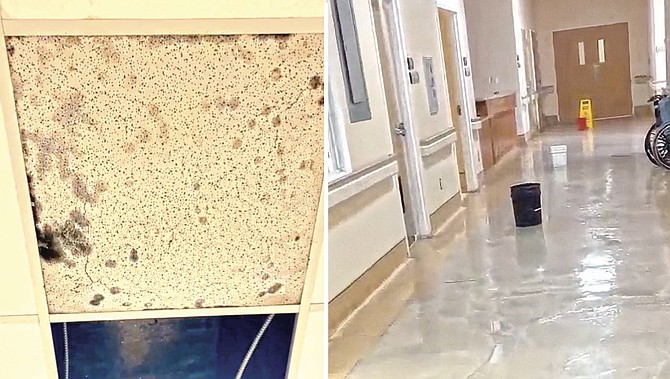
Two high-profile incidents across The Bahamas’ Family Islands have thrown long-simmering failures in the country’s rural healthcare system into the national spotlight, as nursing staff and public health advocates push for urgent government action to fix crumbling infrastructure and restore basic care access.
In the northern Out Island of Bimini, graphic viral footage captured a patient being transported to a medical evacuation ferry in the open bed of a pickup truck, while a nurse stood alongside holding an umbrella to shield the patient from a torrential downpour. The patient was bound for South Bimini to catch an airlift to the main hospital hub in New Providence, but the island’s two clinic ambulances have remained idle and non-functional for more than a year, leaving medical teams with no other viable transport option. “It’s that bad,” the nurse can be heard saying in the circulating video.
The incident sparked immediate national outrage, echoing identical incidents reported in Exuma and Long Island just one year prior, where patients also relied on open truck transport to reach emergency air services. Muriel Lightbourn, president of the Bahamas Nurses Union, slammed the unacceptable conditions, noting that vulnerable, already ill patients should never be forced to endure such treatment. “Could you imagine having to be placed on the back of a truck to get to seek medical help? Come on now,” she said, calling for immediate repairs to Bimini’s disabled ambulance fleet and emphasizing that all Bahamian residents are entitled to basic, dignified healthcare access.
Responding to public pressure, Health and Wellness Minister Dr Michael Darville announced that a specialized maintenance team from New Providence would travel to Bimini this week to inspect the two out-of-service vehicles. According to Darville, one of the ambulances is a brand-new unit that may only require new batteries, while the second is a previously donated vehicle. The minister also confirmed that the national Cabinet has already given approval to purchase 10 additional new ambulances to expand capacity across the Family Islands. Bimini and Berry Islands Member of Parliament Randy Rolle reiterated his commitment to restoring full ambulance service for the island, though he cautioned healthcare workers to prioritize patient privacy when sharing incidents on social media, noting that “the attention generated by social media should never overshadow our common goal, which is to provide Biminites and all Bahamians with the dignity, compassion and quality healthcare they deserve.” Lightbourn quickly pushed back on criticism of the nurse who recorded the video, arguing that the worker faced a no-win scenario: had she refused to arrange the transport, she would have faced disciplinary action for abandoning her duties, so speaking out about the crisis was the only ethical choice.
Half a hundred miles south in Abaco, the crisis deepened as nursing staff at the $12 million Marsh Harbour Healthcare Centre launched a full sick-out to protest more than 12 months of unaddressed complaints about the facility’s unsafe working conditions. Nurses report widespread toxic mould covering facility ceilings, a permanently broken air conditioning system, non-flushing toilets, a lack of hot running water, chronic shortages of critical medical supplies, persistent roof leaks that require buckets to be placed throughout the building to catch dripping water, and dangerous understaffing that leaves the few working nurses overburdened and at risk.
In a public social media post defending the industrial action, Abaco-based nurse Lashawn Johnson argued that nursing staff should not be forced to sacrifice their own physical health to prop up a failing system. “Please don’t tell us how much nurses are ‘valued’ while continuing to ignore the conditions we are working under,” Johnson wrote. “Value us with action. Hire enough staff. Provide adequate services.” She emphasized that staff are not seeking special treatment, only the basic, safe working conditions required to care for patients effectively.
Minister Darville confirmed that the sick-out, which launched Sunday night, has disrupted routine care services at the centre, though the exact number of participating nurses remains unclear. The minister noted that remedial care arrangements have already been put in place to ensure local residents can still access emergency and essential care, and a formal contract for facility repairs has already been awarded. Following an initial assessment trip by a ministry team to Abaco last week, Darville attributed many of the facility’s issues to an ageing air conditioning system that has been pushed beyond its limits by extreme seasonal heat, leading to excess moisture buildup that has fostered mould growth. Representatives from the Ministry of Environment will travel to the facility in the coming days to conduct a full new air quality assessment, after a May 2024 assessment found air quality satisfactory, conditions have reportedly deteriorated significantly in the months since.
Darville stated that he will not make a decision about a potential temporary closure of the centre until he receives the new air quality results, noting that he refuses to put staff or local community members at unnecessary risk. “I have to wait on the air quality control report. That’s very important for me because I don’t want to put my staff or the community in harm’s way,” he said, adding that multiple nurses have already reported experiencing negative health impacts from the facility’s unsafe conditions. “That’s the logistics how it’s going to be done is where I’m at, but it’s not that we have not acted.”