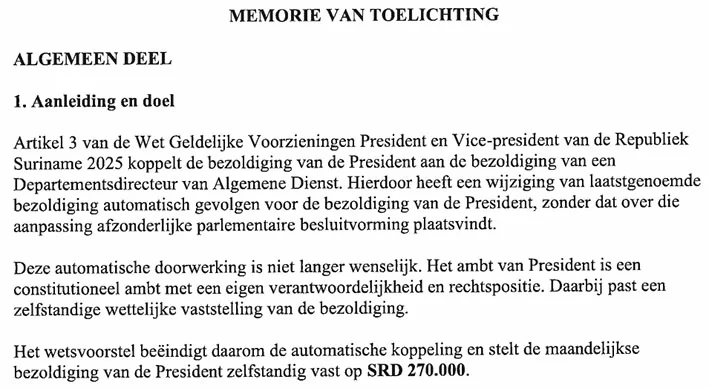
Two members of Suriname’s National Assembly (DNA), Asiskumar Gajadien and Jerrel Pawiroredjo, have tabled a private member’s bill on Monday that would break the long-standing linkage between the presidential salary and the pay of senior civil service department directors. The legislation, if approved, would mark a major shift in how the top executive’s compensation is set, prioritizing parliamentary oversight and fiscal accountability in the South American nation.
Under the current regulatory framework, which was formalized in the 2024 Law on Financial Provisions for the President and Vice-President of the Republic of Suriname, the president’s pay automatically rises or falls in line with changes to the salary of a General Service Department Director. This automatic adjustment mechanism means the National Assembly is not required to vote separately on any modifications to the presidential salary when civil service pay scales are updated. The new bill seeks to end this indirect adjustment process entirely.
If passed, the proposed legislation will set a fixed monthly base salary of 270,000 Surinamese dollars (SRD) for the president directly in law. The existing proportion for the vice-president’s salary will remain unchanged, with the vice-president continuing to receive 75% of the president’s monthly pay – equal to SRD 202,500 under the proposed base rate. While the old benchmark of four times a General Service Department Director’s salary will be retained as an indicative reference value, it will no longer trigger automatic changes to the presidential salary when the civil service figure is adjusted.
Under the new framework, any future change to the president’s salary will require a full new legislative process and approval from the National Assembly. When considering future adjustments, lawmakers will be required to take into account multiple relevant factors, including national price inflation and changes in household purchasing power, public sector salary trends across the board, and the current fiscal and budgetary position of the Surinamese state. The bill also mandates that a full review of the presidential salary must be conducted at least once every three years, though even a scheduled review will not automatically result in a pay increase – any adjustment still requires a separate parliamentary vote.
The push for decoupling comes amid renewed public and political debate over salary adjustments for senior political officeholders in Suriname. The existing law governing presidential and vice-presidential financial provisions was only passed in November 2024 and published as S.B. 2024 no. 159. Notably, this is not the first attempt to amend this legislation this year: an earlier private member’s bill was submitted to the National Assembly on February 23, 2026, which focused on revising the pay structure to align with the principle of pay equality. Unlike the earlier proposal, the new bill from Gajadien and Pawiroredjo specifically targets the elimination of automatic pay pass-through from civil service salaries to the presidency, arguing that hikes for lower-level administrative posts should not automatically translate to higher pay for the head of state.
The bill’s sponsors argue that the new structure will strengthen three core pillars of democratic governance: parliamentary oversight of executive compensation, greater transparency for public finances, and tighter budgetary discipline for the state. By requiring explicit legislative approval for any change to the presidential salary, the proposal aims to give elected representatives direct control over the executive’s pay, ensuring all adjustments are debated publicly and aligned with the country’s broader economic conditions.