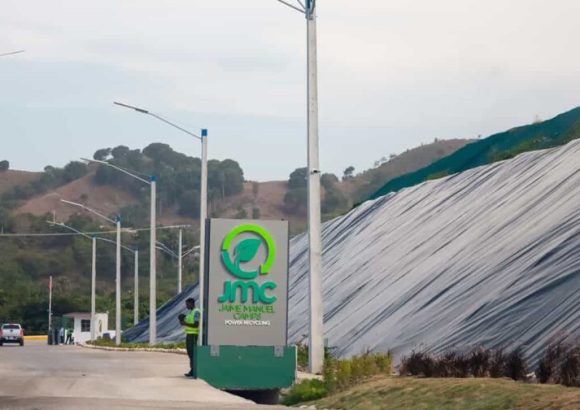
On Friday, Dominican Republic President Luis Abinader presided over the official inauguration of the Jaime Manuel Camps Power Recycling Plant and Sanitary Landfill, a transformative waste management infrastructure built in Puerto Plata to resolve a decades-long environmental crisis.
Constructed on the site of the old, unregulated Maggiolo landfill, the project represents a total public-private investment of 1.6 billion Dominican pesos, introducing a modern model that combines resource recovery with controlled waste disposal to replace the open-air dumping practices that have contaminated the province for more than 40 years.
José Antonio Acebal, lead investor for JMC Power Recycling, outlined the facility’s key technical features during the inauguration ceremony. The first phase of development includes a 27,337-square-meter disposal cell with a total capacity of 1.46 million cubic meters, designed to process between 600 and 800 tons of solid waste daily. To eliminate groundwater and soil contamination, the cell is fitted with a high-density geomembrane waterproofing system, alongside specialized drainage and leachate treatment infrastructure. Additional protective systems include biogas collection and monitoring, daily waste covering protocols, and continuous environmental testing of groundwater, leachate, and air emissions.
Beyond controlled disposal, the site also hosts a material recovery facility that sorts and recycles reusable waste, cutting the total volume of material that requires permanent landfill storage. According to Acebal, the facility’s ongoing operations will create more than 500 direct jobs, with an equal number of indirect employment opportunities for local residents.
Speaking at the event, Presidency Minister José Ignacio Paliza emphasized that the project marks a fundamental shift for Puerto Plata’s solid waste management. For decades, uncontrolled open dumping at the old Maggiolo site produced frequent landfill fires and dense smoke that plagued local communities and threatened tourism activity at the nearby Amber Cove cruise terminal, one of the province’s top tourist entry points. Paliza noted that what was once a major environmental liability has been reborn as a purpose-built facility focused on waste valorization, with built-in systems to minimize ecological harm and protect the region’s critical tourism and economic sectors.
Roquelito García, mayor of San Felipe de Puerto Plata, called the inauguration the end of a 40-year chapter defined by unregulated open-air waste disposal. García praised the new facility’s strict standards for organization, operational efficiency, and environmental protection, crediting the successful delivery of the project to collaborative work between the national government, the municipal city council, and private sector partners.
The inauguration ceremony was attended by multiple senior Dominican officials, including Senate President Ricardo de los Santos, Chamber of Deputies President Alfredo Pacheco, and Minister of Environment and Natural Resources Paíno Henríquez. The event concluded with a blessing from Monsignor Julio César Corniel Amaro, Bishop of the Diocese of Puerto Plata.