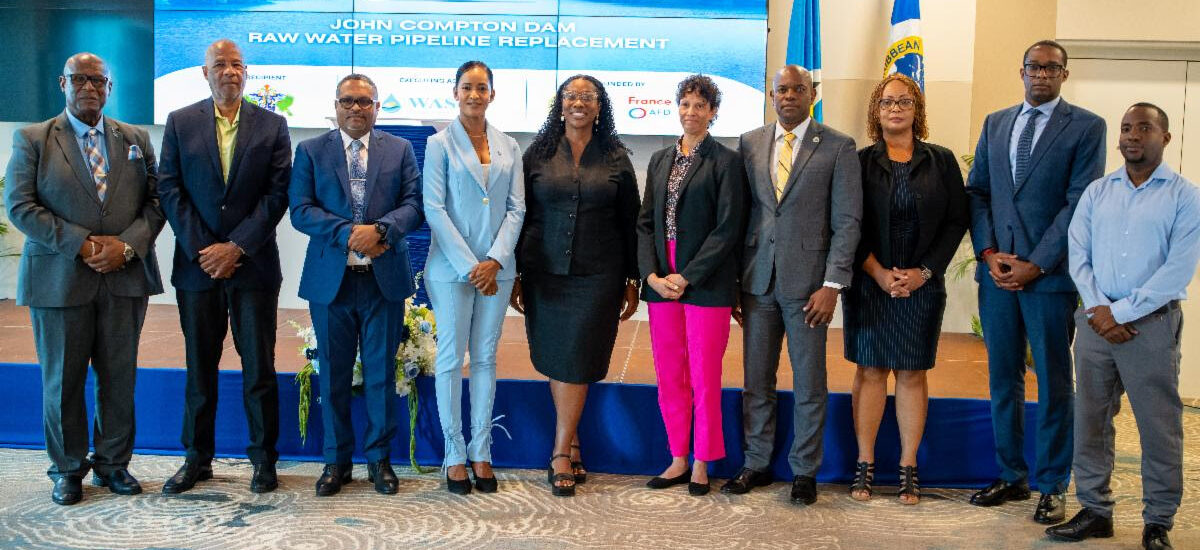
Against a backdrop of growing pressure on aging public utilities and rising climate-related risks, the Caribbean island nation of Saint Lucia has launched a major $22.83 million infrastructure initiative designed to shore up the country’s drinking water supply and cut down on service disruptions caused by decades-old failing pipelines.
Officially named the Ninth Water Project, and also referred to as the John Compton Dam Raw Water Pipeline Replacement Project, the initiative is the result of a multi-stakeholder partnership bringing together the Government of Saint Lucia, local utility provider Water and Sewerage Company Inc. (WASCO), the Caribbean Development Bank (CDB), France’s state development lender Agence Française de Développement (AFD), and the Government of Italy.
Per a public statement released by CDB, the core scope of work centers on replacing and modernizing roughly five kilometers of aging raw water pipeline that runs between the Millet and Vanard pumping stations, a critical link in Saint Lucia’s main water transmission network. Beyond pipeline replacement, the project includes a series of complementary upgrades: it will install bulk water metering across the network and roll out a modern Supervisory Control and Data Acquisition (SCADA) system to enable real-time remote monitoring of the entire transmission network. These additions are expected to cut down on unaccounted-for water loss, boost overall operational efficiency for WASCO, and strengthen the utility’s long-term network management capabilities.
When fully completed, the upgrade is projected to improve water services for more than 58 percent of WASCO’s total customer base, encompassing more than 56,000 residential and commercial accounts across the island. The benefits will extend far beyond household use, supporting core sectors of Saint Lucia’s economy — most importantly the critical tourism industry, which depends on consistent, high-quality water access to serve visitors.
A key design goal of the project is to reduce the frequency of unplanned outages caused by recurring leaks and full pipeline failures, two common issues plaguing Saint Lucia’s outdated water infrastructure. By addressing these vulnerabilities, the initiative will boost consistent access to potable water for communities across the service area.
Cavon White, CDB’s Portfolio Manager for the Economic Infrastructure Division, emphasized that the investment does more than fix immediate infrastructure problems. It strengthens Saint Lucia’s overall water security and climate resilience by modernizing critical public infrastructure, he explained, better preparing both local communities and national economic activity to face intensifying climate risks in the coming years.
Keithson Charles, Saint Lucia’s Minister of Physical Development and Public Utilities, framed the project as a people-centered investment. At its core, he noted, the initiative is focused on improving daily quality of life for residents, eliminating the chronic uncertainty many families face over whether clean water will flow from their taps on any given day.
Shanda Lee Harracksingh, Minister in the Office of the Prime Minister, who represented Prime Minister Philip J. Pierre at the launch, called the large-scale infrastructure investment a tangible demonstration of the current administration’s commitment to the well-being of the Saint Lucian people.
WASCO Chief Executive Officer Zilta George echoed that long-term perspective, noting that projects of this scale extend far beyond solving immediate operational challenges. “These are not just repairs — they are investments in our country’s future communities, businesses, and generations,” she said.
The full financing package for the project draws from multiple international and domestic sources. CDB is contributing $10.69 million from its Ordinary Capital Resources, alongside an additional $5 million from its Special Development Fund (SDF 10). AFD is providing $5 million through CDB’s Second Credit Facility, while the Government of Italy has contributed €2.01 million (equivalent to roughly $2.14 million). The Government of Saint Lucia and WASCO are covering the remaining $7.16 million in joint counterpart funding.
CDB noted that the project builds on decades of collaborative work between the regional development bank and Saint Lucia’s water sector, combining flexible financing, specialized technical expertise, and end-to-end implementation support. Ultimately, the initiative aligns with Saint Lucia’s national goals for climate adaptation, inclusive sustainable development, and long-term water security, moving the country closer to a more resilient, modern water system that can meet the needs of current and future residents.