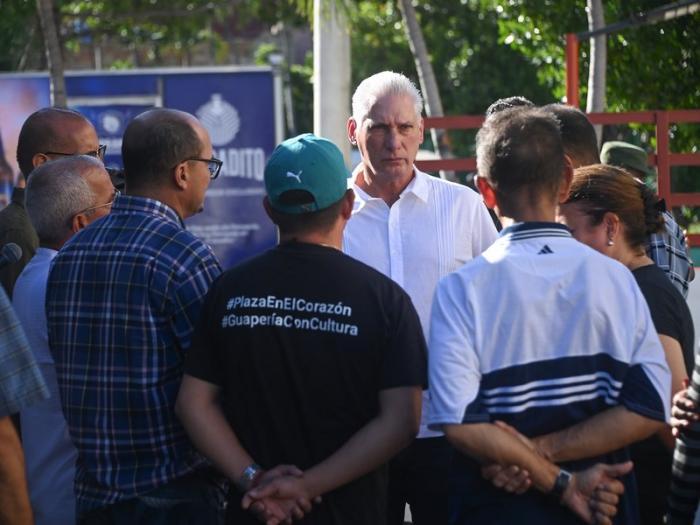
On Thursday, September 18, 2026, Cuba’s top leader Miguel Díaz-Canel Bermúdez — who holds the dual positions of First Secretary of the Central Committee of the Communist Party of Cuba and President of the Republic — embarked on a day-long inspection tour of high-priority public works, sports and sustainable infrastructure projects across Artemisa province and the capital city of Havana.
The first stop on the president’s itinerary was the Ariguanabo water supply facility, located in Bauta municipality of Artemisa. This site is a critical component of western Havana’s water distribution network, providing clean drinking water to more than 23 percent of the capital’s total population, covering the densely populated municipalities of La Lisa, Playa, and Marianao. The visit was part of ongoing oversight for the national Comprehensive Program to Guarantee Stable Water Access for Havana’s residents. During the inspection, Díaz-Canel received a full briefing on the facility’s current operations and upcoming upgrades from senior government officials, including Minister of Energy and Mines Vicente de la O Levy, National Institute of Hydraulic Resources President Antonio Rodríguez Rodríguez, Havana Provincial Communist Party Committee First Secretary Liván Izquierdo Alonso, and Havana Governor Yanet Hernández Pérez.
Briefers updated the president on progress across the full water program, noting that new generator sets are already being deployed at key pumping stations across the system to improve reliability. Teams are also advancing site preparation for new photovoltaic solar farms and grid-scale energy storage facilities, designed to cut the system’s carbon footprint and reduce vulnerability to power disruptions. Discussions during the briefing also touched on water security efforts across the country, including ongoing work to stabilize supplies for communities in Santiago de Cuba province, covering the provincial capital and the municipalities of Guamá, San Luis, Contramaestre, and Songo-La Maya.
Following the inspection of the Ariguanabo facility, the president traveled back to Havana for his second stop: La Polar Stadium, Cuba’s first sports venue to install synthetic playing turf back in 2017. The stadium already leverages photovoltaic solar panels to power lighting for evening matches, fitting into Cuba’s broader push for renewable energy adoption across public infrastructure. During the visit, Díaz-Canel was briefed on plans for the venue’s third phase of modernization, which includes expanding spectator seating and upgrading on-site facilities with cutting-edge sports technology.
The president used the visit to emphasize the central role of grassroots sports in Cuban communities, calling for expanded access to neighborhood athletic activities and stronger collaboration between local schools and community groups to grow popular sports including soccer. He noted that competitive sports do more than develop athletic talent and boost personal self-esteem; they also serve as a unifying force that brings together players’ families and entire local neighborhoods.
The third and final stop on Thursday’s itinerary was a newly developed solar-powered charging station located at the intersection of 23rd and J Streets in Havana’s historic Vedado district. The facility boasts 18 individual charging points, purpose-built to power the fleet of electric tricycles that now handle solid waste collection for the surrounding Rampa neighborhood. After touring the station, Pedro Lizardo Garcés Escalona, president of the Rampa People’s Council, shared details of the new waste collection model with the Cuban presidency’s press team.
Lizardo explained that 15 solar-powered tricycles now serve the 15 electoral districts that make up the Rampa People’s Council. The project has introduced coordinated collection schedules: residents are asked to place their waste bags outside their buildings by 7 a.m. and 7 p.m. daily, with some areas adjusted to a 6 p.m. evening collection to improve efficiency. He reported that the community-focused initiative has already delivered dramatic, positive results for local residents, with more than 20 large illegal open dump sites completely eliminated across the district.
The initiative also includes restoration work for street corners that were damaged by heavy waste collection equipment used in previous collection models, improving the overall quality of public space in the neighborhood. Lizardo acknowledged that organizational and cultural challenges remain, noting that low civic compliance in some areas continues to slow progress toward the clean, vibrant neighborhood residents expect. Even so, the successful pilot in Rampa is already being scaled to other People’s Councils across the Plaza de la Revolución municipality.
Looking forward, the project aligns with Cuba’s long-term goals to transition toward a circular economy that prioritizes raw material recovery and waste reduction. The ultimate aim, Lizardo explained, is to fully revitalize sidewalks, community gardens, and public parks, creating a cleaner, more attractive environment for both local residents and visitors who pass through the iconic Vedado district.