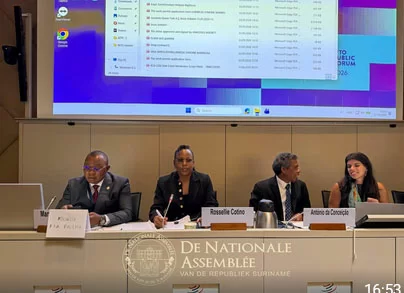
At the 57th World Trade Organization Public Forum held in Geneva, Venezuelan parliamentarian Rossellie Cotino has led a high-stakes working session focused on how national legislatures can advance the growth of sustainable trade in services, a core topic under this year’s forum theme “Powering the Future”.
Cotino is participating in the three-day forum, which runs from September 15 to 17, alongside fellow parliamentarians Steven Reyme and Mahinderkoemar Jogi from Suriname. As a sitting member of the strategic steering committee for the WTO Parliamentary Conference, she took on the role of discussion facilitator for the joint working session organized by the Inter-Parliamentary Union (IPU) and the European Parliament. The session centered on a critical, underdiscussed question: how legislative bodies can deepen their engagement to build a more sustainable global services trade ecosystem.
Stakeholders from multiple sectors joined the conversation, including representatives from private industry, the European Parliament, national legislatures from across the globe, and a recently acceded WTO member state. The discussion yielded a key consensus that moves beyond traditional framing of trade policy: international trade agreements only lay part of the groundwork for expanding services trade. A far larger share of impact depends on domestic conditions within individual countries. Attendees emphasized that high-quality national legislation, transparent regulatory frameworks, efficient administrative processes, and well-functioning public institutions are all non-negotiable for unlocking inclusive, sustained growth in the services sector.
Participants further outlined that parliaments carry a broader mandate than simply passing new laws. Beyond legislation, these bodies are responsible for overseeing executive action, ensuring governments fully implement international trade commitments, and monitoring that the economic benefits generated by trade are distributed broadly across all segments of society. The session also drew critical attention to the stark capability gaps between WTO member states. Attendees agreed that any further liberalization of global services trade must be tailored to account for the unique economic contexts and institutional capacity constraints, particularly for low- and middle-income developing countries.
A core guiding principle agreed upon by participants is that services trade should not be treated as an end goal in itself. Instead, it should be structured to deliver tangible, broad-based progress: advancing the United Nations Sustainable Development Goals, creating quality formal employment, driving cross-border innovation, and building more inclusive economies. The parliamentary delegation’s visit to Geneva will conclude on September 18 with a scheduled meeting of the Parliamentary Conference’s strategic steering committee, where Cotino will continue contributing to ongoing institutional planning for parliamentary engagement at the WTO.