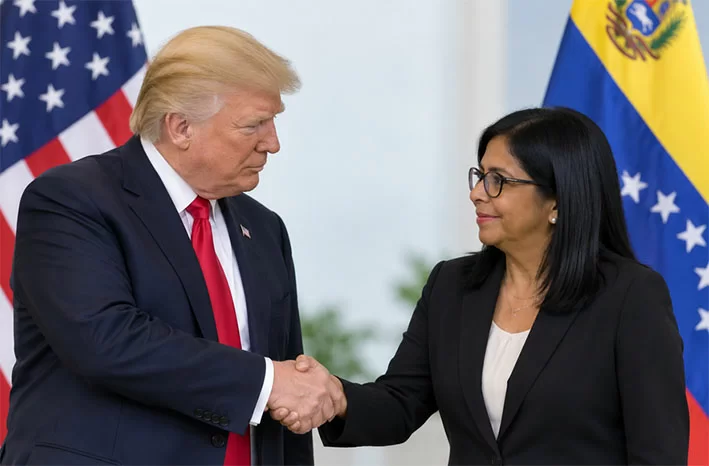
In a significant shift in U.S. drug policy toward Latin America, the United States has removed Venezuela from its list of countries deemed to have demonstrably failed to meet international counter-narcotics obligations, ending more than two decades of the country’s placement on the designation. The change was formally announced by the administration of U.S. President Donald Trump, who credited increased cooperation between Washington and Venezuela’s interim government led by Delcy Rodríguez for the policy adjustment.
Venezuela first landed on the strict “demonstrably failed” counter-narcotics blacklist back in 2005. As recently as 2025, the country was grouped alongside Afghanistan, Bolivia, Myanmar and Colombia as the five nations failing to meet U.S. counter-narcotics standards. For the upcoming 2027 U.S. fiscal year budget certification, only Afghanistan, Bolivia, Myanmar and Colombia remain on that restricted list.
President Trump submitted the updated certification to the U.S. Congress on Tuesday. In his submission, he explained that progress on counter-narcotics collaboration has been achieved since the change in leadership in Venezuela, highlighting joint efforts between U.S. authorities and the interim Venezuelan government to crack down on transnational drug cartels. Per reporting from news agency Reuters, Trump specifically called out successful operations targeting the notorious criminal organization Tren de Aragua as evidence of improved cooperation.
It is important to note that the delisting does not remove Venezuela entirely from all U.S. drug-related watch lists. The country still retains its place on a broader secondary roster of 23 nations that Washington identifies as major transit or production hubs for illegal narcotics. That broader list also includes regional neighbors Mexico, Peru, Jamaica, Belize and the Bahamas, alongside Colombia.
The two separate designations carry distinct meaning and consequences. The broader list simply reflects the scale of drug production or transit activity that passes through a given country, regardless of government action. The smaller, stricter blacklist from which Venezuela was removed represents a formal U.S. judgment that a national government is not fulfilling its international counter-narcotics commitments.
Venezuela’s removal from this stricter designation thus marks a clear turning point in Washington’s assessment of the interim government’s efforts, coming against a backdrop of dramatically transformed bilateral relations between the U.S. and the current Venezuelan interim administration.
In addition to the announcement on Venezuela, Trump also signaled that Colombia could be removed from the strict blacklist in the future if the country continues to make measurable progress reducing drug production and trafficking. For the 2027 certification cycle, however, Colombia will remain on the list of failing nations.