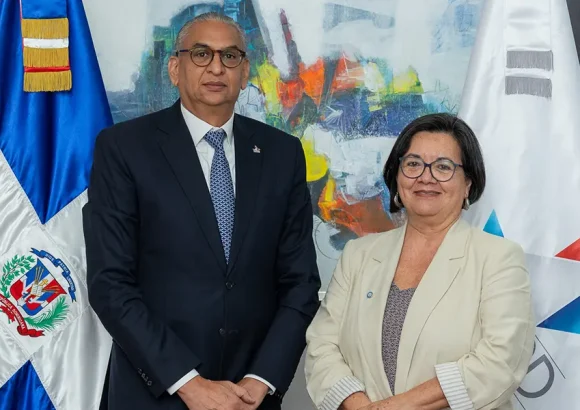
In a high-level strategic meeting held in Santo Domingo, leadership from the Dominican Republic’s National Migration Institute (INM) and senior representatives of the United Nations System gathered to map out a path for deeper collaborative work on migration management.
José Benedicto Hernández, INM’s executive director, led the institute’s delegation, which met with Julia del Carmen Sánchez, the UN System’s resident coordinator in the Caribbean nation, alongside heads of multiple UN operational agencies. The discussions centered on two core objectives: unlocking new opportunities for joint programming and aligning with the priority agenda of INM’s newly installed administration.
A key focus of the talks was advancing work in five high-impact areas: applied migration research, specialized professional training for migration officials, standardized migration data collection, data-driven policy analysis, and long-term institutional capacity building for INM.
During the meeting, Hernández laid out his administration’s transformative vision for INM: to evolve the institution beyond its regulatory role into a regional hub of knowledge, research, and multi-stakeholder collaboration. This vision is anchored by five clear strategic pillars that guide all of the institute’s current and future work: research to build a nuanced understanding of migration dynamics, training to drive systemic change, innovation to modernize outdated migration governance processes, cross-sector cooperation to accelerate progress, and intentional knowledge sharing to connect migration research with broader Dominican society.
Sánchez echoed Hernández’s commitment to partnership, emphasizing INM’s central role in tackling the complex, evolving migration challenges that the Dominican Republic currently faces. She underlined that sustained, close alignment between the UN system and INM is critical to effective migration governance.
She further noted that human mobility is a cross-cutting issue that touches nearly every dimension of the UN’s work in the country. Any effective approach to managing migration requires coordinated, holistic action that accounts for both internal migration shifts within the Dominican Republic and the country’s ongoing bilateral migration relationships with neighboring and partner nations.
Wednesday’s meeting is part of a broader, ongoing push to strengthen coordination between national authorities and international bodies working on migration in the Dominican Republic. The broader goal of these efforts is to embed empirical research and evidence-based analysis into the core of national migration policy development, ensuring policies respond to actual on-the-ground dynamics rather than assumptions.