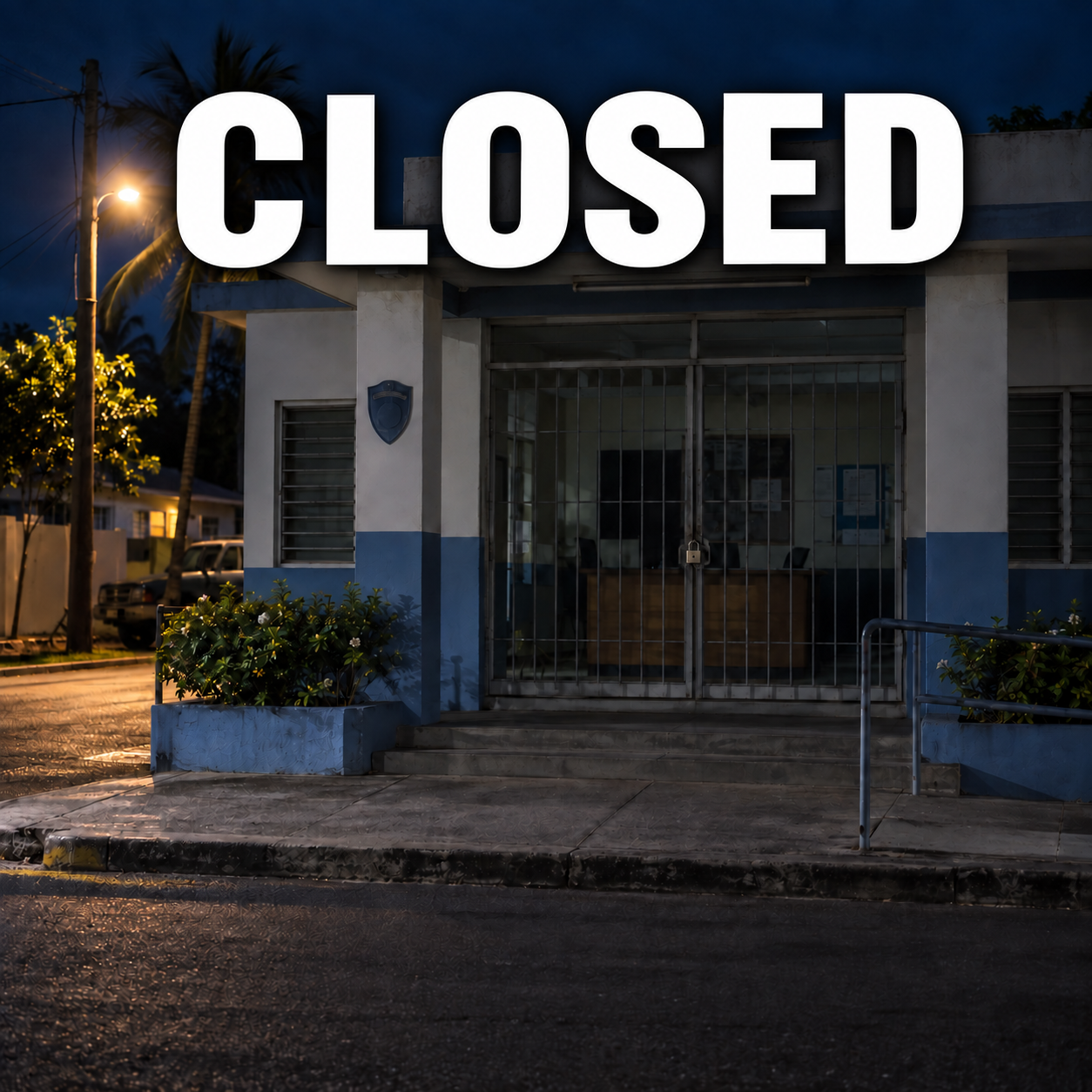
Antigua and Barbuda’s Prime Minister Gaston Browne has exposed a critical breakdown in the government’s national crime-fighting strategy, revealing that multiple local police stations — including the high-traffic Grays Farm facility — have been ignoring a mandatory 24-hour operating order and closing their doors as early as 10 p.m. each night. The prime minister made the revelation during his weekly public radio address, noting he only recently learned of the widespread non-compliance that had gone undetected by senior leadership for some time.
The 24-hour operational mandate was first rolled out as a core pillar of the administration’s aggressive response to rising violent crime across the island nation. Browne’s public confirmation of early closures confirms that the policy has yet to be fully enforced across all precincts, leaving vulnerable communities unprotected during high-risk overnight hours.
In a sharp rebuke of the non-compliant practice, Browne emphasized that police stations must remain accessible around the clock, and that officers should be out conducting proactive patrols and surveillance rather than waiting passively inside station walls for crime reports to arrive. “They’re supposed to be having regular surveillance, taking the fight to the criminals and making their lives uncomfortable,” he told listeners, framing proactive policing as the only effective way to curb ongoing criminal activity.
The prime minister also outlined a series of new targeted deployments to address persistent crime hot spots across the country, naming Grays Farm, Point, Villa, and Green Bay as priority areas for additional officer staffing. He specified that patrols in these zones should combine foot and vehicle mobile units, and all officers assigned to these duties should carry firearms for their safety and to deter criminal action. Browne argued that a consistent, highly visible law enforcement presence is the most effective tool to disrupt criminal plots before they escalate into violent incidents.
Drawing on his own experience in opposition politics, Browne recalled a past collaborative initiative with local law enforcement to set up persistent surveillance in a known high-crime area, noting that the increased presence immediately pushed open illegal activity off the streets and made criminal operations far harder to sustain.
To back up the new crime-fighting push, the Antigua and Barbuda government is also investing in new infrastructure and technology for police: it has already delivered additional patrol vehicles to precincts, and formal plans are in place to acquire specialized night-vision surveillance drones within the next 60 days. Browne confirmed the drones will have an operational range of roughly 25 kilometers, and can be controlled directly from local police stations or national police headquarters to extend surveillance coverage across remote and high-risk areas.
Notably, the prime minister stopped short of announcing any disciplinary action against officers or commanders responsible for the early closures at non-compliant stations, and declined to name any additional precincts beyond Grays Farm that have failed to follow the 24-hour operating mandate.