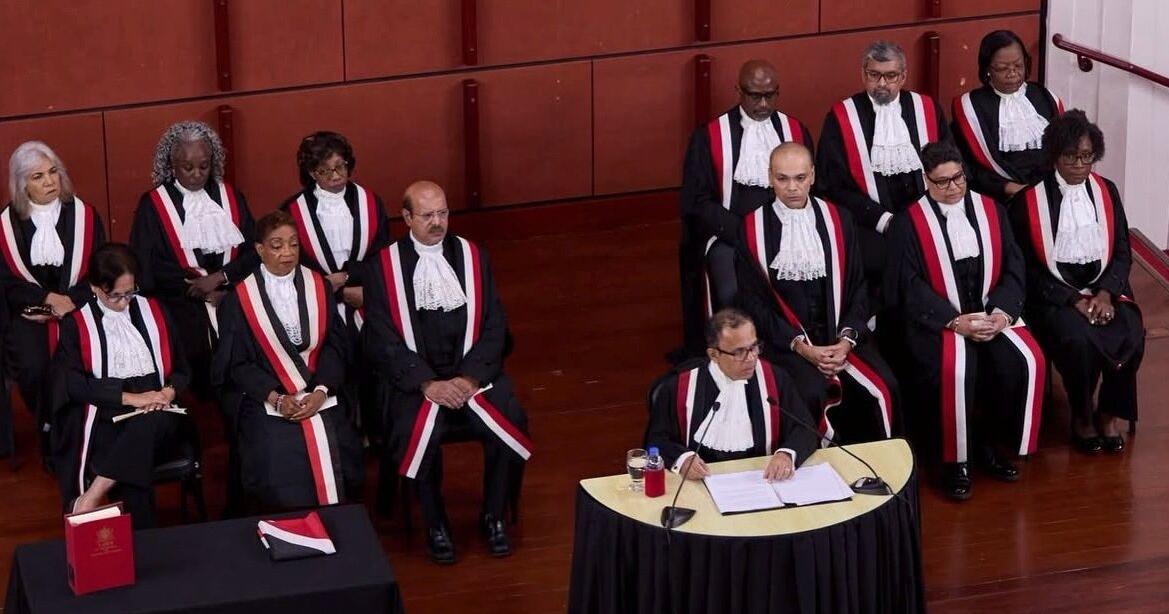
In his inaugural address marking the opening of the 2026-2027 judicial law term at Port of Spain’s Hall of Justice Convocation Hall, newly appointed Chief Justice Ronnie Boodoosingh has announced a comprehensive set of systemic reforms aimed at dismantling the long-standing criminal case backlog that has plagued the country’s judiciary and expanding overall court capacity.
Boodoosingh, who assumed the top judicial role in October 2025, used his first public opening address to lay out the findings of a months-long institutional assessment he conducted after taking office, which uncovered systemic failures across infrastructure, staffing, and case management that have eroded public access to timely justice.
Physical court infrastructure emerged as a top critical concern: the San Fernando Supreme Court Building has remained fully shuttered since the COVID-19 pandemic, stripping the judicial system of 16 functional courtrooms and dedicated staff housing. Meanwhile, the main Hall of Justice and Tobago’s Hall of Justice operate far below their intended capacity, and nearly every regional Magistrates’ Court building across the country is in urgent need of maintenance, major renovations, or structural repairs.
Unlike most other public sector institutions and school systems that returned to full in-person operations after pandemic restrictions lifted, the judiciary has remained almost entirely virtual, Boodoosingh noted. This shift has left many members of the public without consistent in-person access to court staff and critical services, deepening public frustration with the judicial process.
The most pressing challenge identified by the assessment is the growing backlog of pending cases, particularly in the Criminal Court and Family Court divisions. Even after post-pandemic adjustments to preliminary inquiry protocols and traffic case processing, the backlog in Magistrates’ Courts has continued to climb at an alarming rate. Boodoosingh emphasized that reform efforts must center on the core needs of the public, who seek a straightforward, expedited process regardless of whether their case involves a traffic violation, family dispute, criminal charge, or civil claim.
“While the judiciary does not intentionally create delays or place unnecessary obstacles in the path of people seeking justice, resource constraints have undeniably limited our ability to deliver timely outcomes,” Boodoosingh acknowledged. “But that is not an excuse for failing to take every reasonable action to build a more effective justice system. When our systems are not working as well as they should, our job is to fix them.”
To anchor accountability, Boodoosingh is moving to enforce the existing six-month target for most judicial judgments — a standard first established decades ago and reaffirmed by former Chief Justice Ivor Archie in 2025. All judicial officers are now required to submit monthly reports to the Chief Justice’s office detailing sitting hours, completed cases, and pending judgments, creating transparent data to track institutional performance.
A new, cross-stakeholder Criminal Justice Board has already been convened, holding monthly meetings since April 2026 to diagnose bottlenecks and coordinate targeted solutions. A focused backlog clearance initiative is prioritizing the oldest cases in the system for accelerated processing or dismissal. Boodoosingh noted that some cases have lingered in the system for decades, and many are effectively “dead cases” with no path to a trial. The administration aims to resolve and remove all of these legacy cases from the system by the end of the current 2026-2027 law term.
One of the most impactful immediate changes is a near doubling of available criminal jury court space: 15 dedicated Criminal Jury High Court rooms have been operational since the start of September 2026, up from just eight available under the previous system. The judiciary has also scrapped its outdated docket assignment system, instead assigning individual judges to permanent courtrooms with full responsibility for managing and trying their assigned caseloads.
Top judicial officials have already secured commitments from key partners to support the expanded court capacity: Director of Public Prosecutions Roger Gaspard, SC, has pledged to continuously assign prosecutors to all 15 new courtrooms, and the judiciary is collaborating with the Public Defender’s Department to ensure consistent defense counsel coverage for each court. Boodoosingh has publicly backed the Public Defender’s Department’s call for additional staffing to meet this expanded demand, noting that the Judicial and Legal Service Commission is currently working with the DPP’s office to fill long-standing vacant positions across the legal system.
The reforms also include plans to extend sitting hours and cut down on avoidable downtime in the criminal justice system, a change Boodoosingh said is critical to moving cases through the pipeline faster.
In a major pivot away from the pandemic-era virtual model, Boodoosingh announced a gradual phased plan to restore full in-person hearings at all Magistrates’ Courts nationwide by the end of 2027. Official data makes clear that virtual hearings have drastically underperformed in-person proceedings when it comes to case completion rates, he said.
Between 2006 and 2016, when in-person operations were standard, annual case completion rates ranged from 65% to 120% of new annual filings. That rate dropped to just 44% in the most recent completed judicial year. While the number of completed cases has ticked up slightly from 10,746 in 2023/2024 to 15,994 in 2025/2026, that number remains a small fraction of pre-pandemic completion volumes: 115,491 cases were disposed of in 2016/2017, and 82,841 in 2017/2018. A comparative analysis found that virtual hearings dispose of less than 20% of the number of cases completed through in-person proceedings.
“Virtual hearings offer convenience for many stakeholders, including lawyers, magistrates, and law enforcement officers,” Boodoosingh said. “But for the Magistrates’ Court system, they have not delivered the same effectiveness as in-person hearings when it comes to completing cases in a timely manner. That is a gap we must address.”