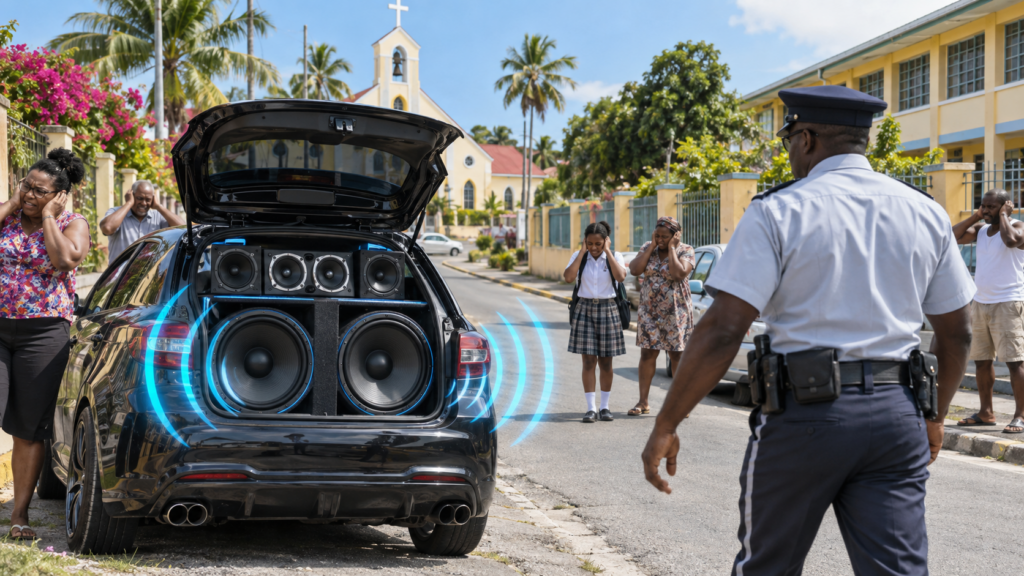
Across Antigua and Barbuda, persistent public outcry over unregulated excessive noise from motorists playing blaring music near sensitive public spaces has pushed top law enforcement officials to call for strengthened enforcement of the country’s existing noise abatement regulations. Superintendent Elson Quammie, who leads the nation’s Traffic Department, outlined the core issue in a recent appearance on the Browne and Browne Show, noting that while the legal framework to curb excessive noise is already in place, inconsistent application of the law has allowed the problem to escalate.
“We have the Noise Abatement Act, but what I would say is that there is just a lack of enforcement,” Quammie stated during the public discussion. The traffic chief argued that current practices, which often allow violators to avoid meaningful consequences after disturbing residents and visitors in quiet zones, must be revised. Instead of letting offenders go with informal warnings, Quammie stressed that repeat and serious violators should be brought before the court to face formal penalties for their violations.
Quammie called out specific high-priority areas that have been disproportionately impacted by the noise crisis. He expressed particular alarm over incidents near the Government House roundabout and houses of worship, emphasizing that the seat of national government should not be subjected to unnecessary disruptive noise. He added that schools and other officially designated quiet zones, which serve vulnerable or focused community functions, also demand urgent protection from excessive noise pollution.
The public conversation on the issue was sparked by a recent high-profile complaint: a motorist reportedly blared music laced with offensive language at extreme volume while dropping off a family member at a local supermarket parking lot. Discussion panelists joined Quammie in highlighting that the problem extends far beyond residential neighborhoods, noting that disruptive noise has even interfered with official government events hosted near the Government House roundabout. In some extreme cases, panelists confirmed, official events have required traffic to be diverted away from the roundabout entirely to avoid the constant loud noise from passing or parked motorists.
As of the current discussion, no new legislative penalties or island-wide enforcement campaigns have been formally announced. Even so, Quammie’s public remarks signal a potential policy shift, with local police expected to begin making far broader use of the existing Noise Abatement Act and increase the number of violators referred for court prosecution in the coming months.