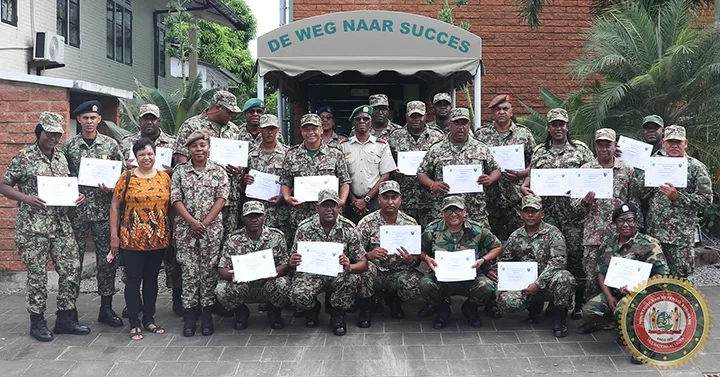
On September 8, a cohort of 20 Dutch military personnel marked a key career milestone, successfully completing the intensive 4.5-month 2026-01 Group Commander Course at the Netherlands Institute for Defense Training (IDO). The graduating service members posed for an official group photograph with their completion certificates following the ceremony, capping off a rigorous program designed to prepare them for frontline leadership roles within the national defense organization.
The course curriculum was structured around three core pillars: effective leadership, strict operational discipline, and tactical team management, blending theoretical instruction and hands-on field training to equip candidates for the heavy responsibilities of their new command positions. Captain Dyoma Blokland, commandant of the Military School (MS) that partnered with IDO to deliver the program, explained that the theoretical segment of the training is broken into specialized modules tailored to build the foundational knowledge and technical skills required for sergeants moving into command roles. The practical segment, which includes a full field exercise, gives candidates the opportunity to apply their new learning in realistic operational scenarios, allowing instructors to assess and validate their capabilities before graduation.
In her remarks to the graduating class, Blokland emphasized that the skills and insights gained through the program must be actively carried into every operational assignment. “Take these lessons with you, and share them across your teams in all of your daily work,” she told the newly commissioned commanders.
Colonel Justus Hew A Kee, commandant of the IDO, highlighted the outsized importance of the group commander role in the Dutch defense hierarchy, noting that the 20 graduates already brought years of frontline practical experience to the training, but had lacked the formal theoretical foundation needed to step into command. The course was designed specifically to bridge that gap, integrating hands-on expertise with structured institutional knowledge to build well-rounded leaders.
Hew A Kee described the group commander as the critical linchpin between senior command and frontline execution. “You are the first point of contact in crisis scenarios, the steady voice when chaos unfolds, and the anchor that keeps your team on course when pressure is at its peak,” he said. He stressed that the position demands not just physical toughness, but above all moral courage: group commanders must be willing to make hard decisions, take accountability for missteps, and advocate for the service members under their care.
In closing, Hew A Kee urged the new commanders to enforce strict standards when necessary, but always to do so with fairness and integrity. True leadership, he reminded the cohort, is not rooted in power, rank, or simply issuing orders – it grows from positive influence, leading by example, and building a team culture where every member can trust their colleagues and their command.