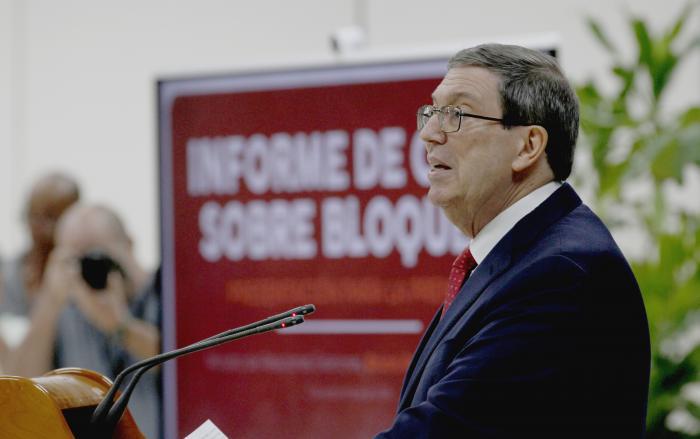
On September 8, 2026, Cuban Foreign Minister Bruno Rodríguez Parrilla unveiled a comprehensive report detailing the devastating human and economic harm inflicted by the United States’ decades-long economic, commercial, and financial blockade against Cuba, covering the 12-month period from March 2025 to February 2026. Speaking to an assembled audience of domestic and international journalists, Rodríguez framed the current intensification of the U.S. policy as an intentional act of collective punishment that meets the international legal definition of genocide.
Rodríguez painted a visceral picture of daily life for ordinary Cubans under the tightened blockade, describing widespread, prolonged power cuts that leave communities with just two to three hours of electricity access, or less, each day. “The long months living with only two or three hours of electricity a day or less, food spoiling, the heat that makes it impossible to sleep, parents fanning their babies, children doing their homework in near darkness, young people without internet access or recreation, grandparents without television or, sometimes, even radio—all family life is damaged,” he said.
The most acute crisis stems from a U.S. executive order imposed in January 2026 that formalized a full fuel blockade, which prohibits fuel imports, intimidates international shipping and tanker companies from delivering cargo to Cuba, and even blocks shipments of spare parts for the country’s existing thermoelectric and solar energy infrastructure. Rodríguez explained that 11 of Cuba’s 15 operational thermal power generation units are currently out of service for critical maintenance that cannot be completed due to blocked parts, resulting in a combined generating capacity shortfall of 1,400 megawatts. Despite Cuba’s rapid push to expand domestic solar energy capacity – with new photovoltaic parks able to be constructed in as little as 45 days – U.S. threats are now blocking shipments of solar panels and energy storage batteries needed to complete these projects. The energy crisis has rippled across every sector of Cuban society, from cutting power to water pumping stations that rely on electric infrastructure to disrupting public transportation that leaves most of the country’s vehicle fleet idled for lack of fuel, forcing students and workers to walk long distances to reach schools and workplaces.
The human cost of the blockade is most severe in Cuba’s universal public health system, which has long been a point of national pride. Rodríguez detailed how routine power cuts put vulnerable patients at extreme risk: newborns relying on electrically powered incubators must be sustained by manual ventilation when backup generators fail, and some emergency surgeries have been completed using only the light from rechargeable lamps or medical staff’s personal cell phones. More than 95% of the country’s medical equipment is affected by shortages of spare parts and supplies. Thousands of patients on hemodialysis face disrupted care due to ambulance fuel shortages, and 100,000 people – including 12,000 children – are currently on surgical waiting lists. The report documents that the childhood cancer survival rate has fallen from 85% to 65% due to blocked access to cancer medications and treatment supplies, with more than 70 people dying from the disease each day. Rodríguez emphasized that the rise in infant mortality recorded between 2018 and 2025 was entirely preventable: “These are children, not numbers. These are deaths that should not have happened” because Cuba was stripped of access to legitimate medical resources needed for its robust public health system.
The 2025–2026 report quantifies the total direct economic losses from the blockade at $8.083 billion, a 7% increase from the prior 12-month reporting period. Cumulative total damages, calculated at current dollar values, reach $178.7 billion; adjusted for gold price appreciation against the U.S. dollar, cumulative damages top $3.89 trillion. Without the blockade, Cuban GDP would have grown by 10.8% in 2025 alone. The energy blockade alone caused more than $802 million in direct losses over the reporting period, with a 2.67 million ton shortfall in planned fuel imports and more than 980 gigawatt-hours of lost generation capacity. The agricultural sector recorded $848 million in losses, with irrigation access falling to just 2 hours per day from the required 16 during the critical cold growing season, and 20,000 tons of prepositioned United Nations food aid for vulnerable communities held up by fuel shortages for distribution. The education sector recorded $98 million in combined losses, with 30% of students forced to relocate to access classes, and critical assistive technologies for disabled students – including 21 irreparable Braille machines and limited access to cochlear implants – left unavailable. Tourism, one of Cuba’s largest export sectors, suffered more than $2 billion in losses, while the national biopharmaceutical sector recorded $134 million in losses.
Rodríguez rejected claims that the harm inflicted by the blockade is accidental “collateral damage,” stressing that the suffering of the Cuban people is a deliberately planned outcome. He drew a parallel between the current policy and the genocide unfolding in Gaza, noting: “It is the same ruthless sentiment and destructive spirit behind the genocide being committed in Gaza. In Cuba, it is silent, without bombs, but it is killing nonetheless.” He also linked the current U.S. policy to the 19th century Spanish reconcentration policy that killed hundreds of thousands of Cubans, arguing that the ideological architects of the modern blockade, from mid-20th century U.S. policy planner Lester Mallory to current U.S. politicians and State Department officials, carry forward the same hostile intent to subjugate Cuba to foreign control for the benefit of anti-Cuban interest groups based in Miami.
Addressing claims from the U.S. government that it has provided $100 million in humanitarian aid to Cuba, Rodríguez called the assertion a deliberate falsehood. He noted that only a single small shipment of food and hygiene products for 700 families has been delivered to date, and challenged U.S. officials to disclose when full aid will arrive, why implementation has been delayed for months, and whether it will include critical medicine and food that Cuban communities urgently need. He clarified that Cuba welcomes all humanitarian aid offered in accordance with international law and UN norms, but will not accept aid that comes with political strings.
On the topic of bilateral talks between Cuba and the U.S., Rodríguez confirmed that exploratory discussions with the U.S. State Department are ongoing, but no progress has been made due to a lack of good faith on the U.S. side. Cuba remains open to continuing negotiations on the basis of sovereign equality, mutual respect, no preconditions, and non-interference in internal affairs, he said, but no binding agreements or roadmaps have been reached to date.
Responding to questions about recent economic and social reforms approved by Cuba’s National Assembly of People’s Power, Rodríguez emphasized that these reforms are an exercise of Cuba’s sovereign right to shape its own domestic policy, and do not require any approval or comment from the U.S. government. He added that broad sectors of U.S. society, including members of Congress, business leaders, and Cuban Americans living in the U.S., have expressed strong interest in exploring new trade and investment opportunities created by the reforms. The U.S. blockade’s recent escalation, particularly the energy strangulation policy, has hit small and medium-sized Cuban private enterprises particularly hard, with more than 7,000 pre-paid, contracted cargo containers still blocked from entering the country, most carrying food, medicine, and medical devices. Rodríguez called the energy blockade an act of war that violates freedom of navigation and international trade norms in peacetime.
Rodríguez noted that the damage figures included in the 2025–2026 report do not yet include the full impact of the January 2026 energy blockade and new secondary sanctions, whose effects only began to be felt after the reporting period’s cut-off. The report’s methodology, he added, adheres to strict international accounting standards and was previously audited and validated by a U.S. congressional commission. The Cuban government will release a full update on the additional damages from the recent escalation as soon as data collection is completed.
On the topic of rising threats of direct U.S. military aggression against Cuba, Rodríguez warned that the Cuban government takes these threats seriously, as multiple credible sources, independent analysts, and U.S. NGOs have documented active military preparations for a potential attack. He noted that senior U.S. officials, including the president, secretary of state, and secretary of defense, have publicly named direct military action as an option on the table. “Our people, our State, take them very seriously and are preparing to defend with determination, to the utmost, our independence, sovereignty, and territorial integrity,” he said. A U.S. military attack would serve no legitimate U.S. national interest, he added, and would result in a devastating bloodbath that would kill both Cubans and young U.S. service members forced to fight a war they do not support.
The United Nations General Assembly is set to vote once again on a resolution calling for an end to the U.S. blockade on October 27–28, 2026. Rodríguez said that despite intense U.S. diplomatic pressure and intimidation aimed at UN member states, the Cuban people remain confident in retaining the overwhelming international support the resolution has received for decades. “Behind every statistic is a human face. Behind every blockade measure is a tragedy, harm, or family drama,” he said. “Faced with this cruel challenge, Cuba is working tirelessly. It will never be defeated.” Reaffirming that Cuba poses no threat to the United States, Rodríguez ended with a simple demand: “Let us live in peace.”