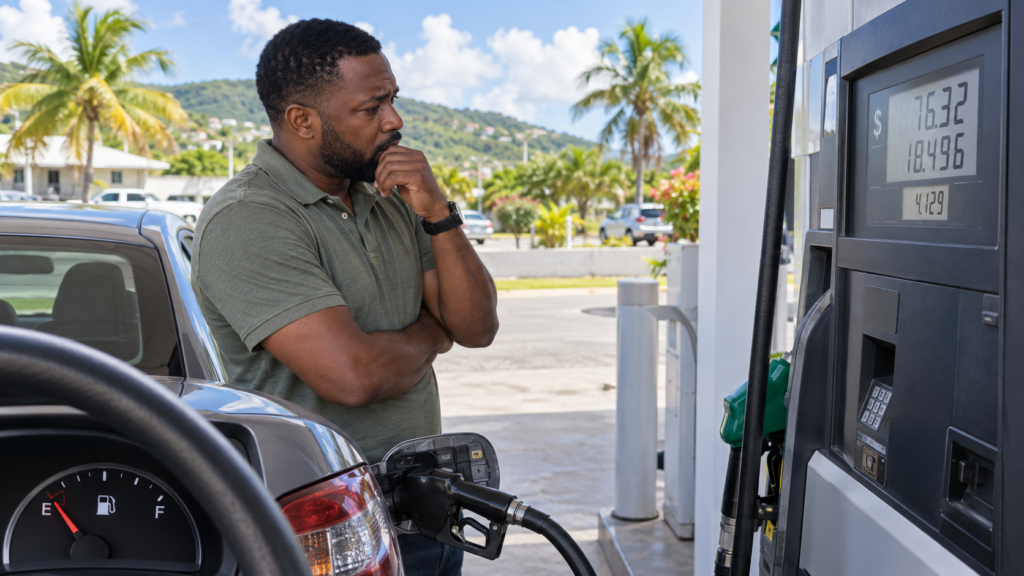
Antigua and Barbuda’s Prime Minister Gaston Browne is calling on motorists across the twin-island nation to cut back on non-essential fuel use, as skyrocketing international petroleum prices loom to push pump costs even higher for local consumers.
Speaking during the weekly Browne and Browne Show on Saturday, Browne delivered a clear warning: the government has hit the ceiling of what it can do to shield citizens from rising costs, after years of absorbing the gap between global price spikes and local retail rates.
“We are asking our people to be a little more conservative,” Browne stated, urging drivers to use fuel responsibly and cut down on unnecessary trips to reduce demand.
His public appeal comes just after the government implemented a EC$2 per gallon increase on both gasoline and diesel earlier this month. The prime minister explained that the price adjustment was unavoidable: it was needed to cover ballooning import costs and stop the country’s existing fuel subsidy program from growing even more costly for public finances.
Browne traced the root of the current crisis to unfolding global events, noting that international crude prices have surged dramatically in recent months driven by persistent geopolitical instability, most notably ongoing tensions involving Iran. The prime minister shared that he closely tracks daily fluctuations in Brent crude, the global benchmark, and that recent upward trends in the international market left the government with no option but to pre-warn residents of coming local price changes.
“These are not things that we have any control over,” Browne emphasized.
If global prices continue their upward climb, the prime minister confirmed that consumers will almost certainly face additional pump price hikes in the near future. “We have absolutely no choice but to continue to increase the price of petroleum products,” he said.
Even with the recent adjustments, Browne argued that fuel prices in Antigua and Barbuda still rank among the lowest in the entire Caribbean, a notable feat given the country produces no crude oil of its own. He attributed this to intentional, costly government intervention designed to buffer households and local businesses from the full brunt of global price swings.
To keep prices low, the government previously scrapped a 15% fuel consumption tax that typically generated roughly EC$4 million in monthly public revenue. It has also transferred millions of dollars directly to the West Indies Oil Company to keep retail pump prices below their actual market value.
To date, Browne confirmed, these relief measures have cost the national treasury more than EC$40 million, forcing the administration to delay payments on other critical public obligations. Going further, the prime minister disclosed that the government was even forced to take on more than EC$30 million in new borrowing to settle a debt that would have otherwise been paid using regular revenue from the West Indies Oil Company.
Browne stressed that the government did not fund these consumer protections from surplus cash reserves. Instead, it redirected funding earmarked for other government priorities to keep fuel costs down. “What we did, we robbed Peter to pay Paul,” he summarized.
While the administration remains committed to offering as much relief as possible to residents, Browne reiterated that the government’s financial capacity is finite. He urged local motorists to adjust their habits and prepare for the very real possibility of further fuel price increases in the coming months.