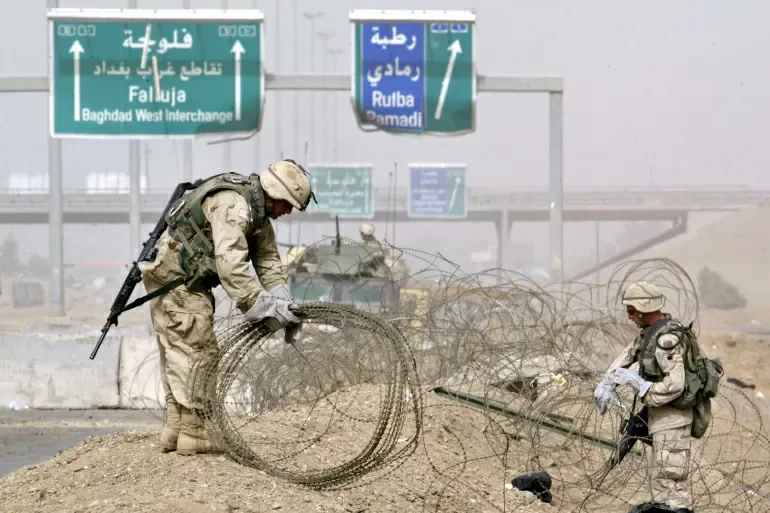
After more than two decades of foreign military engagement that began with the 2003 U.S.-led invasion, Iraq is preparing to mark a historic turning point. On September 30, the U.S.-led international military coalition will formally conclude its mission in the country, transferring full security responsibility to the Iraqi government — a symbolic milestone that Baghdad has framed as the start of a fully sovereign, foreign troop-free era opening October 1.
In recent weeks, as the deadline has drawn near, speculation around the withdrawal has grown steadily. Iraqi military leadership has now confirmed the timeline officially. Lieutenant General Abdul Amir al-Shammari, head of the Iraqi Armed Forces Commander-in-Chief’s office, confirmed September 30 as the coalition’s final end date in a statement to Iraq’s state news agency INA, matching long-held expectations across political and military circles.
For Iraqi Prime Minister Ali al-Zaidi, the withdrawal delivers on a core campaign promise made earlier this year. “This step is an essential prerequisite to guide Iraq into a new phase of development and prosperity,” a statement from the prime minister’s office read, framing the post-withdrawal period as a “new era” free of any foreign military presence on Iraqi soil.
Yet analysts caution that the withdrawal is far more symbolic than transformative for Iraq’s on-the-ground security landscape. Iyad al-Anbar, a political science professor at the University of Baghdad, told Al Jazeera that the bulk of the adjustment has already taken place. Most U.S. troops have long vacated traditional Iraqi military bases across central and southern Iraq, he noted, and are already concentrated solely at the Harir base in Erbil, the capital of Iraq’s autonomous Kurdistan Region.
“Ultimately, this move will be largely symbolic,” al-Anbar explained. “The U.S. has already ended its active military presence at most major headquarters, including Camp Victory near Baghdad International Airport and even the Green Zone, located just meters from the U.S. embassy in Baghdad.”
While the coalition’s exit closes a 23-year chapter of foreign military involvement, it opens a critical domestic test for al-Zaidi’s government: consolidating control over all armed factions and centralizing weapons under exclusive state authority — one of the biggest internal challenges Iraq has faced since the 2003 fall of Saddam Hussein.
Al-Zaidi has reissued a firm ultimatum this week to non-state armed groups: disarm voluntarily, or face prosecution on terrorism charges. The prime minister has stood firm on tying progress on disarmament to the September 30 withdrawal deadline, but al-Anbar points to a major gap in credibility: despite the broad rhetoric, the government has released no concrete details on how the disarmament process will work.
“Now we are only talking about ‘regulating’ weapons. What is the actual enforcement mechanism? No one is talking about the details,” al-Anbar said.
Complicating the security landscape further, pro-Iranian armed factions including Kataib Sayyid al-Shuhada, Harakat al-Nujaba, and Kataib Hezbollah have ramped up anti-government and anti-coalition rhetoric in recent weeks. Key leadership positions at Iraq’s Defense and Interior ministries — the two core institutions tasked with implementing the disarmament plan — also remain unfilled, leaving the government without a clear operational backbone for its security push.
For the United States, the withdrawal aligns with a broader strategic reorientation of foreign policy under the second Trump administration, but it does not signal a full retreat from Iraqi or regional affairs, according to former U.S. diplomat Marlin Hardinger.
“I think we can say that large-scale conventional military deployment has come to an end in the medium term, but remaining counterterrorism and intelligence operations will continue, particularly focused on protecting the U.S. embassy and consulate,” Hardinger explained. He added that the Trump administration plans to shift its focus to expanding economic and development cooperation with Baghdad, a move designed to boost immediate and medium-term economic outcomes for Iraqi citizens and strengthen al-Zaidi’s domestic standing.
Even so, the withdrawal faces pushback from multiple quarters. Pro-Israel factions in the U.S. that favor continued direct American military engagement in the Middle East have already voiced opposition, while Gulf Arab states warn that a power vacuum could allow extremist and Iranian-aligned groups to regain territory and influence.
“The core problem is that the region is far more unstable and volatile today than it was when negotiations over the withdrawal first began,” Hardinger warned.
One of the most immediate and pressing security consequences of the withdrawal is the removal of U.S. Patriot air defense systems, which have long been deployed in Erbil to serve as the primary shield against Iranian ballistic missiles and drone attacks. Hassan al-Barari, an international relations professor at the University of Jordan, argues that Iraq is not currently prepared to fill that security gap on its own.
“It is unlikely that the Iraqi state is currently capable of defending its airspace against Iranian missiles and drones if Iran were to launch an attack on Erbil, for example,” al-Barari said. “If Iran continues to send drones and missiles into Iraqi territory, who will intercept them now that the American Patriot systems are leaving? Without a direct security agreement with Tehran, who can stop this Iranian threat?”
For Iraq, al-Barari argues, the true test of Iraqi sovereignty does not end with the departure of foreign troops — it begins the day after. For al-Zaidi’s government, the ability to secure Iraq’s borders, unify control over weapons, and maintain national independence will define whether the milestone of troop withdrawal delivers on its promise of sovereignty.
“The ability of the Baghdad government to maintain or fully restore Iraq’s sovereignty is not only linked to the withdrawal of U.S. troops, but also to al-Zaidi’s ability to bring all weapons under state control,” al-Barari said. His outlook for the coming period is cautious: “In my view, events are moving into uncharted territory. If al-Zaidi fails to deliver, Iraq could fall fully under exclusive Iranian influence, creating a dangerous security vacuum. That is exactly the scenario Washington has long warned about and sought to avoid.”
As the world watches, Iraq prepares for what is being called the greatest test of its modern history. The coalition’s flag will be lowered, but critical questions remain unanswered: who will protect the Kurdistan Region from cross-border rocket attacks? Who will force unregulated militias to disarm? Who will guarantee that Iraq does not slide back into widespread chaos?
September 30 is not an endpoint. It is a beginning: a period where Iraq will have to prove it can survive and govern without external leadership. Whether it succeeds depends on one prime minister, one fractured government, and a divided nation. The coming weeks will reveal the answer.