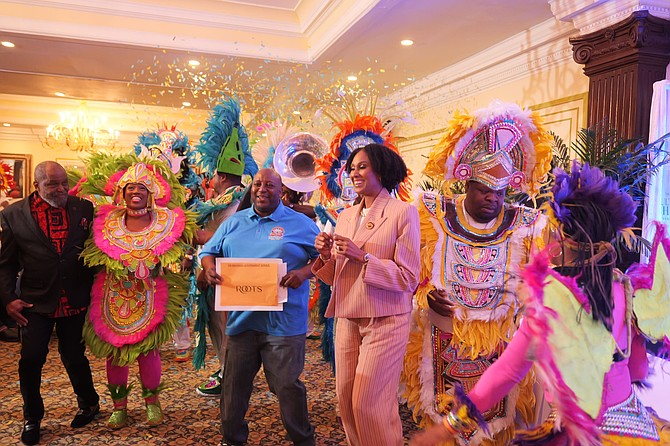
The Bahamas’ iconic Junkanoo carnival celebration has officially opened its 2026 season, marking a major milestone as the newly established National Junkanoo Authority disbursed more than $900,000 in seed grants to participating groups across the archipelago.
More than 50 competitive Junkanoo groups, spanning A, B, and D categories, alongside five recreational troupes and multiple collectives from the country’s Family Islands including Eleuthera, Grand Bahama, and Central and North Andros, signed formal participation contracts outlining event rules and funding terms ahead of the season’s kickoff. Funding amounts have been held steady from previous cycles, with top-tier A category groups receiving $40,000 each and B category groups awarded $20,000 each.
The launch caps a year of major governance restructuring for the beloved cultural tradition. The National Junkanoo Authority was created by parliamentary legislation passed in March 2026, but only became fully operational three weeks ago, when board members received their formal appointment documents and held their inaugural meeting. The restructuring followed a bitter dispute between the Bahamian government and the long-standing Junkanoo leadership community in October 2025, when the government transferred oversight of that year’s parades from the Junkanoo Corporation of New Providence (JCNP) — the historic self-governing body for the event — to an interim National Junkanoo Committee. The JCNP had previously criticized the new governing legislation as an attempt to centralize state control and erode the community’s long-standing autonomy.
Speaking at the official launch, Culture Minister Leslia Miller-Brice outlined the government’s new long-term vision for Junkanoo, centered on expanding access to the tradition beyond its traditional holiday parade dates by integrating it into school curricula and year-round tourism programming. The Ministry of Culture has already begun collecting data to assess the cultural event’s long-term financial sustainability and map the condition and support needs of the iconic Junkanoo shacks where groups build their elaborate parade costumes and floats.
Miller-Brice called for unity across the Junkanoo community as the new season gets underway, urging groups to compete with passion while upholding values of mutual respect, public safety, and collective care for young participants and behind-the-scenes workers. She emphasized that historic legacy organizations like the JCNP remain critical stakeholders in the new governing structure, noting that the new authority stands to benefit from decades of institutional knowledge built by long-time community leaders.
“Those organizations have done a fantastic job. I think we stand on their shoulders,” Miller-Brice said. “It’s important for us to feed from them, to learn from them, and to gain the wealth of knowledge that they’ve gained over this time. To those persons who were a part of those organizations, we welcome the collaboration. Mr. Dion Miller, he is a part of the National Junkanoo Authority, and so he will be there to guide us, to help us, just to ensure that any mistakes that they would have made in the past, moving forward, that those same mistakes will not be made again.”
National Junkanoo Authority Chairman Dr. Christopher Curry confirmed that the board has moved quickly to set up operations in the three weeks since members received their appointment letters, holding two full board meetings to date. The authority has already formed specialized subcommittees to oversee core responsibilities, begun drafting its first annual operating budget, and taken key steps to build long-term financial stability as a formal government entity. It has also completed a full strategic plan for the 2026–2027 fiscal year and begun the process of assembling a full-time management team.
This week, Junkanoo group delegates will elect six group representatives to fill seats on the new authority’s Management and Planning Committee. Two delegates from each registered group will take part in ongoing parade planning, with the first working session scheduled for this Friday.
JCNP Chairman Dion Miller, who holds a statutory permanent seat on the new authority’s board, said the 2026 season marks the first time the new overarching governing body is fully functional. Under the new structure, the JCNP and former interim National Junkanoo Committee will operate as sub-committees under the authority’s umbrella, with most of their existing functional structures for parade rules and operations remaining intact.
Despite the heated tensions of 2025, Miller said he is ready to move past past disagreements to advance the shared goal of growing and protecting Bahamian Junkanoo culture, noting that collaboration and communication with Minister Miller-Brice has been “stellar” to date.
“It is what it is. My focus now is moving forward, moving Junkanoo forward, united, and to push the culture forward. So any grievances that would have occurred in the past is in the past. My focus now as the chairman and as someone who is on the authority is to move the culture forward,” Miller said.
A minor early misstep saw Miller not receive meeting invites for the authority’s first two sessions, a mistake Dr. Curry and Miller-Brice have already moved to correct. Dr. Curry said the oversight was not intentional, and that he has since spoken with Miller to share full meeting minutes and bring him fully into ongoing work. Miller-Brice echoed that framing, confirming the issue has been fully resolved and all stakeholders are now aligned to deliver a successful 2026 season.
To inform long-term planning, the Ministry of Culture has also collected public and stakeholder input via two separate surveys: the National Junkanoo Cost, Sustainability, and Economic Impact Survey, and the Junkanoo Shack Location Survey, which will help guide future investment in core Junkanoo infrastructure.